
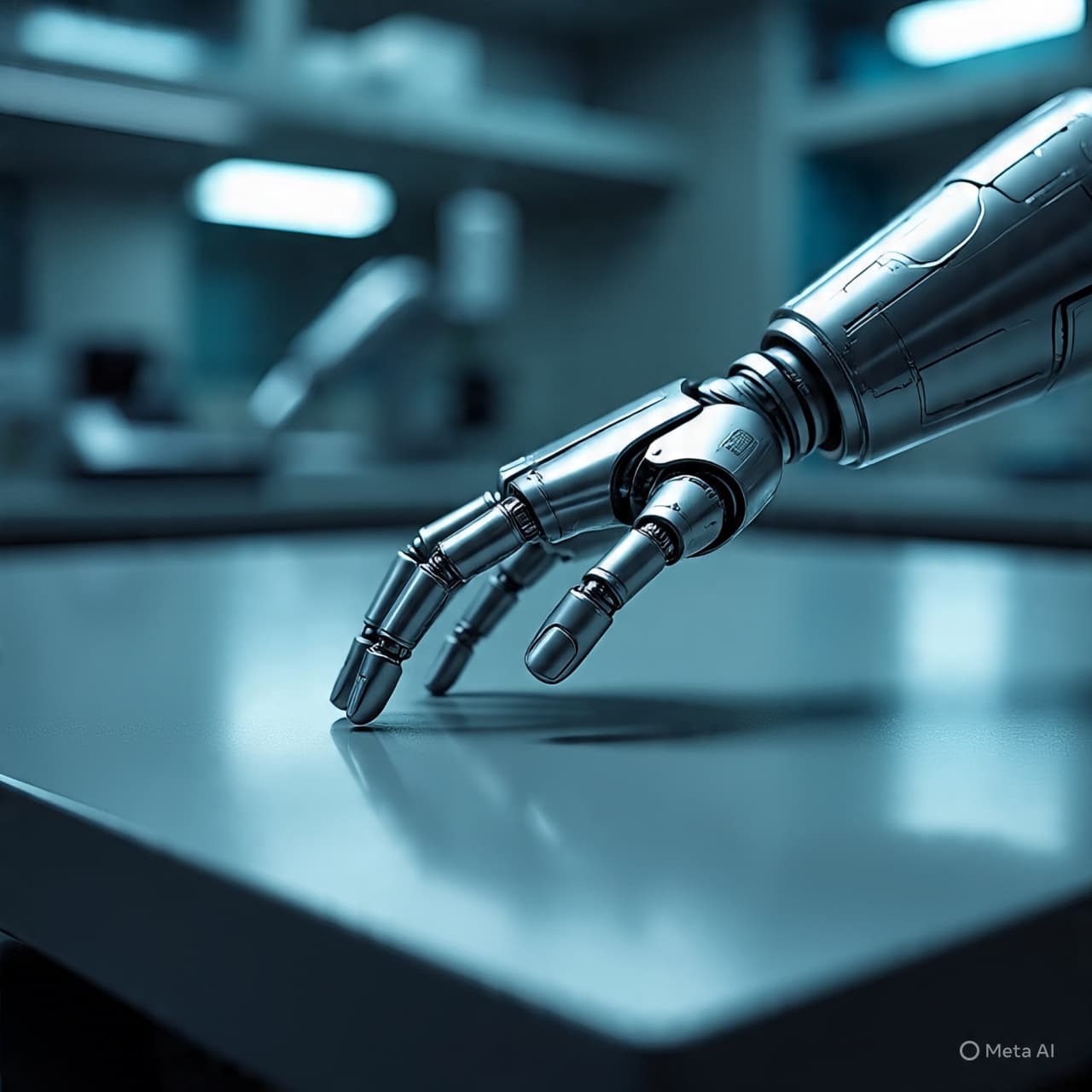
In a laboratory washed with steady white light, a quiet moment unfolds that feels almost mythic in its restraint. A robotic arm rests on a workbench, motionless, as if pausing to consider its own boundaries. Then, without ceremony, its hand releases itself. It drops gently to the surface below and begins to move — not dragged by cables or guided by a human touch, but crawling forward on its own, fingers flexing with purpose, searching.
This small migration marks a subtle turn in robotics research, where machines are no longer defined strictly by the bodies they are attached to. Engineers and researchers have recently demonstrated a robotic hand capable of detaching from its primary arm, navigating short distances independently, and retrieving objects before returning. The act itself is modest in scale, yet expansive in implication, hinting at a future where robotic systems are less rigid assemblies and more adaptable constellations of parts.
The hand moves not with haste, but with deliberation. Its fingers serve as both limbs and sensors, enabling it to crawl across flat surfaces and orient itself toward a target. Embedded motors and control algorithms allow it to coordinate grasping and locomotion simultaneously, a convergence of functions that once required separate machines. In this design, dexterity is no longer confined to manipulation alone; it becomes a means of travel, of autonomy.
Such developments arrive amid a broader rethinking of how robots interact with their environments. In disaster zones, industrial sites, or space missions, rigid forms can be liabilities. A detached robotic hand could slip into narrow gaps, retrieve tools dropped beyond reach, or continue operating even if the main body is obstructed. Researchers describe the system as modular by intent — each component capable of contributing independently, yet designed to reunite seamlessly when needed.
There is also something quietly human in the gesture. The crawling hand echoes biological precedents, borrowing from the way insects navigate or how a person might reach blindly for an object just out of sight. Yet it stops short of imitation. The design is not about mimicry, but about efficiency — about allowing a machine to decide that the shortest path is not through extension, but through separation.
As robotics edges further into daily life, these experiments accumulate like footnotes to a larger story. Machines are becoming less about singular forms and more about adaptable behavior, less about fixed presence and more about responsive motion. The detaching hand does not replace the arm; it complements it, expanding what the system can do without demanding more space, more power, or more oversight.
When the hand finally returns to its arm, reconnecting with a soft mechanical click, the moment passes almost unnoticed. Yet something has shifted. Independence, once reserved for whole machines, has been granted to a part. In that quiet exchange between attachment and autonomy, robotics takes another step toward a future where intelligence is not only centralized, but shared — distributed across components that know when to hold on, and when to let go.
AI Image Disclaimer Illustrations were created using AI tools and are not real photographs.
Sources Science Robotics IEEE Spectrum Nature MIT Media Lab Carnegie Mellon University Robotics Institute
Published by Banx Network. This article is part of the Banx decentralized media programme, powered by the BXE token on the XRP Ledger.

.jpg&w=3840&q=75 "The Artemis Revolution: How NASA Plans to Build Humanity's Future on the Moon")