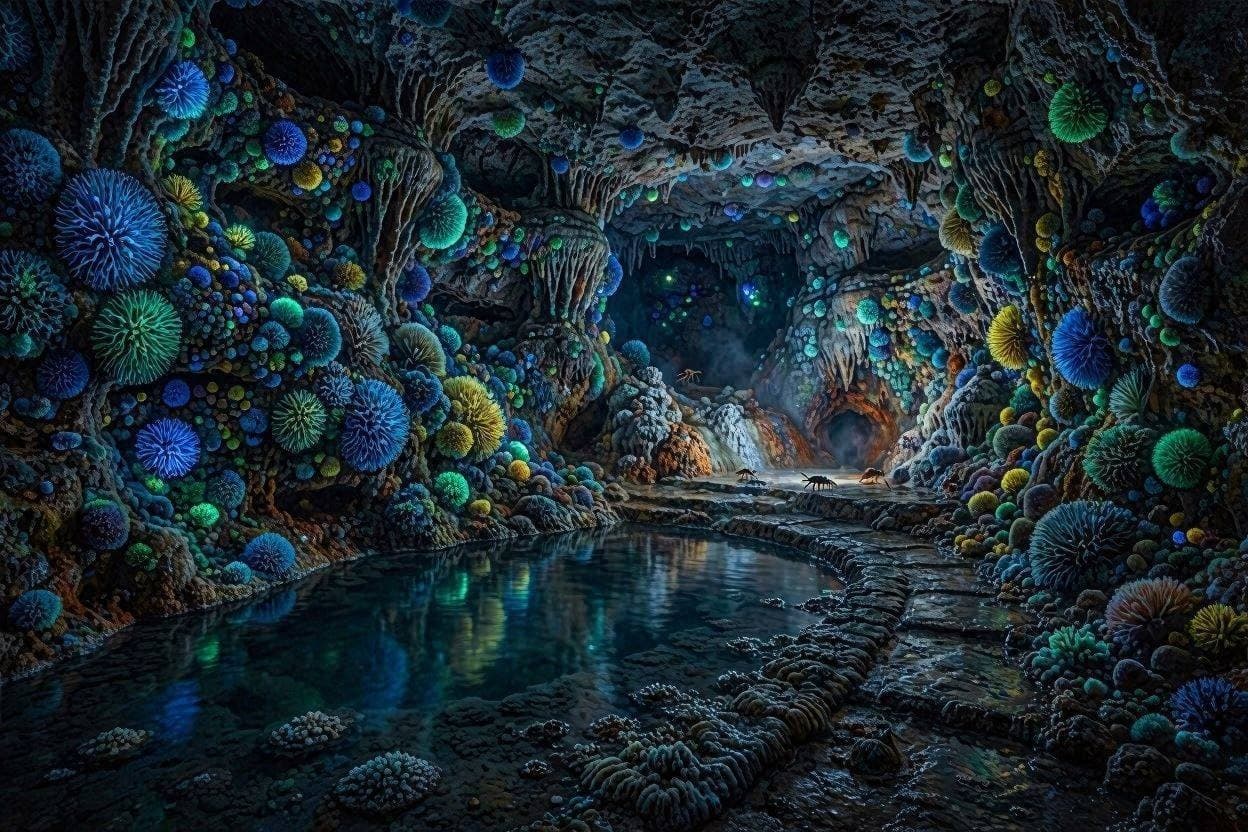
Deep beneath the earth, in places where sunlight has never penetrated, life finds a way to persist against all odds. In the Movile Cave of Romania, sealed off from the outside world for five and a half million years, a unique ecosystem thrives in darkness. Here, forty-eight distinct species have evolved to survive on hydrogen sulfide, creating a biological community unlike any other on the planet. This subterranean world invites reflection on the resilience of life and the diverse forms it can take when isolated from the familiar rhythms of day and night.
Body: Discovered in 1986, Movile Cave presents a challenge to traditional understanding of biology. Most life on Earth depends on photosynthesis, the process by which plants convert sunlight into energy. However, the organisms in Movile rely on chemosynthesis, deriving energy from chemical reactions involving hydrogen sulfide and methane. This alternative pathway allows bacteria to form the base of the food web, supporting a complex array of creatures including spiders, scorpions, and crustaceans that have adapted to this extreme environment.
The isolation of the cave has led to remarkable evolutionary adaptations. Many of the species found here are endemic, meaning they exist nowhere else in the world. Over millions of years, they have lost their eyesight and pigmentation, traits that are unnecessary in perpetual darkness. Instead, they have developed heightened senses of touch and smell, allowing them to navigate and hunt in the blackness. These adaptations offer a glimpse into how life might evolve in other extreme environments, perhaps even on other planets.
Studying Movile Cave requires careful protocols to prevent contamination. Researchers must undergo decontamination procedures before entering, ensuring that no outside microbes disrupt the delicate balance of the ecosystem. This level of caution underscores the fragility of isolated habitats and the importance of preserving them in their natural state. The cave serves as a living laboratory, providing insights into evolutionary biology and the limits of life’s adaptability.
The discovery of such a diverse community in such a hostile environment challenges our definitions of habitability. It suggests that life can flourish in conditions previously thought uninhabitable, expanding the possibilities for where we might find life elsewhere in the universe. Astrobiologists look to places like Movile as analogs for subsurface environments on Mars or Europa, where similar chemical energy sources might support microbial life. The cave thus bridges earthly science with cosmic curiosity.
For the scientists who study it, Movile is a place of wonder and humility. Each expedition reveals new details about the interactions between species and their environment. The complexity of the food web, built entirely on chemical energy, demonstrates the ingenuity of natural selection. It is a reminder that nature does not follow a single script but writes many stories, each adapted to its specific context. The cave’s secrets continue to unfold, offering lessons in resilience and innovation.
Beyond its scientific value, Movile Cave holds philosophical significance. It reminds us that there are still hidden corners of our own planet that remain largely unexplored. In an age of satellite imagery and global connectivity, the existence of such a secluded world is a testament to the earth’s enduring mysteries. It encourages a sense of awe and respect for the unknown, urging us to protect these rare and fragile ecosystems.
Closing: The ecosystem of Movile Cave stands as a testament to the tenacity of life. By thriving in darkness and feeding on chemicals, its inhabitants redefine what is possible. As research continues, this subterranean world offers profound insights into evolution, ecology, and the potential for life beyond Earth.
AI Image Disclaimer: Visuals in this piece are artificially generated and should be viewed as artistic interpretations rather than factual documentation.
Sources: BBC News National Geographic Smithsonian Magazine Science Daily
Published by Banx Network. This article is part of the Banx decentralized media programme, powered by the BXE token on the XRP Ledger.