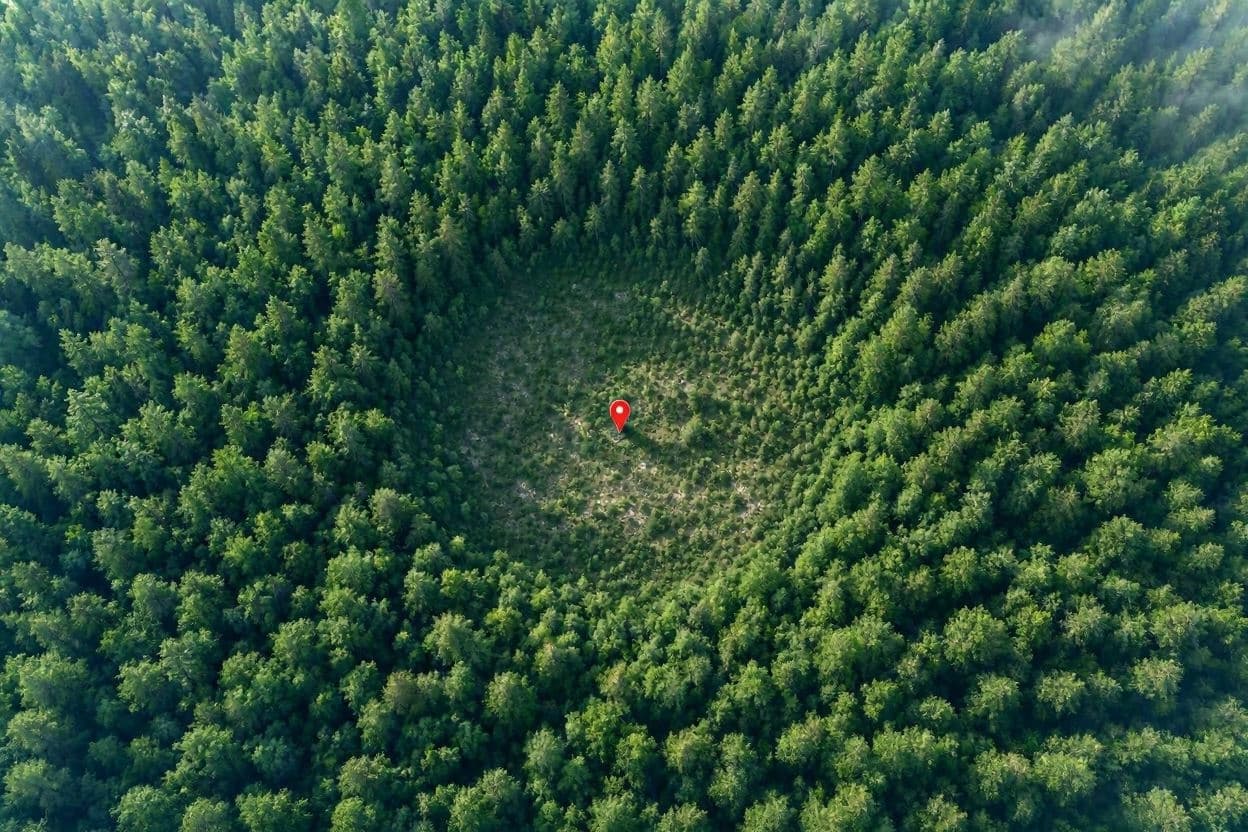
There is a certain magic in the act of exploration, even when it happens from the comfort of one’s home. Joël Lapointe, an amateur astronomer and former miner from Australia, was simply searching for a quiet place to camp in Quebec’s Côte-Nord region when his eye caught a subtle irregularity on Google Maps. What appeared to be a faint circle in the landscape was not a glitch or a natural depression, but the hidden scar of a cosmic impact, a 15-mile-wide crater that had remained unrecorded for 390 million years.
The discovery began with curiosity. Lapointe noticed a circular pattern that seemed too perfect to be random erosion. His background in geology and mining gave him an intuition for such features, prompting him to investigate further. He shared his findings with professional geologists, who were initially skeptical but intrigued. The remote location of the site, now named Uhackatik, had likely contributed to its obscurity, hiding it beneath layers of vegetation and time.
A team of researchers subsequently embarked on an expedition to verify the claim. The journey was arduous, taking them deep into the wilderness of Quebec. Upon arrival, they found evidence that confirmed Lapointe’s hunch. The rocks at the site showed signs of shock metamorphism, a distinctive change in mineral structure caused by the immense pressure of a meteorite impact. These microscopic clues are the fingerprint of such events, distinguishing them from volcanic or tectonic formations.
The crater, dating back to the Devonian period, offers a window into a time when life on Earth was vastly different. It is a reminder that our planet has been subjected to countless impacts throughout its history, each leaving a mark that may be subtle or profound. The fact that this particular crater remained undiscovered for so long highlights how much of our own world remains unexplored, even in the age of satellite imagery.
This discovery underscores the valuable role of citizen science. Amateur enthusiasts, with their fresh perspectives and dedicated observation, can contribute significantly to scientific knowledge. Lapointe’s find is not an isolated incident; there are many examples of amateurs identifying astronomical or geological phenomena that professionals had overlooked. It is a testament to the power of collaborative inquiry, where passion and expertise converge.
For the local community and the scientific world, the confirmation of the Uhackatik crater is a cause for celebration. It adds to the catalog of known impact structures, helping researchers better understand the frequency and effects of such events. It also serves as an inspiration for others to look closely at their surroundings, whether through a telescope or a map, and to question the familiar.
The story of this discovery is one of patience and attention to detail. It reminds us that significant findings often come from simple acts of observation. Lapointe’s willingness to share his curiosity led to a verified scientific contribution, bridging the gap between hobby and profession. It is a gentle reminder that anyone can participate in the unfolding story of our planet’s history.
As we reflect on this discovery, we are reminded that the Earth still holds secrets, waiting for those who take the time to look. The 15-mile-wide crater in Quebec is a testament to the enduring power of curiosity and the unexpected ways in which science can advance. It invites us to appreciate the hidden histories beneath our feet and the diverse contributions that shape our understanding of the world.
AI Image Disclaimer: Images used in this article are AI-generated interpretations created for illustrative purposes and do not represent actual satellite or field photographs.
Sources: Live Science CBC News Smithsonian Magazine Space.com
Published by Banx Network. This article is part of the Banx decentralized media programme, powered by the BXE token on the XRP Ledger.