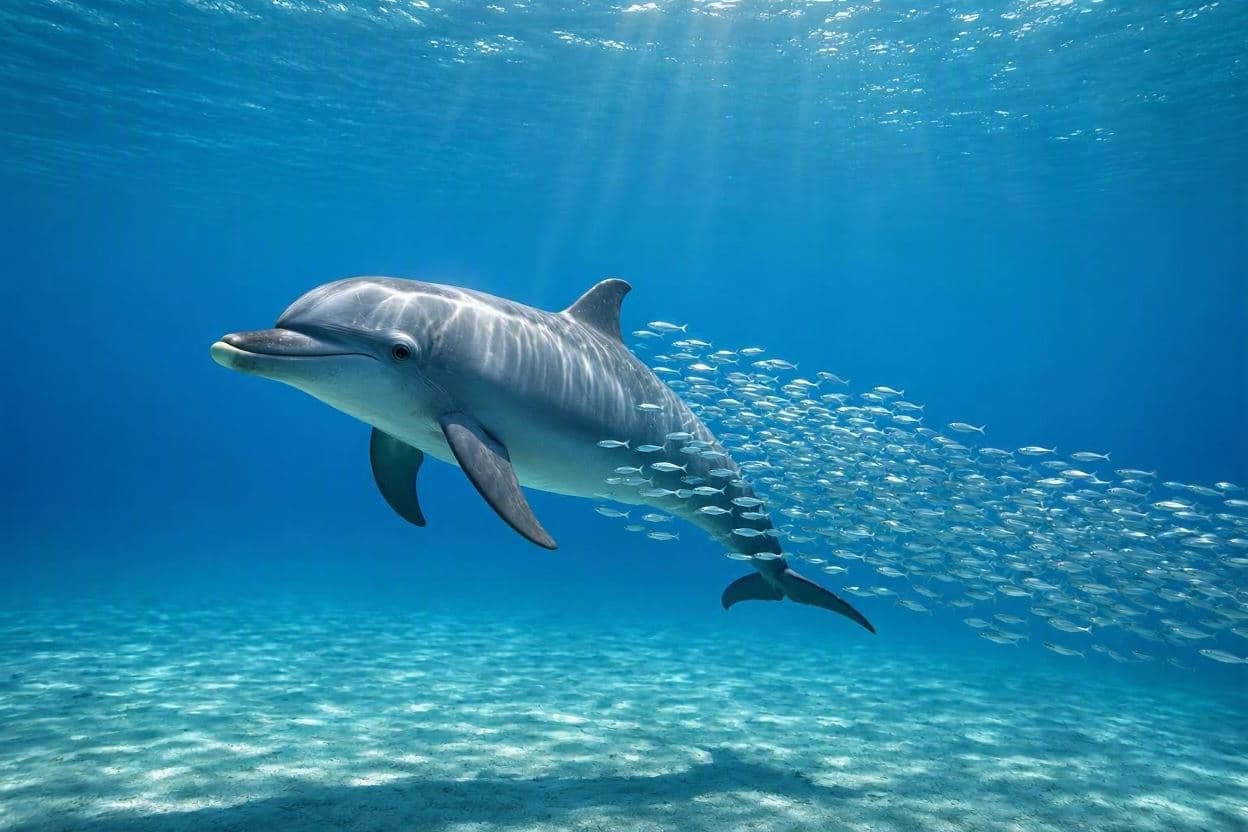
In the crystal-clear waters surrounding Lady Elliot Island, off the coast of Queensland, Australia, a unique drama unfolds beneath the waves. It is a scene of persistence and peculiar strategy, starring a bottlenose dolphin known affectionately by researchers as Bubbles. Unlike his peers who might hunt with speed or cooperation, Bubbles has developed a method that is as unsettling as it is ingenious: he chases specific fish until they are so stressed that they regurgitate their last meal, which he then consumes. This behavior, recently documented in scientific literature, offers a rare glimpse into the complex cognitive abilities and adaptive strategies of marine mammals.
The target of Bubbles’ attention is often the bigeye trevally, a predatory fish that hunts smaller prey. By isolating a single trevally and pursuing it relentlessly, Bubbles induces a state of extreme stress in the fish. The chase is not necessarily about catching the fish itself, but about forcing it to expel the contents of its stomach. Once the trevally vomits, Bubbles swoops in to consume the partially digested meal, effectively stealing the fish’s hard-earned nutrition without the effort of hunting the original prey. This behavior is a form of kleptoparasitism, a term used to describe the act of stealing food from another animal.
For six years, researchers have observed and recorded this behavior, noting that Bubbles does not engage in it randomly. He appears to select individual fish with precision, suggesting a level of planning and recognition that goes beyond simple instinct. The documentation of this habit provides the first direct evidence of such targeted kleptoparasitism in a cetacean. It challenges our understanding of dolphin hunting techniques, which are typically characterized by echolocation, herding, or cooperative fishing. Bubbles’ method is solitary, psychological, and remarkably efficient.
The energy economics of this strategy are fascinating. Hunting small fish can be energetically costly, requiring rapid bursts of speed and precise maneuvering. By stealing the pre-digested meals of other predators, Bubbles may be conserving energy while still obtaining high-calorie nutrition. It is a shortcut in the food chain, bypassing the need for capture and digestion of primary prey. This adaptation highlights the flexibility of dolphin intelligence, showing how they can exploit the behaviors of other species to their own advantage.
While the behavior may seem grotesque to human observers, it is a testament to the diverse ways life finds sustenance in the ocean. Nature is rarely concerned with human sensibilities of cleanliness or fairness; it is driven by survival and efficiency. Bubbles’ actions are a reminder that the marine ecosystem is a complex web of interactions, where even the most unlikely strategies can succeed. It invites us to look at the ocean with new eyes, appreciating the ingenuity of its inhabitants.
The study of Bubbles also underscores the importance of long-term observation in marine biology. Without years of dedicated monitoring, such a unique behavior might have gone unnoticed. It highlights the value of citizen science and local knowledge, as tour operators and divers often provide the initial clues that lead to formal scientific investigation. Collaboration between researchers and the community enriches our understanding of the natural world.
As climate change and human activity continue to impact marine environments, understanding these behavioral adaptations becomes increasingly important. Dolphins are highly sensitive to changes in their habitat, and their ability to innovate may be key to their resilience. Bubbles’ story is not just a curiosity; it is a data point in the broader narrative of how marine mammals navigate a changing world. It reminds us that there is still much to learn about the creatures we share the planet with.
In the end, Bubbles the dolphin is more than just a local character; he is a subject of scientific intrigue and a symbol of nature’s creativity. His unusual dining habit challenges our assumptions and expands our knowledge of cetacean behavior. As researchers continue to watch the waters of Lady Elliot Island, they do so with the hope of uncovering more secrets hidden beneath the surface. It is a gentle reminder that the ocean is full of surprises, waiting for those willing to look closely.
AI Image Disclaimer: The visual representations included here are AI-generated illustrations designed to depict marine life and underwater scenes, not actual photographs of Bubbles the dolphin or the specific predation events.
Sources: Ars Technica Discover Magazine
Published by Banx Network. This article is part of the Banx decentralized media programme, powered by the BXE token on the XRP Ledger.