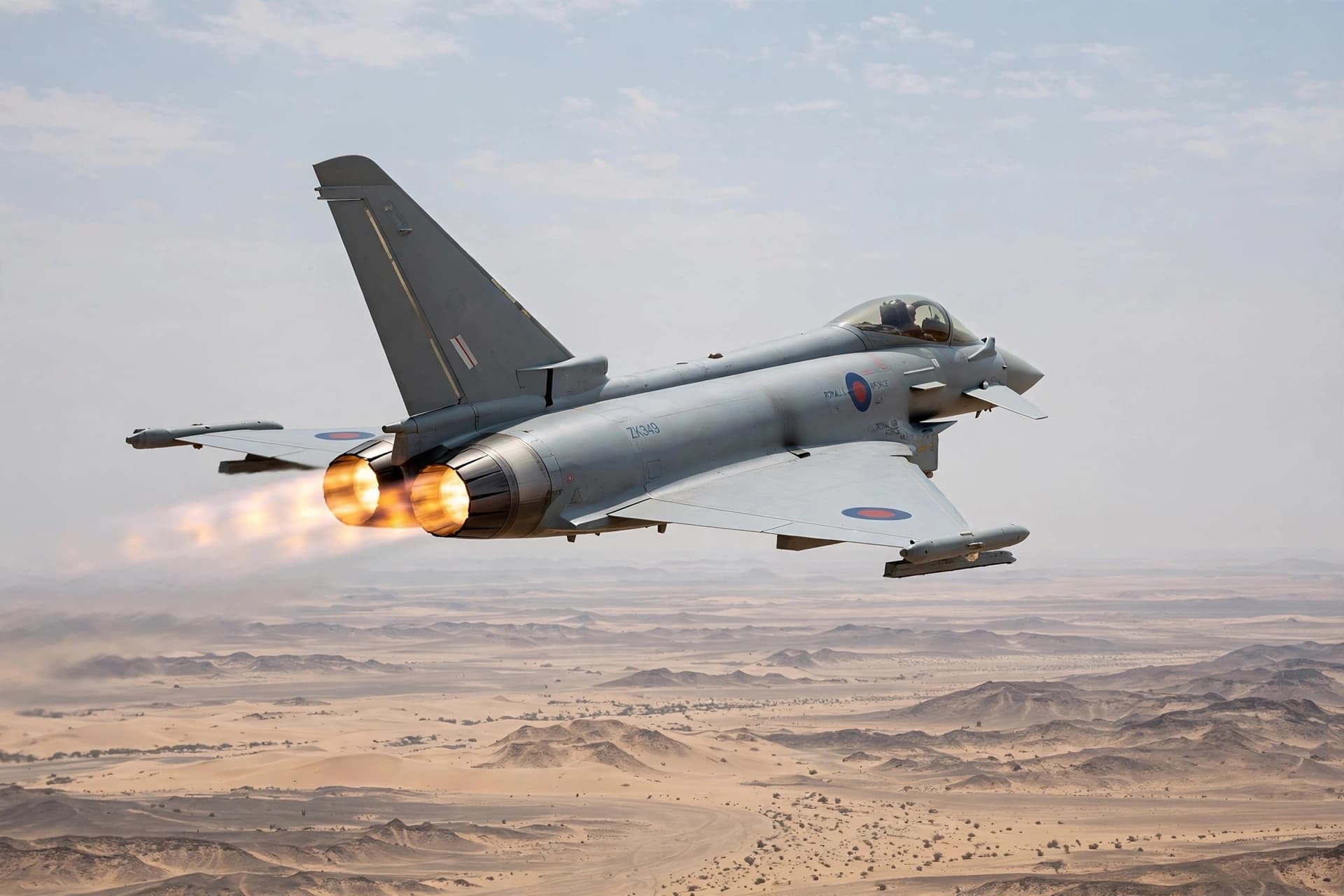
There is a particular gravity to a military deployment announced in the language of defense, a decision framed not as an entry into conflict but as a shield raised against it. On Tuesday, the British government confirmed that Royal Air Force Typhoon fighter jets will be sent to Saudi Arabia to help protect its cities and critical infrastructure from missile and drone attacks launched by the Houthi movement in Yemen. The aircraft, officials emphasized, will operate in a defensive role only and will not conduct offensive strikes against Houthi targets .
The decision follows a sharp escalation in Houthi attacks on Saudi territory. The group claimed responsibility for two separate strikes on Riyadh's King Khalid International Airport on October 10 and 11, attacks that killed at least 14 people and injured more than 300 . Houthi military spokesmen have vowed to maintain the tempo of operations, pledging to continue what they describe as "escalating operations deep inside Saudi Arabia" . Defense Secretary Wes Streeting described the attacks as "absolutely despicable," noting that the targeting of the Riyadh airport "shows the lengths the Houthis are going to escalate the situation in the region" .
The deployment is not a standalone gesture. Alongside the Typhoons, Britain will dispatch an RAF A400M transport aircraft to help move defense equipment within Saudi Arabia, and military advisers to support Saudi staff officers . London had already been providing air-to-air refueling support for Saudi defensive operations, an arrangement that has now been extended by 90 days . The support comes at the request of the Saudi government, and Prime Minister Andy Burnham had indicated earlier this month that the proposal was under consideration .
There is a geopolitical calculus beneath the announcement that extends beyond the immediate threat to Saudi cities. The British government warned that escalating violence in the Gulf could affect the UK through higher living costs, disruptions to energy supplies, and increased costs for British businesses . The Houthis, backed by Iran, are locked in a civil war with Yemen's internationally recognized government, which receives military backing from Saudi Arabia. The conflict has become a widening front in a regional struggle, and the defense of Saudi infrastructure is, in practical terms, the defense of global energy markets.
The framing of the mission as strictly defensive is significant. Britain is not joining the Saudi-led coalition's offensive operations, nor is it conducting strikes against Houthi positions in Yemen. The Typhoons will intercept missiles and drones, a role that is technically defensive but strategically consequential. Every interception is a message to the Houthis that their escalation will be met with capability, and a message to Saudi Arabia that its allies will not leave it exposed.
There is no resolution in this deployment, only a reinforcement of a position. The Houthis have demonstrated that their arsenal can reach Riyadh, and they have shown no inclination to stop. The Typhoons will arrive, the refueling agreement will continue, and the defense of Saudi airspace will become a shared responsibility. What remains is the question of whether defense is enough, or whether the conflict will find a way to escalate beyond the capacity of any shield to contain it.
---
AI Image Disclaimer: The visuals in this article are generated by artificial intelligence and are intended for illustrative purposes only.
Sources: Anadolu Agency, GBC Ghana Online, RTVE, Yonhap News Agency, RTP
Published by Banx Network. This article is part of the Banx decentralized media programme, powered by the BXE token on the XRP Ledger.