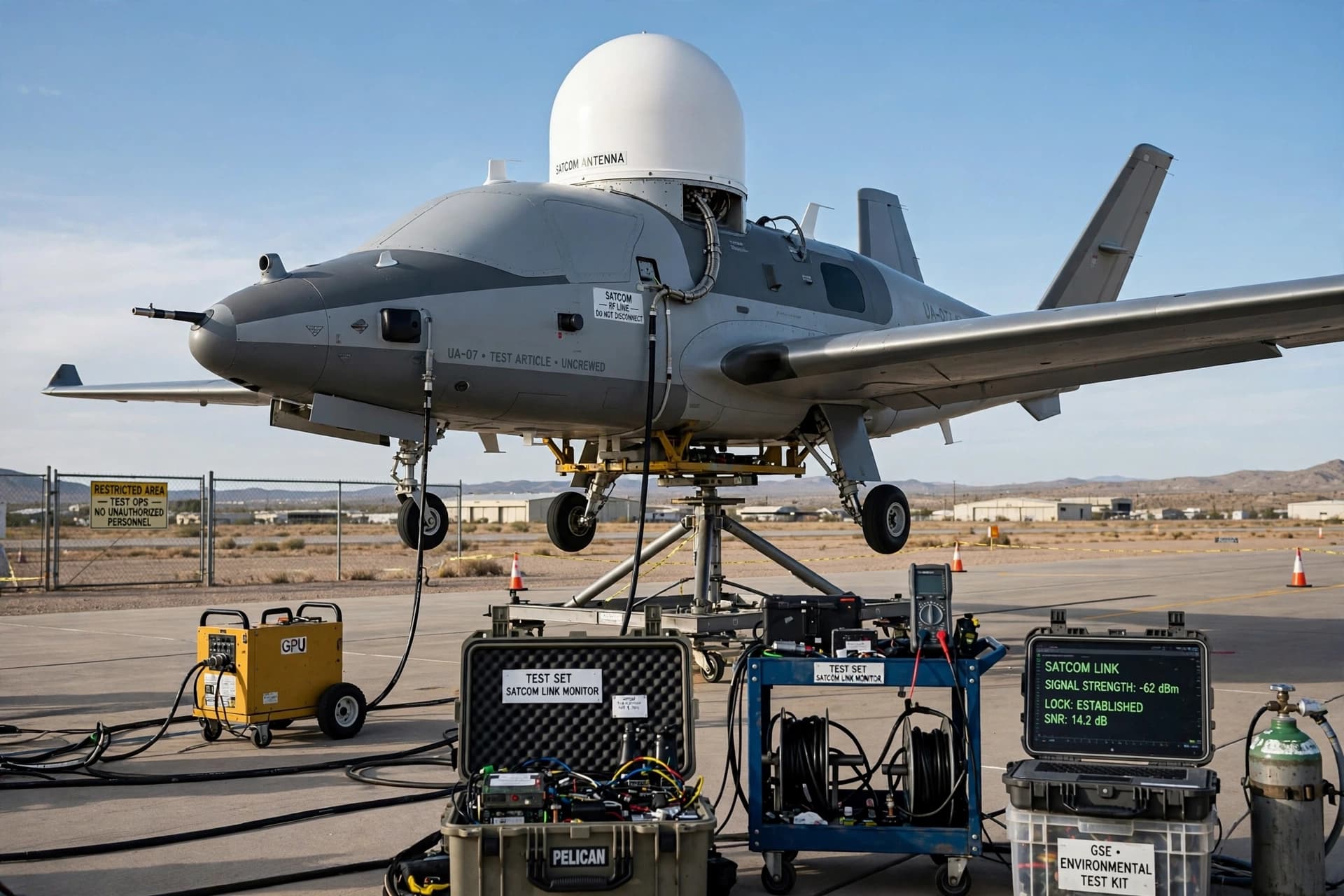
The test involved Insitu’s Integrator, a mid-sized uncrewed aircraft used by military customers for surveillance and reconnaissance missions. Gogo Special Missions, the company’s government and military division, integrated a modified Galileo HDX antenna onto the aircraft. The system is designed to connect the drone to Eutelsat OneWeb’s low-Earth-orbit satellite network.
The significance of such a connection is found in the space between the aircraft and the people controlling it. Conventional radio communication can become limited by distance, terrain or other physical conditions. Satellite communications can provide another route, allowing information and commands to travel through a much broader network.
Gogo and Insitu said the system is designed to provide high-speed global internet connectivity to the Integrator. They also said the arrangement would not be subject to U.S. International Traffic in Arms Regulations, or ITAR, which could make the technology easier to export to international customers.
The development comes at a time when military organizations have become increasingly interested in the ability of drones to operate over longer distances and in environments where communications can be disrupted. Satellite networks have become part of that technological landscape, particularly as uncrewed systems take on more complex surveillance and data-transmission roles.
Starlink has already established a substantial presence in satellite connectivity, including through SpaceX’s Starshield service for government customers. Reuters reported that European governments and some U.S. defense officials have raised concerns about excessive reliance on a single satellite communications platform. The Boeing-Gogo test therefore enters a market where redundancy and alternative networks are becoming important considerations.
For the aircraft itself, the value of a satellite connection is not simply measured by the distance it can travel. Faster transmission of sensor information can influence how quickly operators receive information from an aircraft, while a longer command-and-control range can expand the environments in which the system can operate. Insitu said those capabilities were among the reasons for adding the satellite communications option.
Yet the test should be understood as a technology demonstration rather than a confirmation of an operational deployment. Gogo and Insitu did not disclose a timetable for putting the system into service. The companies have demonstrated the connection, but questions surrounding deployment, scale, customer adoption and long-term performance remain open.
The story also illustrates how the future of drones is increasingly tied to infrastructure far beyond the aircraft itself. A small uncrewed vehicle can depend on antennas, satellite constellations, ground stations, software and communication networks spread across enormous distances. The aircraft may occupy the sky, but its usefulness can depend on systems that reach much farther.
Above the horizon, then, another layer of aviation is taking shape. The drone remains visible as a machine in the sky, while the invisible network around it becomes just as important. In that space between aircraft and satellite, companies are testing not only new technology, but new possibilities for how uncrewed systems remain connected when the ground is no longer enough.
IMAGE DISCLAIMER: Images or visualizations accompanying this article are illustrative and may not depict the exact aircraft, antenna configuration, satellite network, or test environment described.
SOURCES: Reuters CNA Insitu Gogo Eutelsat OneWeb
Published by Banx Network. This article is part of the Banx decentralized media programme, powered by the BXE token on the XRP Ledger.