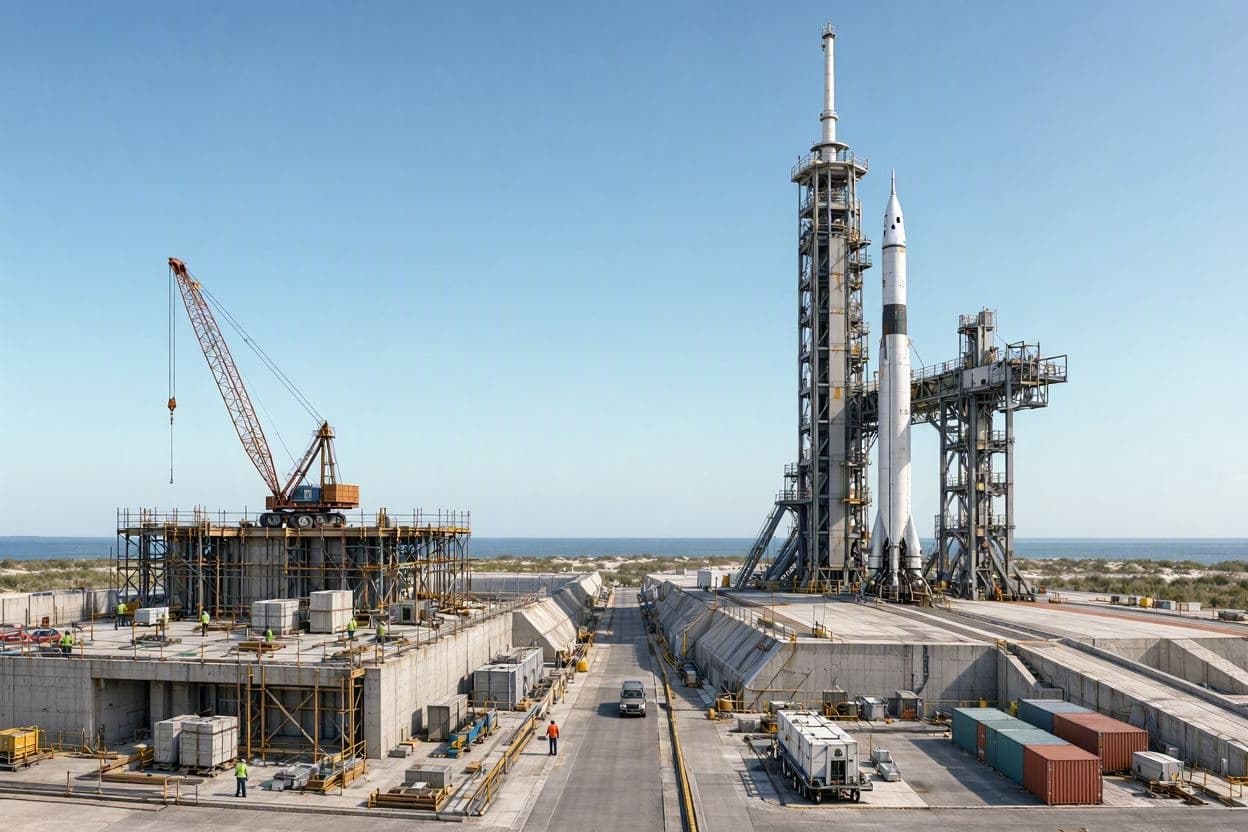
In the wake of a dramatic setback, ambition persists on the Space Coast. Blue Origin, the aerospace company founded by Jeff Bezos, is moving forward with plans to add a second launch pad at its Cape Canaveral facility, even as crews work diligently to repair the damage from a recent rocket explosion. This dual effort of reconstruction and expansion signals a steadfast commitment to the company’s vision of routine access to space.
The explosion occurred in May 2026 during a static fire test of the New Glenn rocket at Launch Complex 36 (LC-36). The incident caused significant damage to the pad and the vehicle itself, halting immediate launch plans. However, in a display of rapid response, Blue Origin teams cleared the wreckage in just nine days, demonstrating a resilience that has become characteristic of the modern commercial space industry.
Now, the company is not merely restoring the original pad, designated LC-36A, but is also constructing a new adjacent pad, LC-36B. This expansion effectively doubles the footprint of Blue Origin’s operations at Cape Canaveral, allowing for more frequent launches and greater operational flexibility. The decision to build a second pad amidst repairs underscores a long-term strategy that looks beyond immediate challenges.
The new pad, LC-36B, is targeted to become operational by late 2027. It will feature updated infrastructure designed to support the increasing cadence of New Glenn missions. By having two pads, Blue Origin can mitigate downtime in the future, ensuring that maintenance or anomalies at one site do not halt the entire program. This redundancy is crucial for a company aiming to compete in the heavy-lift launch market.
Rebuilding LC-36A is also progressing steadily. The company has outlined plans to restore the pad to full functionality, incorporating lessons learned from the explosion. These improvements aim to enhance safety and reliability, ensuring that future tests and launches proceed smoothly. The integration tower and other key structures are being rebuilt with reinforced materials and advanced monitoring systems.
This expansion comes at a time when the demand for heavy-lift launch services is growing. With numerous satellite constellations and deep-space missions planned for the coming decade, having robust launch infrastructure is essential. Blue Origin’s investment in LC-36 reflects confidence in the market and in the capabilities of the New Glenn rocket, despite the recent setback.
The local community and space industry watchers have noted the rapid pace of work. The ability to clear debris and begin new construction simultaneously is a testament to the company’s logistical prowess. It also highlights the collaborative environment at Cape Canaveral, where multiple commercial entities operate in close proximity, driving innovation through competition and shared infrastructure.
As Blue Origin looks toward the end of 2026 for the resumption of flights, the addition of a second pad serves as a symbol of perseverance. It is a reminder that in the high-stakes world of space exploration, setbacks are not endpoints but stepping stones. The expansion of LC-36 ensures that Blue Origin remains a key player in the next chapter of human spaceflight.
AI Image Disclaimer: Images accompanying this report are AI-generated artistic interpretations of launch complexes and rocket infrastructure, intended to visualize the scale of construction and repair efforts without depicting real-time footage.
Sources: Space.com, SpaceNews, Fox 35 Orlando, BizJournals
Published by Banx Network. This article is part of the Banx decentralized media programme, powered by the BXE token on the XRP Ledger.