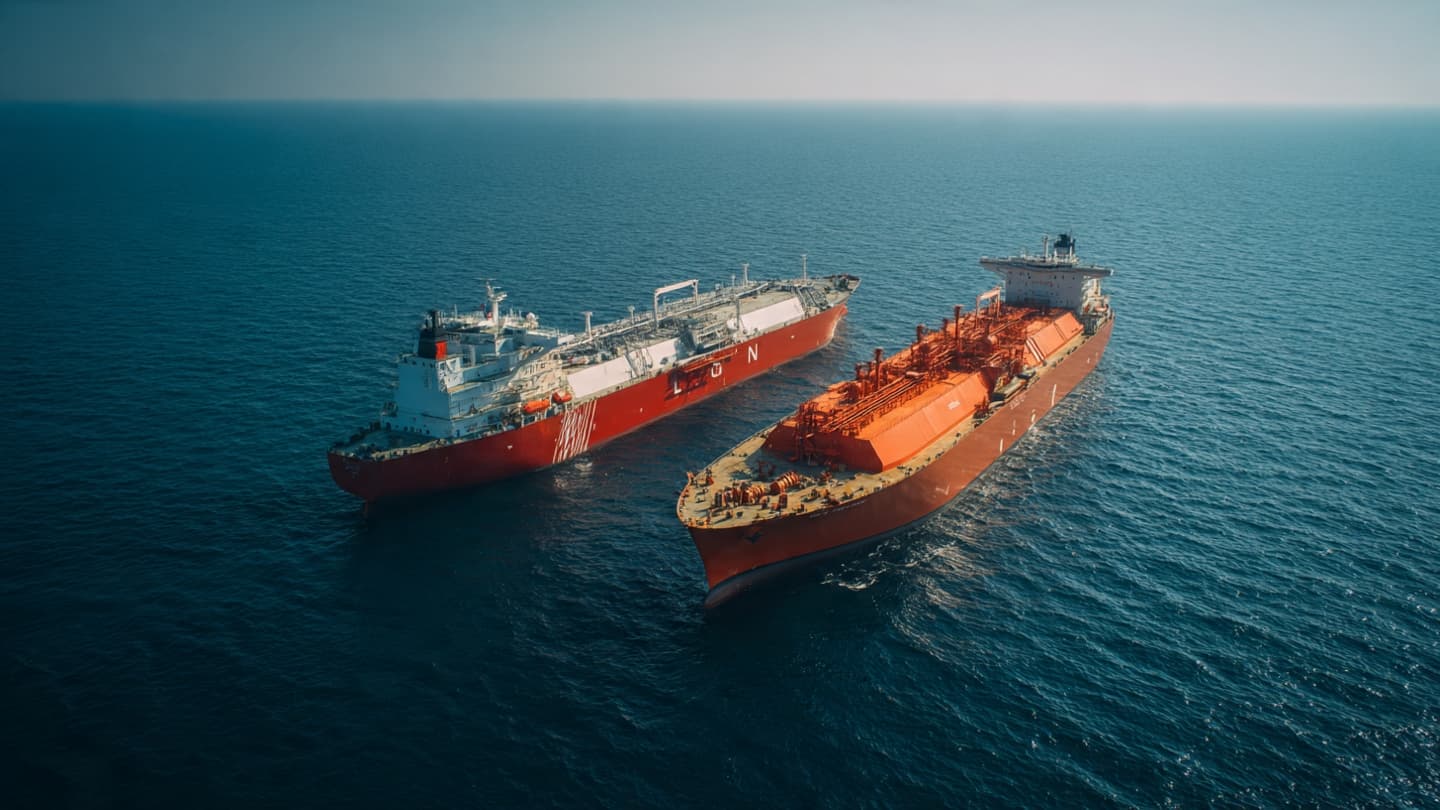
Far from the bright towers of the Gulf’s major cities, another kind of movement has been unfolding across open water. Large LNG carriers, normally following established routes toward distant markets, have begun taking a less familiar path. In recent weeks, three cargoes loaded in Qatar and the United Arab Emirates were transferred between ships outside the Strait of Hormuz, according to ship-tracking firms cited by Reuters.
The transfers are unusual because ship-to-ship movements involving liquefied natural gas are not common. Unlike crude oil, LNG generally travels directly from an exporting terminal to its destination aboard the same carrier. The recent activity therefore offers a glimpse into how energy companies and shipping operators are adjusting their logistics when traditional routes become more difficult to use.
One of the vessels involved was GasLog Shanghai, which completed a ship-to-ship transfer with GasLog Savannah off the coast of Oman in late August. The vessel had previously encountered an incident while leaving the Strait of Hormuz after loading its cargo at Qatar’s Ras Laffan export terminal.
Another transfer involved the QatarEnergy-controlled Al Rekayyat. After being struck by a projectile near the Strait of Hormuz in early July, the LNG carrier transferred its cargo to another Qatari vessel, Tembek, off the eastern coast of the United Arab Emirates. The cargo was subsequently delivered to India’s Dahej terminal on August 31, according to Kpler data.
A third operation involved Mraweh, a vessel controlled by the UAE’s ADNOC. After loading LNG at Das Island in early August, the tanker transferred its cargo to LNG Enugu off Oman. The receiving vessel was then headed toward Futtsu in Japan, illustrating how the altered logistics still connect Gulf production with major Asian consumers.
Behind these individual voyages lies a much larger energy market. Qatar and the UAE are important LNG suppliers, while India and Japan remain major Asian consumers. When cargoes require additional transfers before reaching their destinations, the extra steps can introduce greater complexity into transportation, scheduling, insurance, and overall supply planning.
The disruption has also been reflected in LNG prices. Regional exports have fallen since the conflict began, while Asian spot LNG prices reached $23.20 per million British thermal units, according to the Reuters report, more than twice the level seen before the disruption. For energy-intensive economies, higher gas prices can eventually influence electricity costs and industrial expenses.
Yet the ships continue moving. Cargoes are being redirected, transferred, and matched with alternative vessels, creating a maritime choreography that is less visible than the numbers on energy-market screens. Each transfer represents another attempt to preserve the connection between Gulf production and Asian demand despite the difficulties surrounding one of the world's most important waterways.
For now, the unusual ship-to-ship LNG operations show how global energy networks can adapt under pressure. The routes may be longer, the arrangements more complicated, and the costs less predictable, but the flow of energy has not simply disappeared. Across the waters beyond Hormuz, the cargoes continue their journey toward markets waiting for them.
AI Image Disclaimer: The illustrations accompanying this article are AI-created visual interpretations and are not photographs of the actual vessels or events.
Published by Banx Network. This article is part of the Banx decentralized media programme, powered by the BXE token on the XRP Ledger.