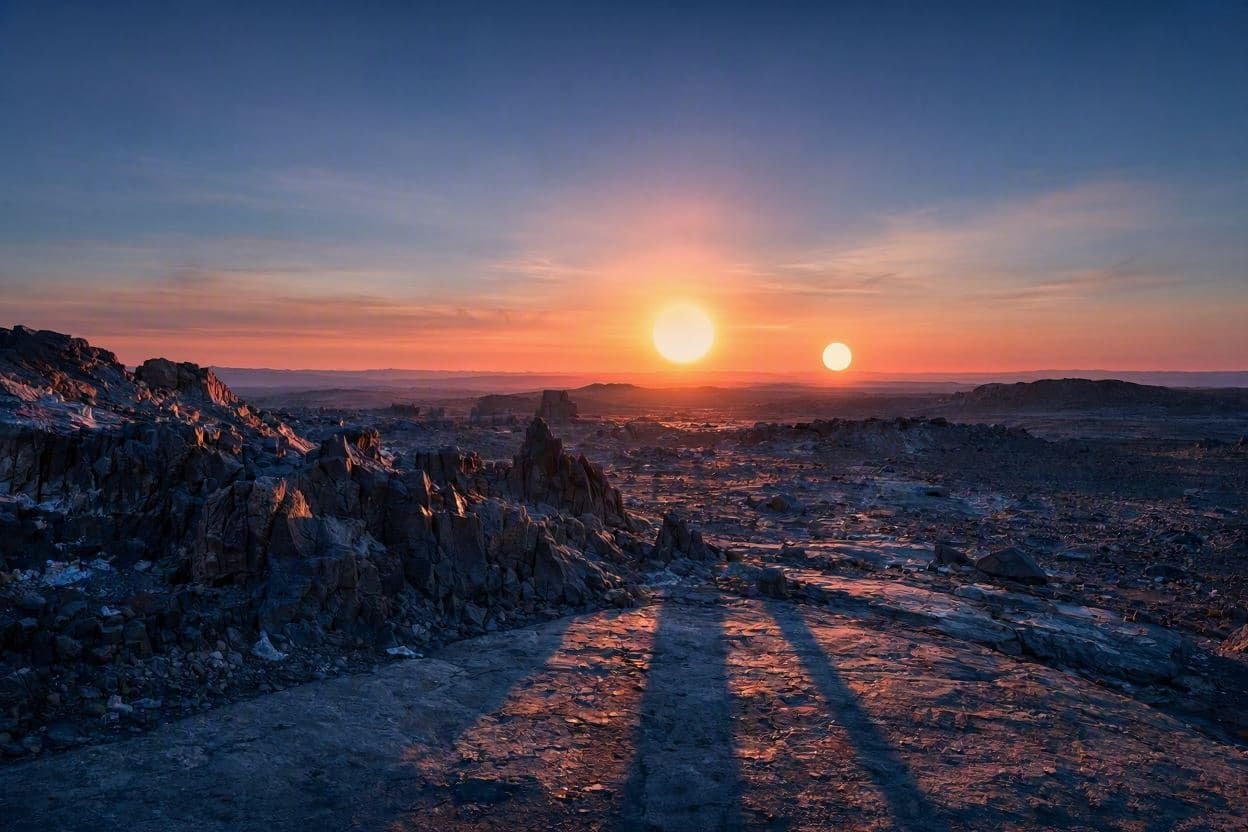
For centuries, our imagination of habitable worlds has been shaped by the solitary grace of our own Sun. We picture planets orbiting a single star, basking in its steady warmth, much like Earth does. Yet, the universe is far more crowded and complex than this singular model suggests. A significant portion of stars exist not alone, but in pairs, dancing around a common center of gravity. As we expand our search for life beyond our solar system, scientists are increasingly turning their gaze toward these binary systems, asking whether an "Earth 2.0" might thrive under the light of two suns.
The concept of a planet orbiting two stars was once the realm of science fiction, famously depicted in movies where characters cast double shadows. In reality, the dynamics of such systems are intricate and often chaotic. The gravitational pull of two stars can destabilize planetary orbits, potentially ejecting worlds into the cold void or causing them to crash into their stellar hosts. However, recent simulations and observations suggest that stable zones do exist, where a planet could maintain a consistent distance from its stars, allowing for the possibility of liquid water.
Searching for Earth-like planets in these systems presents unique challenges. The varying brightness as the stars eclipse each other or move in their orbits can mask the subtle dimming caused by a transiting planet. Astronomers must employ sophisticated algorithms to disentangle these signals, filtering out the stellar noise to find the faint whisper of a world passing in front of its lights. It is a task that requires both computational power and patience.
Despite these hurdles, binary systems offer intriguing possibilities. A planet in such a system might receive energy from two sources, potentially expanding the "habitable zone" where temperatures are just right for life. Depending on the distance between the stars, a planet could orbit one star closely while the other remains a distant companion, or it could orbit both stars at a greater distance. Each configuration creates a different climatic rhythm, with days and seasons that may be unlike anything we experience on Earth.
Recent discoveries have already identified several candidate planets in binary systems, some of which reside within the habitable zone. While none have been confirmed as exact twins of Earth, their existence proves that planet formation can occur in these complex environments. This expands the real estate available for life in the galaxy, suggesting that habitable worlds may be more common than previously thought.
Studying these systems also helps us understand the limits of planetary stability. By observing how planets survive in binary systems, we gain insights into the formation processes that shape solar systems. It challenges our assumptions about what constitutes a "normal" planetary environment and encourages us to broaden our definition of habitability.
Moreover, the cultural impact of discovering a world with two suns cannot be understated. It would fundamentally alter our perspective on our place in the cosmos, reminding us that Earth’s singular solar experience is just one variation among many. It invites us to imagine life adapting to different rhythms of light and dark, fostering a deeper appreciation for the diversity of the universe.
As technology improves, particularly with next-generation space telescopes, our ability to characterize these distant worlds will grow. We may soon be able to analyze the atmospheres of planets in binary systems, looking for signs of oxygen, methane, or other biosignatures. The search for Earth 2.0 is no longer limited to single-star systems; it has expanded to include the dual-light dances of the cosmos.
The quest to find Earth-like planets in binary systems represents a significant expansion of our astrobiological horizon. By overcoming the technical challenges of observing these complex environments, scientists are uncovering new possibilities for life. It is a reminder that the universe is full of surprises, and that habitable worlds may exist in configurations we are only beginning to understand.
AI Image Disclaimer: The visual accompaniments to this article are AI-generated interpretations designed to visualize the concept of a planet orbiting a binary star system.
Sources: The Astrophysical Journal NASA Exoplanet Archive Scientific American
Published by Banx Network. This article is part of the Banx decentralized media programme, powered by the BXE token on the XRP Ledger.