Space is often imagined as silent and still, a vast emptiness stretching between worlds. Yet in truth, it is alive with invisible currents. Charged particles stream outward from the Sun, magnetic fields twist and ripple, and planetary atmospheres respond in subtle, shifting ways. Between Earth and Mars lies a dynamic corridor shaped by solar wind — a space not empty, but active. Into this moving environment, NASA is preparing to send a new pair of explorers.
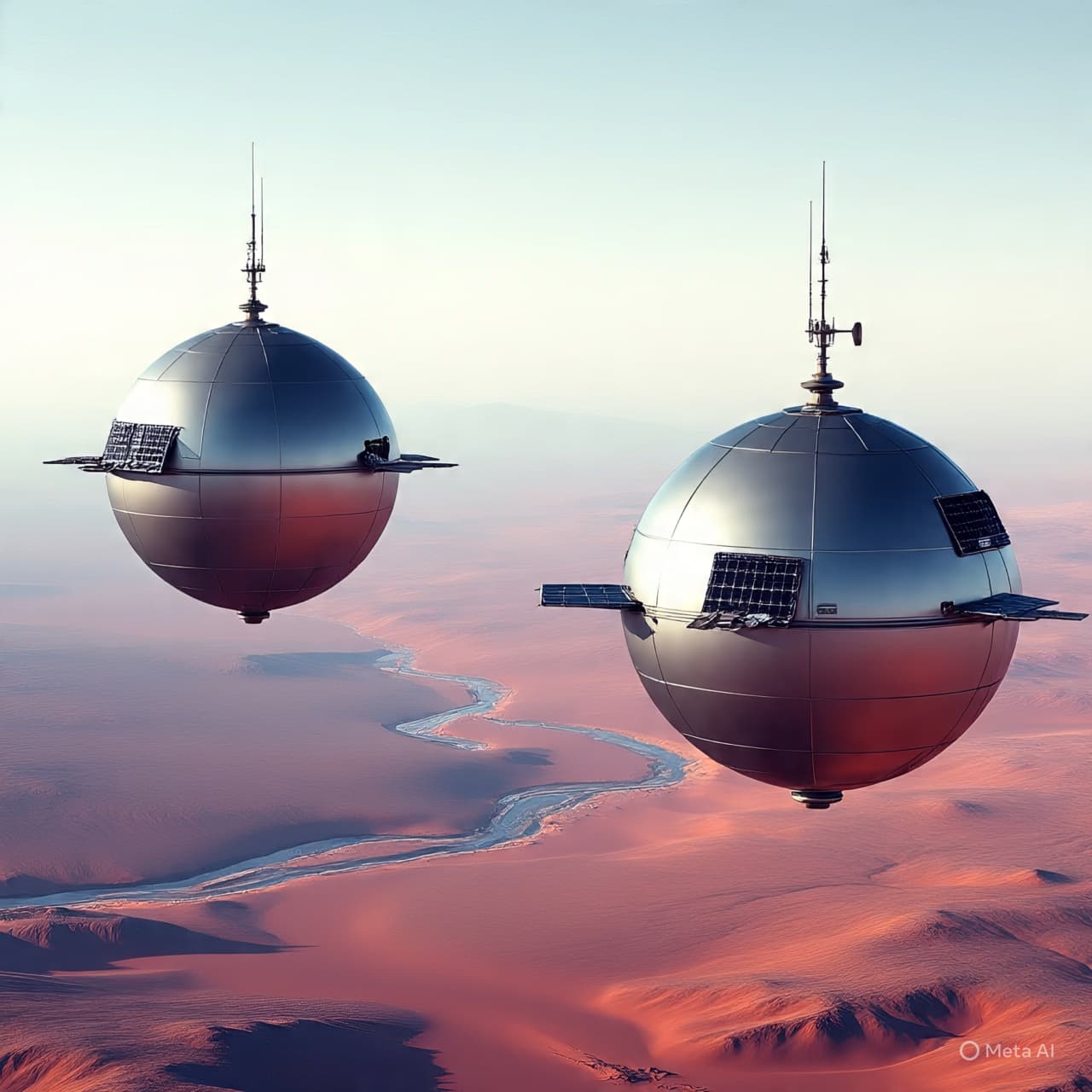
NASA’s ESCAPADE mission, short for Escape and Plasma Acceleration and Dynamics Explorers, is designed to study space weather in the region around Mars. Unlike single spacecraft missions, ESCAPADE will deploy two small satellites that orbit the Red Planet in coordinated formation. Their purpose is to measure how solar wind interacts with Mars’ magnetic environment and upper atmosphere.
Space weather refers to the stream of charged particles and magnetic energy emitted by the Sun. When these particles encounter a planet, they can shape atmospheric loss, trigger auroras, and influence radiation levels. Earth is shielded by a strong global magnetic field, but Mars lacks such comprehensive protection. Instead, it has patchy magnetic regions embedded in its crust, leaving much of its atmosphere exposed.
ESCAPADE’s twin spacecraft will orbit Mars at different altitudes, allowing scientists to measure plasma conditions from multiple vantage points. By comparing simultaneous data, researchers can better understand how solar wind energy flows around and through the Martian environment. This coordinated approach offers a more complete picture than previous single-satellite missions.
The mission’s goals extend beyond Mars alone. By studying how solar wind affects a planet with a weak magnetic field, scientists gain insights into atmospheric evolution. Over billions of years, Mars is believed to have lost much of its once-thicker atmosphere, possibly due in part to solar wind stripping. Understanding these processes may also inform research into exoplanets and planetary habitability elsewhere in the galaxy.
ESCAPADE is scheduled to launch as part of a rideshare mission, reflecting NASA’s growing emphasis on cost-effective exploration using smaller spacecraft. Despite their compact size, the satellites carry sophisticated instruments capable of measuring magnetic fields, plasma density, and particle energy.
There is a quiet elegance in the mission’s design. Two small craft moving in tandem, tracing invisible streams of charged particles, gathering data in silence. Their task is not dramatic in appearance, but fundamental in importance. Space weather shapes radiation environments that future human explorers must navigate. It influences communications, electronics, and atmospheric stability.
By bridging the region between Earth and Mars conceptually and scientifically, ESCAPADE helps connect planetary science with heliophysics — the study of the Sun’s influence across the solar system. It represents a step toward understanding not just individual planets, but the relationships between them and their star.
In closing, NASA confirms that ESCAPADE is ready to begin its mission to study solar wind interactions at Mars. Once launched and operational, the twin spacecraft will provide new data on space weather processes that influence planetary atmospheres and future exploration planning. The mission reflects continued efforts to deepen scientific understanding of the dynamic space environment between Earth and Mars.
AI Image Disclaimer Images in this article are AI-generated illustrations, meant for concept only.
Sources
NASA Space.com Reuters BBC News CNN
Published by Banx Network. This article is part of the Banx decentralized media programme, powered by the BXE token on the XRP Ledger.