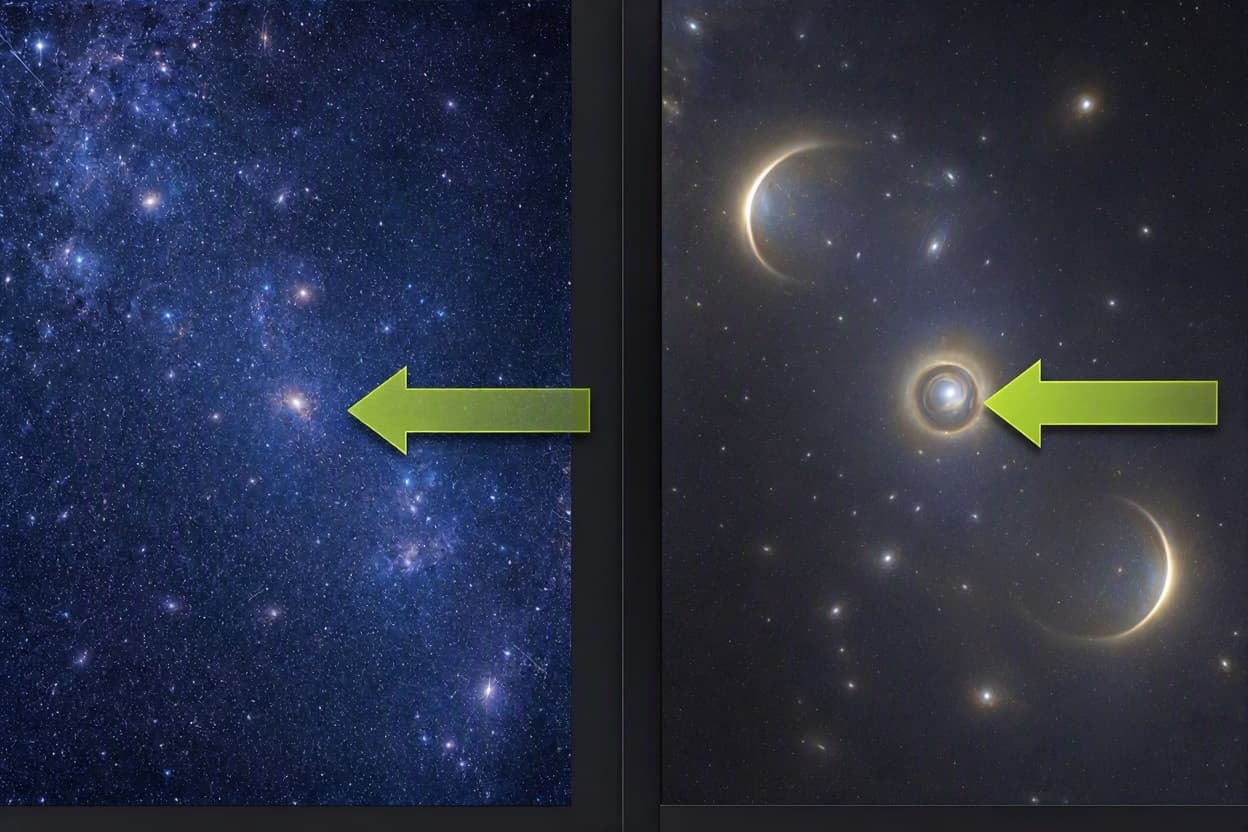
In the vast digital archives of astronomical history, where billions of pixels capture the silent drama of the cosmos, serendipity often plays the role of a quiet collaborator. It was not a targeted search but a casual, curious glance at an old image from the Hubble Space Telescope that recently yielded a startling find. This accidental discovery, hidden in plain sight for years, may offer a new key to unlocking the elusive nature of dark matter, the invisible scaffolding that holds our universe together.
The image in question was part of Hubble’s extensive legacy, originally taken to study distant galaxies and star formation. For years, it sat in databases, analyzed for its primary targets while a faint, unusual anomaly remained unnoticed. It was only when a researcher, driven by intuition rather than a specific hypothesis, revisited the data that the significance of the artifact became clear. This moment underscores the enduring value of archival data, where today’s noise can become tomorrow’s signal.
The object identified is a rare example of a gravitational lens, a phenomenon predicted by Einstein’s general theory of relativity. When a massive object, such as a cluster of dark matter, sits between Earth and a distant light source, it bends the fabric of spacetime. This bending acts like a cosmic magnifying glass, distorting and amplifying the light from background galaxies. The specific pattern observed in the Hubble image suggests the presence of a concentrated mass that emits no light of its own.
Dark matter has long been one of the greatest mysteries in physics. It does not interact with electromagnetic radiation, making it invisible to traditional telescopes. Scientists infer its existence only through its gravitational effects on visible matter. This new discovery provides a unique laboratory for studying how dark matter clumps and interacts on smaller scales, offering clues about its fundamental properties and distribution.
The implications of this finding are profound. By analyzing the distortion patterns, researchers can map the distribution of mass in the lensing object with high precision. This allows them to test various theoretical models of dark matter, distinguishing between those that predict smooth distributions and those that suggest a clumpy, granular structure. Each detail helps refine our understanding of the universe’s hidden architecture.
Furthermore, this discovery highlights the importance of human insight in an age of automated data processing. While algorithms are excellent at finding known patterns, they may overlook the unexpected. The human eye, guided by experience and curiosity, remains an invaluable tool in scientific exploration. It reminds us that technology is a partner in discovery, not a replacement for the inquisitive mind.
As follow-up observations are planned using more powerful instruments like the James Webb Space Telescope, the scientific community waits with anticipation. These newer tools will provide higher resolution and deeper sensitivity, allowing for a more detailed analysis of the lensing effect. The hope is that this single, chance observation will open a window into the dark sector of the cosmos.
The story of this discovery is a testament to the patience and persistence of scientific inquiry. It reminds us that the universe still holds many secrets, sometimes hiding in the data we already possess. As we continue to peel back the layers of reality, each accidental glimpse brings us closer to understanding the invisible forces that shape our existence.
AI Image Disclaimer: Please note that any accompanying visuals for this article are AI-generated representations intended for illustrative purposes only.
Sources: NASA, European Space Agency (ESA), The Astrophysical Journal, Space.com
Published by Banx Network. This article is part of the Banx decentralized media programme, powered by the BXE token on the XRP Ledger.