The idea arrives the way many space dreams do: quietly, almost improbably, carried on a whisper of equations and ambition. Somewhere between laboratory benches and long winter nights, Russian researchers are once again speaking the language of propulsion—this time in plasma, ionized and luminous, promising a journey to Mars measured not in months, but in weeks.
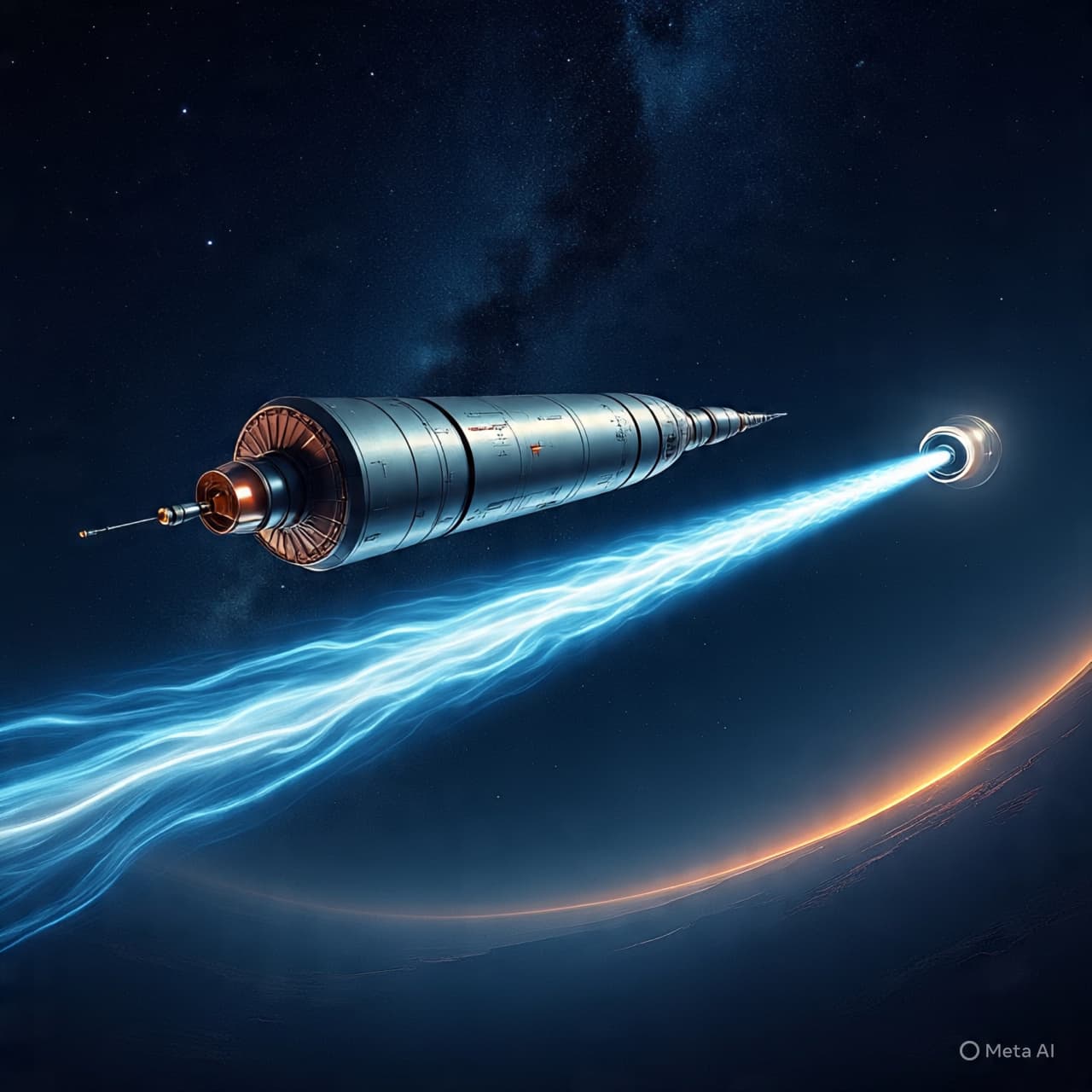
According to scientists involved in the project, the proposed plasma engine would rely on sustained electromagnetic acceleration rather than explosive thrust. Unlike chemical rockets, which burn furiously and briefly, plasma concepts imagine endurance: engines that run steadily for long durations, nudging spacecraft to ever-greater velocities over time. In theory, such systems could reduce the Earth-to-Mars transit to roughly 30 days, a figure that sounds less like engineering and more like science fiction.
The contrast with today’s dominant approach is striking. SpaceX’s Starship—massive, stainless, and unapologetically chemical—represents brute force refined by iteration. It is designed to lift enormous payloads, refuel in orbit, and cross interplanetary distances with reliability rather than speed. Plasma engines, by comparison, trade raw thrust for efficiency, offering acceleration so gentle it would barely be felt by passengers, yet relentless enough to reshape mission timelines if scaled successfully.
But between theory and departure lies a wide, unlit gap. Plasma propulsion has existed for decades in smaller forms, powering satellites and deep-space probes with exquisite efficiency and modest power demands. Scaling such systems to move crewed spacecraft introduces unresolved challenges: energy generation, heat management, radiation exposure, and materials capable of enduring prolonged electromagnetic stress. No plasma engine capable of carrying humans beyond Earth orbit currently exists.
Still, the claim matters—even if it never flies. It reflects a broader restlessness in space exploration, a sense that the old arithmetic of distance may no longer be enough. As geopolitical tensions spill quietly into scientific competition, propulsion becomes more than hardware. It becomes narrative: who gets there faster, who dares to rethink the journey itself.
Whether this plasma engine remains a laboratory curiosity or becomes a catalyst for a new era is, for now, unknowable. What is clear is that Mars continues to exert its pull not just on rockets, but on imagination. And in that pull, engineers everywhere are still asking the same ancient question—how much faster can we learn to move through the dark?
AI Image Disclaimer
“Illustrations were created using AI tools and are not real photographs.”
Sources (names only)
Roscosmos Russian Academy of Sciences NASA European Space Agency Space.com
Published by Banx Network. This article is part of the Banx decentralized media programme, powered by the BXE token on the XRP Ledger.