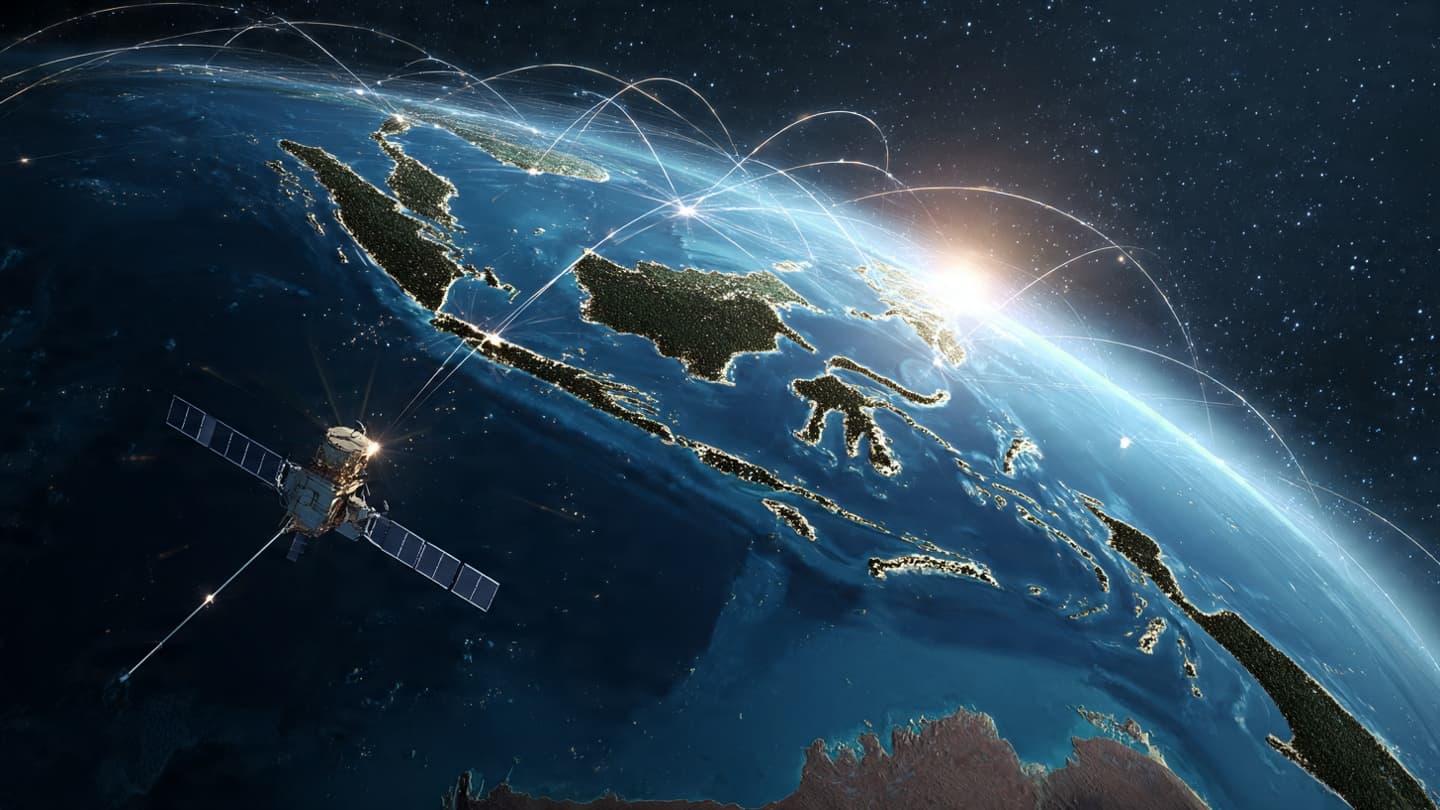
From the ground, a satellite is little more than a point moving quietly across the night sky. Yet above the clouds, those distant machines can carry signals between islands, connect remote communities and support systems that increasingly shape modern life.
Indonesia is continuing to develop its space and satellite capabilities as part of a broader effort to strengthen national connectivity and technology infrastructure. The country's geography, spread across thousands of islands, makes satellite technology particularly relevant for communications and remote-area services.
Satellite connectivity can provide an alternative where terrestrial infrastructure is difficult or expensive to build. Fiber-optic networks remain essential, but remote islands, mountainous areas and sparsely populated regions can present logistical challenges for conventional infrastructure.
Indonesia's satellite ambitions have therefore developed alongside its wider digital transformation. The government has continued investing in communications satellites and related infrastructure to expand access to digital services across the archipelago.
The country's SATRIA-1 communications satellite is an important part of that effort. The satellite was launched in 2023 and is designed to provide internet connectivity to public facilities, particularly in areas where terrestrial networks remain limited.
Satellite technology also extends beyond internet access. Space-based systems can support weather monitoring, environmental observation, disaster management, mapping and agricultural applications.
For a country frequently affected by earthquakes, volcanic activity, floods and other natural hazards, remote sensing can provide valuable information about changing conditions across large areas. Satellites can observe locations that may be difficult for ground teams to reach.
The technology also creates opportunities for research. Universities and scientific institutions can use satellite data to study forests, oceans, agriculture and urban development, building a more detailed picture of how Indonesia's landscape changes over time.
Developing these capabilities requires more than launching satellites. Ground stations, communications networks, engineers, software and data-processing systems must operate together. Space technology is therefore closely connected to the broader technology ecosystem on Earth.
The commercial side is evolving as well. Global satellite companies are increasingly developing systems designed to provide broadband connectivity from low Earth orbit, creating new possibilities for regions that remain difficult to serve through conventional infrastructure.
For Indonesia, the challenge is balancing different technologies and ensuring that satellite connectivity complements rather than replaces terrestrial networks. Each system has different strengths, costs and limitations.
The country's space ambitions therefore remain closely tied to everyday needs on the ground. A signal traveling from orbit may eventually become a video call in a remote village, weather information for farmers or communication during an emergency.
As Indonesia's digital economy expands, the sky above the archipelago is becoming part of its infrastructure. Satellites may remain distant from everyday view, but their role in connecting an increasingly digital nation is becoming steadily more tangible.
Image Disclaimer
The following visuals were generated with AI and are conceptual representations of Indonesian satellite technology and space infrastructure, not real photographs.
Sources
ANTARA BRIN Ministry of Communication and Digital Affairs Ministry of National Development Planning Indonesian Space Agency
Published by Banx Network. This article is part of the Banx decentralized media programme, powered by the BXE token on the XRP Ledger.