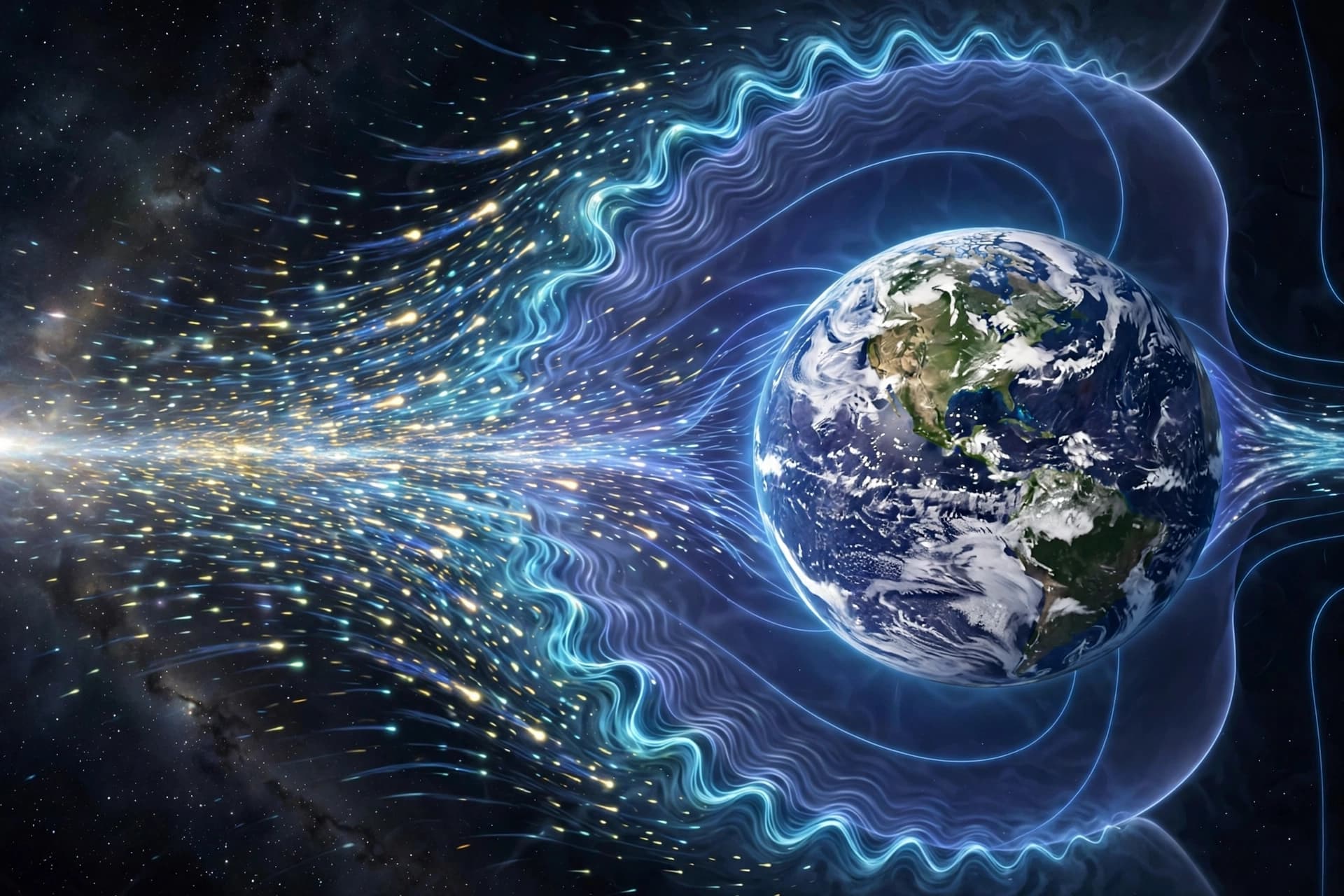
At dawn, the sky can look endless, a canvas of blues and faint golds, stretching beyond what the eye can fully grasp. Yet invisible to that gaze, something drifts above the clouds, suspended in a realm that few ever consider directly. Rockets, launched with human intent and cosmic ambition, leave more than trajectories and fleeting fire — they leave traces, traces that settle softly in the upper reaches of our atmosphere.
A recent study confirms what some had long suspected: the repeated reentry of SpaceX’s reusable rockets is introducing metallic particles — aluminum, iron, and other residues — into the mesosphere and lower thermosphere. These fragments, invisible and insidious, linger for months, interacting subtly with the chemistry of the sky, altering layers that have existed largely unchanged for millennia. Each mission, celebrated for ingenuity and technological daring, contributes imperceptibly to a growing pattern of atmospheric change.
The research, conducted with careful observation and satellite data, illustrates a tension between progress and permanence. While rockets allow humanity to touch distant planets, deploy satellites, and peer deeper into the cosmos, they also remind us that the act of reaching outward carries consequences downward. Metal particles, once confined to Earth’s surface or laboratory, now drift across the stratosphere, a quiet reminder of ambition’s reach. Scientists note that these materials can affect cloud formation, the reflection of sunlight, and potentially even climate dynamics — subtle shifts that ripple across time and space.
This is not an immediate crisis, nor a cataclysm of smoke and ash. Rather, it is a layering of motion and consequence, a human signature upon a domain that has long seemed infinite. Just as footprints linger in desert sands long after travelers depart, so too do these microscopic traces remain aloft, their presence recorded in the atmosphere’s quiet chemistry. The study invites reflection, not alarm: an opportunity to consider the full arc of human exploration and the ways even small acts — the fall of tiny particles from great heights — echo through systems beyond our daily awareness.
As the pace of space launches accelerates, this awareness may guide future engineering and policy, prompting questions about materials, reentry methods, and the balance between exploration and stewardship. Above us, the sky carries memory — each rocket a fleeting flame, each particle a lingering note in the symphony of Earth’s upper reaches.
AI Image Disclaimer
Visuals are AI-generated and serve as conceptual representations.
Sources (Media Names Only)
Nature Space.com Scientific American NASA The Guardian (Science Section)
Published by Banx Network. This article is part of the Banx decentralized media programme, powered by the BXE token on the XRP Ledger.