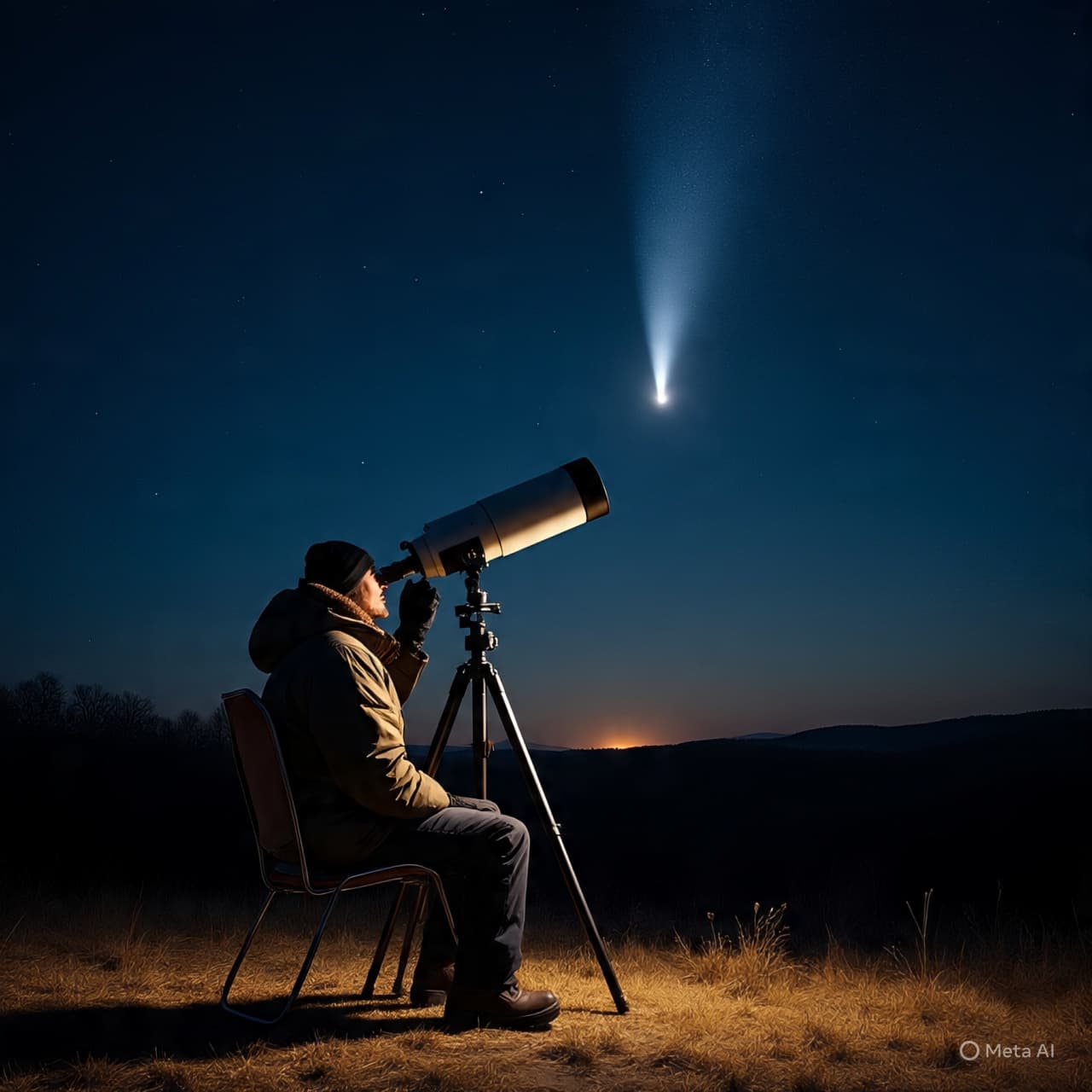
In the slow, deep theatre of the cosmos, where time is measured in millions of years and distances seem more like whispers than spaces, a visitor has emerged. This object — a comet designated C/2024 E1 — has lately drawn the gaze of those who study the sky, its icy core and ghostly halo of gas catching light as it nears the inner reaches of our solar neighbourhood. There is a stillness to this spectacle, as though ancient winds themselves have paused to watch the comet’s journey, painted in a muted green that betrays its carbon‑rich breath carried off into space.
Discovered in the spring of 2024 by an astronomer scanning the distant skies, this comet has traveled from the far reaches of the Oort Cloud, a vast reservoir of icy bodies that encircles the Sun at the edge of its influence. The cloud’s memory is long, and comets that emerge from it carry tales of epochs long past. As C/2024 E1 drifted inward over perhaps millions of years, the gentle warmth of the Sun began to coax gas and dust from its frozen surface, forming the luminous coma that now brightens with each passing day.
Its path through the inner solar system — including a close approach to Mars before edging toward Earth’s domain — is not a return but a single passage. Unlike familiar comets that circle back on predictable orbits, this one travels on a hyperbolic trajectory, a route that will see it fling outward once more, beyond the Sun’s gravitational embrace. This motion, shaped by the interplay of celestial mechanics and the gentle tug of planetary gravity, suggests that the comet will not revisit our skies, but rather begin a long sojourn into the interstellar vastness.
Observers with telescopes and binoculars, particularly in the Southern Hemisphere as the comet makes its closest swing this February, have noted its steady brightening. The green glow — a signature of diatomic carbon and other molecules energized by sunlight — shifts and sighs throughout its passage, reminding us that comets are not static relics but dynamic beings in their own right. They carry with them the raw ingredients of solar system formation, structures of ice and dust shaped by time and distance beyond reckoning.
In laboratories and observatories on Earth, researchers watch its progress with quiet dedication. Instruments tuned to different wavelengths seek to tease out the composition of the coma and tail, insights into the comet’s origins and the forces that animate it. Though it will fade from view as it recedes once more, the brief grace of its visit leaves a record in data and memory alike — a moment where human curiosity met a wanderer from the deep.
As this celestial visitor arcs toward the distant perimeter of our solar system and beyond, scientists say its future lies not in return but in perpetual drift through the galaxy. In straightforward terms, the comet’s hyperbolic orbit and growing brightness near Mars and Earth mark an uncommon passage: a long‑period comet that is likely to be cast out into interstellar space after its brief sojourn within the Sun’s influence.
All Visuals are AI‑generated and serve as conceptual representations.
Sources (Media Names Only)
Gadgets 360 Live Science
Published by Banx Network. This article is part of the Banx decentralized media programme, powered by the BXE token on the XRP Ledger.