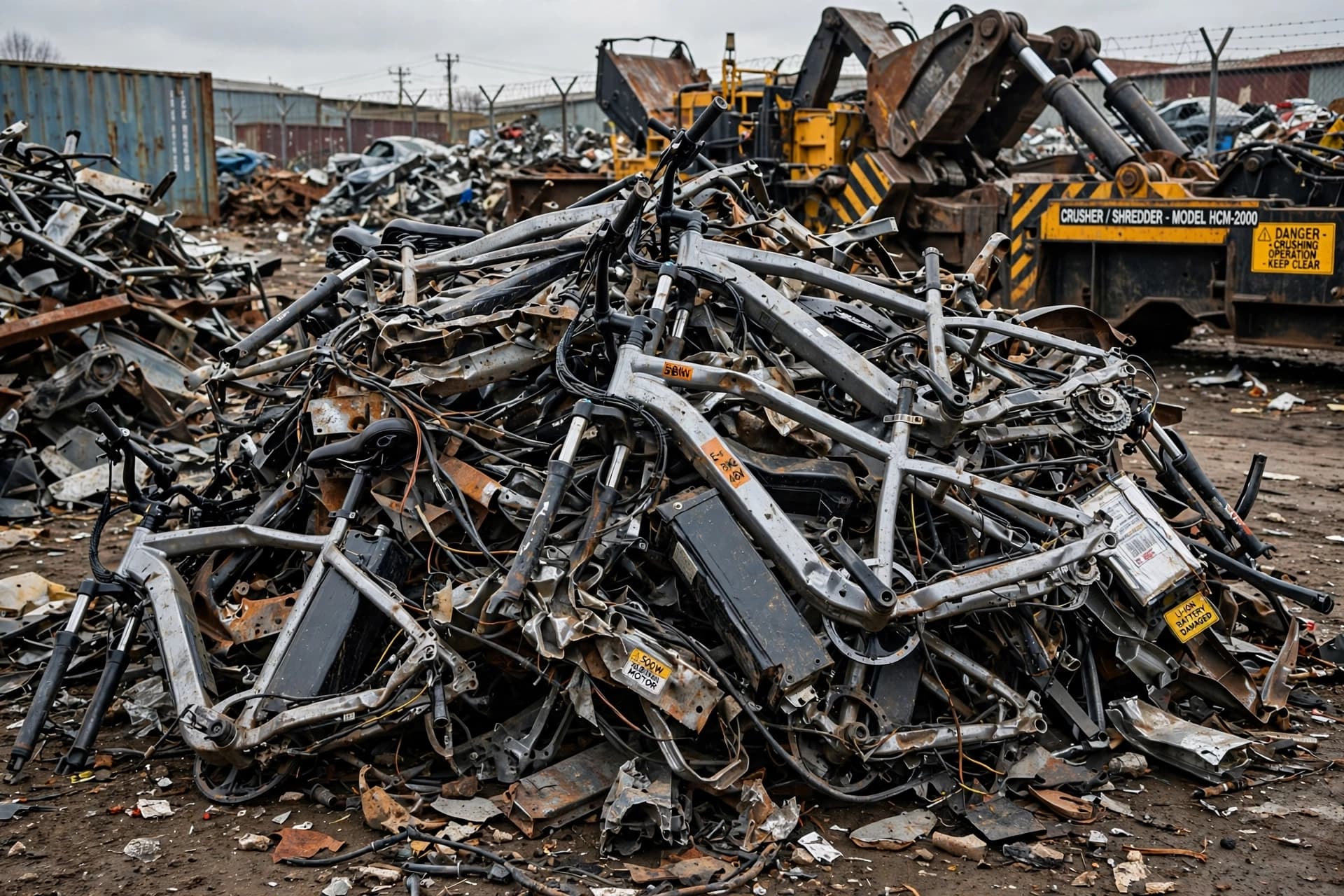
In a scrapyard in Blacktown, New South Wales, the sound of crushing metal echoed through the afternoon air. Electric bikes that once raced along Sydney's northern beaches streets now lay stacked together, awaiting their final fate. Some had been modified to reach speeds over 90 kilometers per hour. Some were ridden by children as young as 14. Some had traveled in packs across the Sydney Harbour Bridge, becoming brief, noisy images on social media. Now they would be flattened into twisted scrap, their batteries removed for separate disposal.
This was the first batch of illegal electric bikes destroyed under new seizure powers that took effect in New South Wales in August. On September 30, 23 seized vehicles were publicly crushed at the scrapyard. State Transport Minister John Graham stood at the site and said something that was later quoted by multiple media outlets: "This is not a Mad Max scene. This is where illegal ebikes go to die."
The seizure of these vehicles stemmed from a joint operation in September. Police and Transport for NSW conducted enforcement on the northern beaches, seizing 36 illegal electric bikes. Thirteen of those remain under assessment for possible return to their owners. Among the destroyed vehicles was one used for food delivery and others modified with tampered speed limiters. Under the law, legal electric bikes must meet conditions including a maximum continuous motor power of 500 watts, power cutoff above 6 kilometers per hour when not pedaling, and a top speed of 25 kilometers per hour.
The background to this enforcement is a growing body of injury data. Figures released by St Vincent's Hospital in Sydney showed that between January and July this year, the hospital treated 22 percent more electric bike injuries than in the same period last year, with 42 percent of those cases triggering a trauma response. Dr. Ed Lewis, acting director of rehabilitation medicine, described the nature of some injuries—fractures, internal bleeding, and "perforation of certain organs." He said the most severe injuries were often associated with riding without a helmet, speeding, or riding under the influence of alcohol and drugs. "Severe brain injury does carry a very high risk of death."
The rise in child injuries has been particularly concerning. Data from the Sydney Children's Hospital Network showed that 183 children have presented to Westmead and Randwick hospitals with electric bike or scooter injuries so far this year, compared with 40 for all of 2023. A spokesperson for the network said electric vehicle injuries have become the third most common reason for admission, with about one in five presentations involving major trauma requiring intensive care, surgery, and long-term rehabilitation.
New South Wales Opposition Leader Kellie Sloane has called for further measures, advocating a national electric bike registration system to make it easier to identify riders and hold them accountable. Dr. Richard Bunning from the University of Queensland noted that there is currently no clear, unified national data on electric bike deaths and injuries, and state laws vary considerably. "Some incidents classified as electric bike accidents actually involve legal electric motorcycles," he said.
The electric bike itself is not the problem. It is a convenient, low-carbon mode of transport that carries a different vision of how cities might move. The problem lies in that blurred line—when a bicycle becomes less like a bicycle and closer to a motorcycle in speed and weight, riders, pedestrians, and the riders themselves face different risks. At the scrapyard, Minister Graham said the government wants people to "do the right thing" on electric bikes and ride legally and safely.
As the first batch of vehicles turns to fragments, New South Wales is sending a clear signal: those that exceed legal standards will be removed from the roads. For riders and parents, this means being more careful about understanding the rules when buying and using these vehicles. For the city, finding the balance between encouraging green transport and protecting public safety remains a task that requires ongoing calibration.
AI Image Disclaimer: The images accompanying this article were generated by artificial intelligence and are for illustrative purposes only.
Sources: Transport for NSW, ABC News, The Guardian, The Australian, Sydney Children's Hospital Network
Published by Banx Network. This article is part of the Banx decentralized media programme, powered by the BXE token on the XRP Ledger.