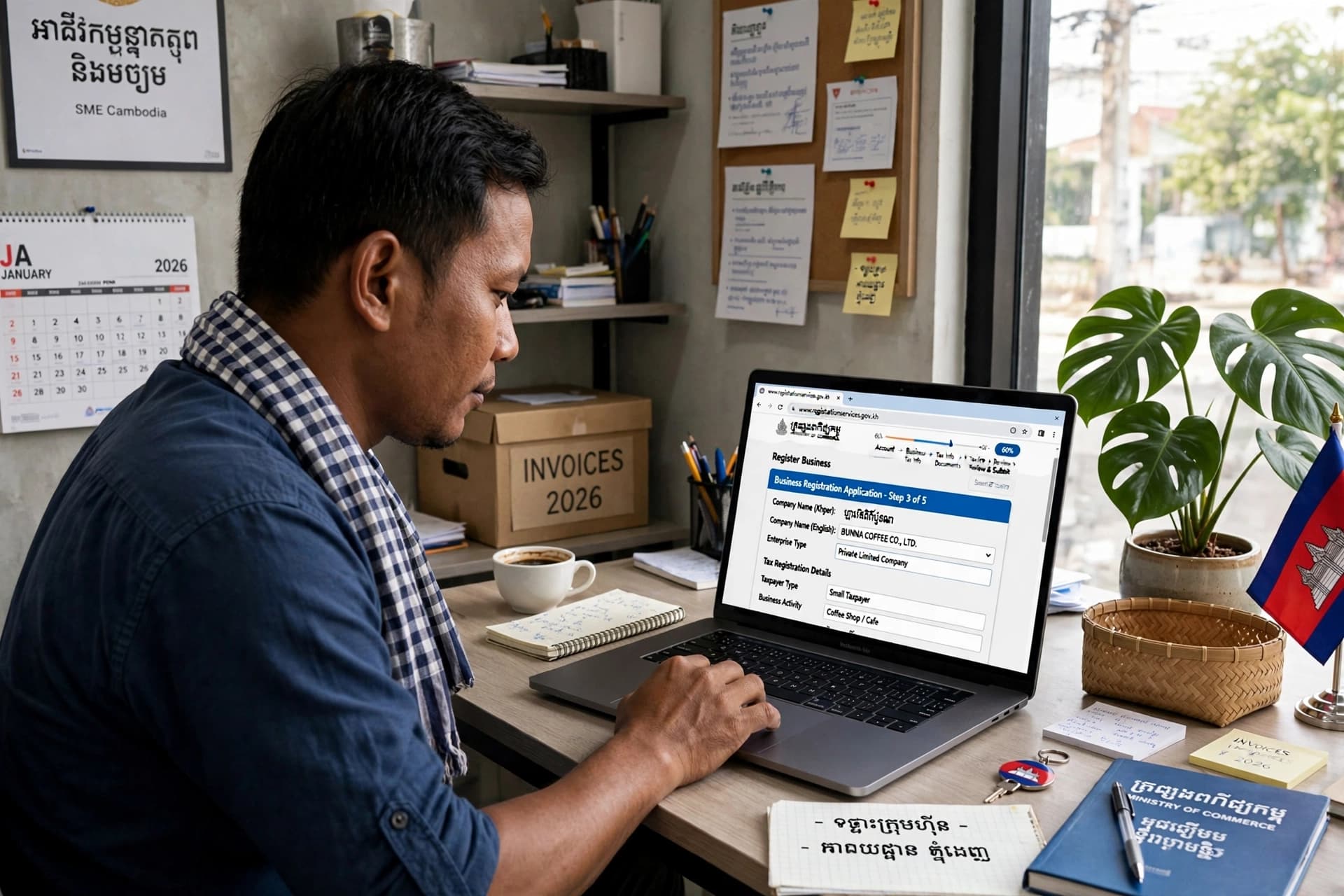
For a small business owner, the beginning of a company can sometimes feel like a journey through several doors. Registration, taxation, labour requirements, licensing, and other administrative matters may involve different institutions. Cambodia is now trying to bring more of those doors together through a shared digital system.
The Digital Economy and Business Committee is targeting the full integration of fundamental services for micro, small and medium-sized enterprises into the Cambodia Data Exchange, or CamDX, by the end of September 2026. The plan was reviewed during a working group meeting involving government ministries and institutions.
CamDX functions as a national digital infrastructure connecting government systems and participating private institutions. One of its important applications is an online business registration platform that combines several relevant information systems through a single portal.
The system currently connects 32 public-sector members and 55 private institutions. Among the participating government bodies are the Ministry of Commerce, General Department of Taxation, Ministry of Labour and Vocational Training, Ministry of Land Management, Urban Planning and Construction, Ministry of Tourism, and Ministry of Agriculture, Forestry and Fisheries.
The integration is particularly relevant to smaller enterprises because administrative procedures can consume time and resources that are limited for young businesses. By connecting services through one digital ecosystem, the government is seeking to reduce the need for businesses to repeatedly interact with separate systems.
The scale of CamDX has also grown considerably since its launch. The platform surpassed 117 million transactions in June 2026 and supports systems including E-Services for Business, E-Invoicing, Social Protection, and the General Department of Customs and Excise system.
Further integration is being considered beyond business services. Cambodia’s Ministry of Interior is seeking to enable identity-card information to be verified through CamDX, while the Council for the Development of Cambodia has proposed connecting investment data with company-registration information.
Those connections point toward a broader digital-government structure in which information held by one institution can, where authorised, be used by another without requiring the same information to be repeatedly entered. Such systems also place greater importance on data security, accuracy, access controls, and institutional coordination.
The current initiative builds on earlier efforts to simplify business registration through CamDX. In August, an inter-ministerial working group had already been working on priority services for MSMEs, with the September deadline established for initial integration.
As the end of September approaches, the focus is moving from planning toward implementation. Full technical integration will be only one part of the process; the practical experience for businesses will also depend on whether the connected services are reliable, accessible, secure, and easy to navigate.
For Cambodia’s growing digital economy, CamDX is gradually becoming more than a platform for exchanging information. It is becoming part of the infrastructure through which businesses and government institutions interact, bringing administrative processes closer to the digital environment in which modern enterprises increasingly operate.
Image Disclaimer:
The accompanying visuals are AI-generated conceptual illustrations and are not real photographs of the facilities or digital systems described.
Sources:
Vietstock Angkor Times Accounting and Auditing Regulator of Cambodia Cambodia Data Exchange
Published by Banx Network. This article is part of the Banx decentralized media programme, powered by the BXE token on the XRP Ledger.