The pace of artificial intelligence has begun to resemble a road that keeps extending beyond the horizon. Each new system opens another possibility, while the questions surrounding safety, control, and responsibility follow close behind. This week, Singapore joined a group of countries seeking to give that rapidly changing landscape a more common set of boundaries.
Singapore joined the European Union and 19 other countries in a joint call for stronger international control and oversight of frontier artificial intelligence models. The declaration, issued during the United Nations General Assembly period, calls for countries to develop standards, verification methods, and stronger international mechanisms for AI safety.
The statement reflects a growing recognition that advanced AI systems do not remain neatly within national borders. Models can be developed in one country, operated through infrastructure in another, and used by people thousands of miles away. The declaration therefore places international cooperation at the center of its approach to managing emerging risks.
Singapore’s participation gives the discussion a particular regional dimension. It is the only Southeast Asian country included among the signatories to the joint declaration, alongside countries including Australia, Canada, Germany, Japan, South Africa, Türkiye, and the United Arab Emirates, as well as the European Union.
The declaration does not call for stopping the development of frontier AI. Instead, it emphasizes mechanisms that could help governments and companies understand and evaluate increasingly capable systems. Among the proposals are common standards, reporting methods for serious AI safety incidents, and improved access to scientific expertise and evaluation capacity across countries.
Companies are also addressed in the declaration. The participating countries call for stronger safety protocols, testing before deployment, and independent evaluations conducted by qualified experts with sufficient access to systems. The intention is to make safety assessment part of the development process rather than something considered only after a system is already widely used.
For Singapore, the discussion sits alongside its broader effort to use artificial intelligence as part of economic and technological development. Prime Minister Lawrence Wong said Singapore wants to harness AI for the benefit of the country and its people, while emphasizing that risks crossing national borders require cooperation beyond any single government.
The declaration also proposes exploring an international institution that could help establish standards and verification while bringing countries together when AI systems reach certain capability thresholds. It remains open to further endorsements, leaving the framework as an evolving international conversation rather than a finished global system.
For now, the movement around frontier AI continues along two parallel paths: rapid technological development and the slower work of building common safeguards. Singapore’s latest participation places it within that international effort, as governments, researchers, and technology companies continue discussing how advanced AI can develop while remaining subject to human direction and oversight.
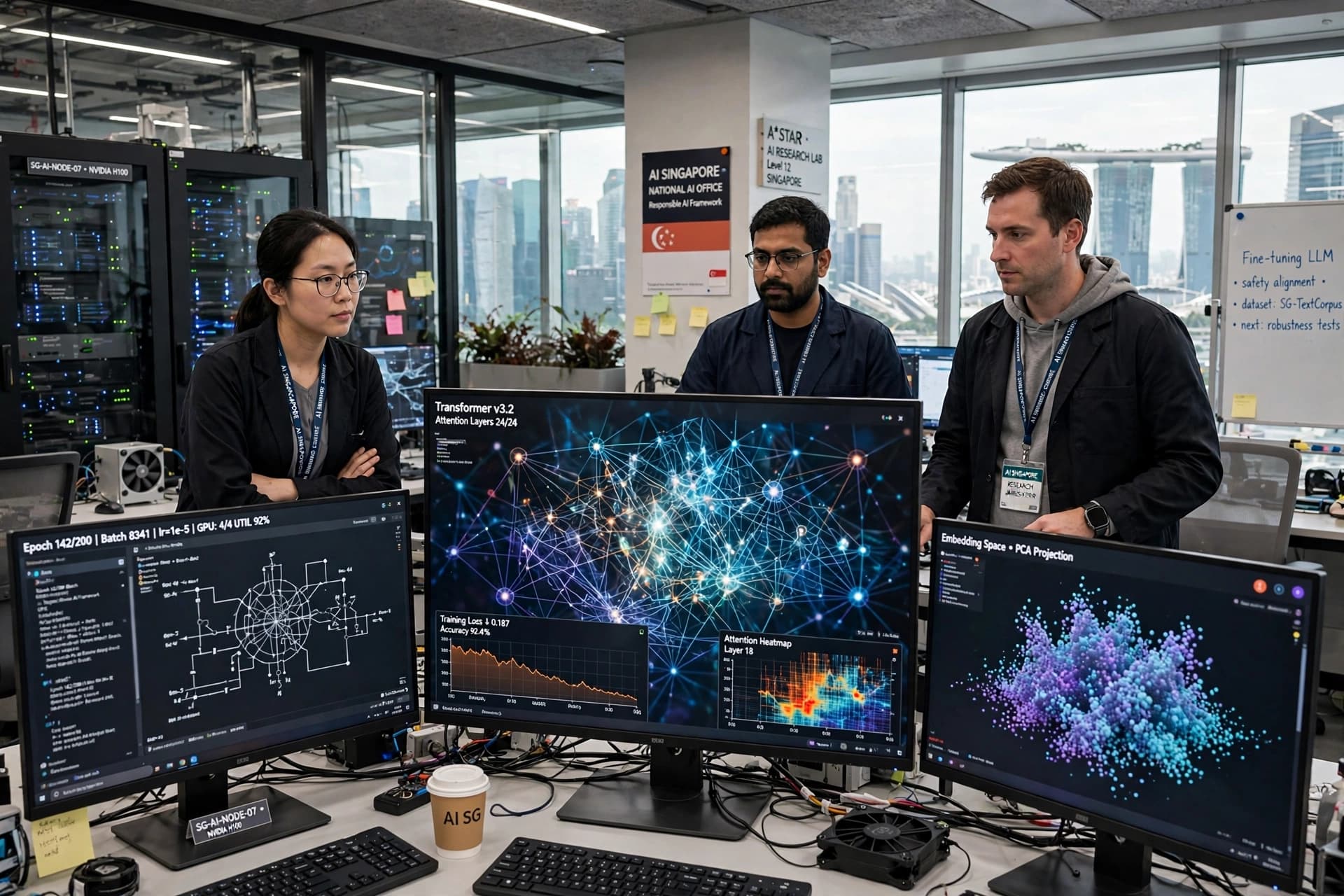
Image Disclaimer The accompanying visuals are AI-generated illustrations created to represent the reported subject and are not real-world photographs.
Sources The Straits Times Channel NewsAsia AsiaOne The Jakarta Post
Published by Banx Network. This article is part of the Banx decentralized media programme, powered by the BXE token on the XRP Ledger.