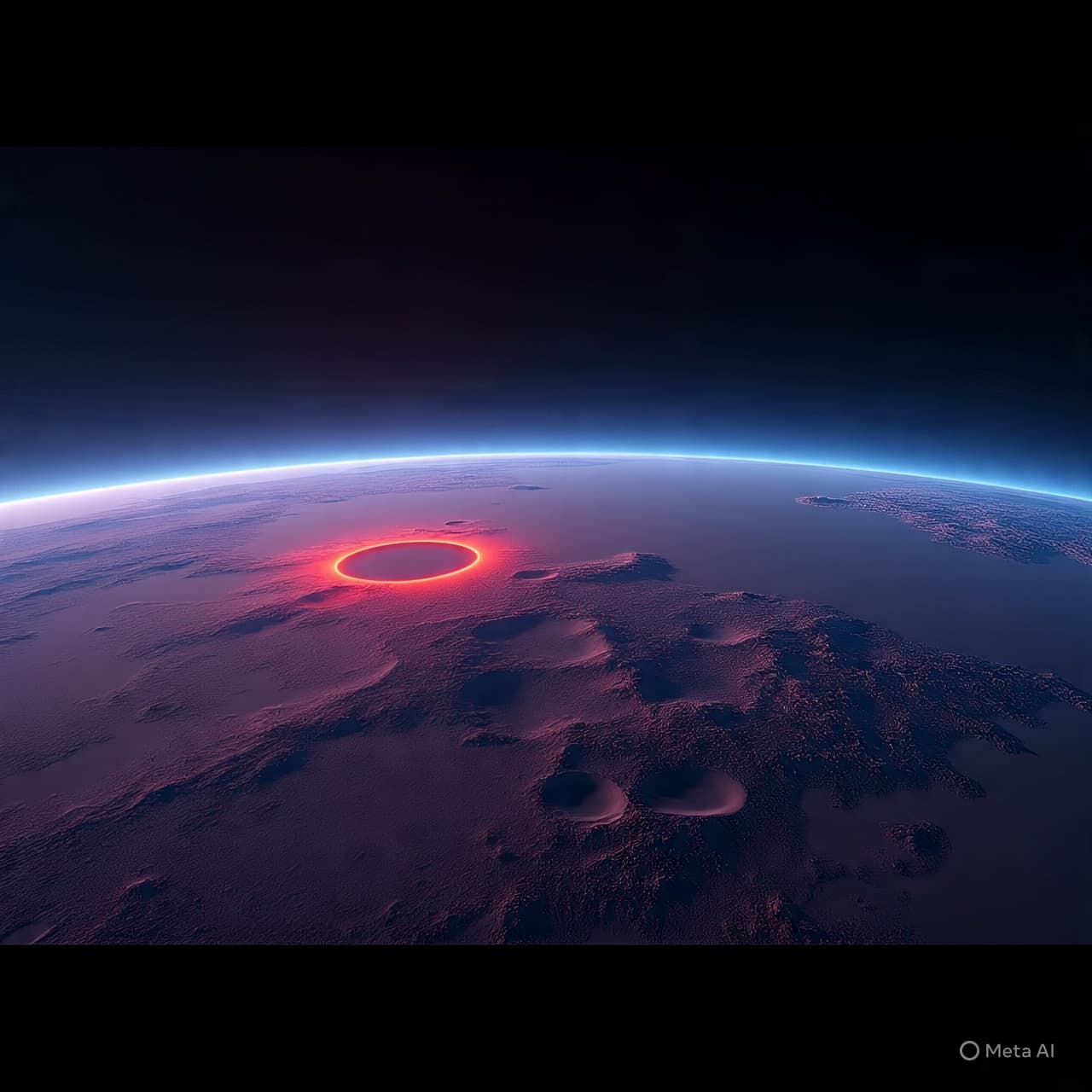
The night sky has long held Venus as a luminous enigma, glowing like a distant lantern beyond Earth’s reach. Shielded by clouds thick as dreams and hostile as truth, Venus has resisted clear sight for generations. In this shroud of cloud and mystery, scientists now claim to have found a silent tunnel — a corridor carved by ancient volcanic fire deep beneath that otherworldly surface, a hollow witness to the restless geological heartbeat of our closest planetary neighbor.
For decades, Venus was understood only by its surface and its smothering atmosphere, both impenetrable to ordinary observation. Yet, like listening for music behind a locked door, researchers learned to interpret the faint echoes of radar waves bounced from the planet. Among the corpus of radar archives left by NASA’s Magellan spacecraft from the early 1990s, a particular landscape called Nyx Mons began to tell a quiet story — one of subterranean corridors buried by time.
Imagine cooling lava on Earth, where its outer skin hardens while molten fire flows on within, eventually leaving behind a hollow tract. These natural passageways, known as lava tubes, have been seen on our Moon and on Mars. Yet until now, such features on Venus were purely theoretical, hinted by surface traces but unseen beneath the infernal skies.
By applying advanced imaging techniques to Magellan’s synthetic aperture radar data, scientists from the University of Trento have identified signatures of a large underground cavity — roughly a kilometer wide and hundreds of meters deep — consistent with a lava tube. The evidence does not peer through Venus’s clouds with light but listens through layers of rock with waves of reflection.
These subterranean halls, if confirmed, would be among the largest volcanic conduits discovered in our solar system. Their dimensions suggest a world that once nurtured rivers of molten rock on a grand scale, etched into its very skeleton by fire and time.
What once was speculation has now gained weight. The thick atmosphere and lower gravity of Venus may have favored the persistence of such underground structures, allowing hollow channels to stand where on Earth they might crumble.
But these findings do more than map a hidden duct within Venusian stone. They breathe fresh curiosity into the narrative of Venus’s geological evolution. If the planet’s surface bears testament to ancient flows, then these hidden caves might preserve the unspoken history of how Venus evolved and cooled, resisting the harsh conditions imposed upon it by gravity and greenhouse fire.
Radars and new missions may, in the years ahead, open further windows into Venus’s depths. Space agencies across the world look toward upcoming orbiters equipped with next-generation radar sounders that promise to chart beneath the surface — perhaps even extending the mapped reach of these lava conduits.
Thus, beneath the silvery glare that graces our dawns and dusks, there may lie more than mere rock and fog. There may be corridors that once channeled the planet’s fiery breath, layered in silence beneath the rumble of storms and the sweep of clouds. In that quiet refuge, Venus whispers a story of how other worlds evolve — and how much we have yet to hear.
In this first glimpse beneath its surface, Venus may still keep many secrets, but the discovery of such subterranean architecture marks a step deeper into its silent heart.
AI Image Disclaimer “Visuals are created with AI tools and are not real photographs.”
Source Check (5 credible media sources):
Reuters Phys.org Sci.News SpaceDaily OpenAccessGovernment
Published by Banx Network. This article is part of the Banx decentralized media programme, powered by the BXE token on the XRP Ledger.