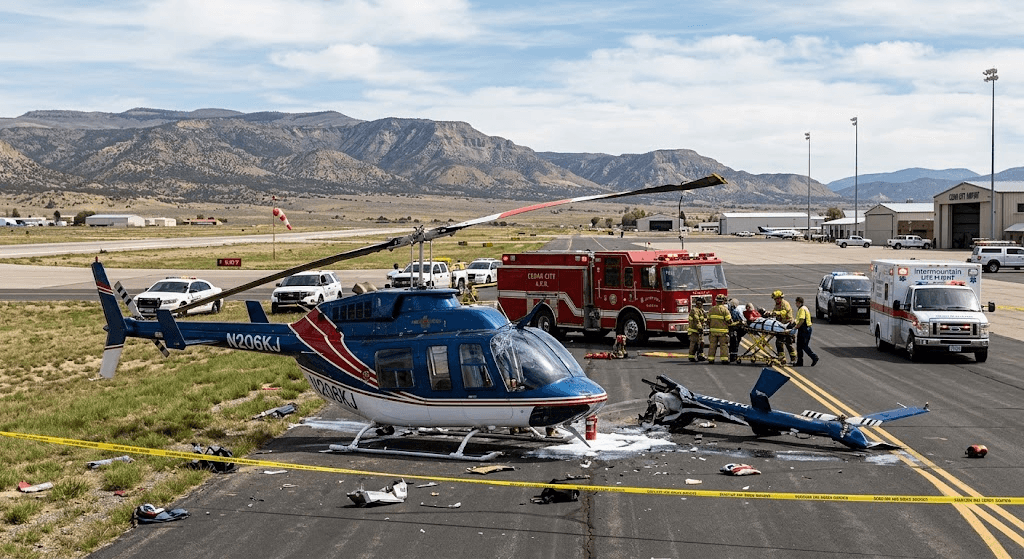
CEDAR CITY, Utah — A training flight turned critical when a Bell 206-L4 helicopter suffered a sudden loss of control during low-altitude hover maneuvers, crashing violently onto an active airport taxiway. The dynamic hard landing separated key structural components of the aircraft and left both crew members injured.
The incident occurred during routine flight instruction at the airfield. While attempting to adjust the engine governor reference RPM during a station hover, the flight crew encountered an uncommanded attitude deviation. Airport surveillance footage captured the helicopter drifting backward and descending rapidly before contacting the taxiway surface. The aircraft bounced, entered an uncontrollable rightward spin, and struck the pavement a second time, severing its tail boom and main rotor assembly upon impact.
Airport emergency services and regional first responders deployed immediately to the crash site, establishing a safety cordon around the damaged fuselage. Fire crews secured the area to mitigate potential fuel leaks and fire hazards stemming from the ruptured airframe.
Paramedics evaluated the two occupants—a certified flight instructor and a student pilot—at the scene. Both individuals sustained minor injuries and received medical treatment. Ground crews successfully isolated aviation fuel spills and cleared scattered debris, allowing airfield operations outside the immediate crash zone to safely resume.
Federal aviation safety investigators from the National Transportation Safety Board (NTSB) and Federal Aviation Administration (FAA) launched a forensic inquiry into the sequence leading to the loss of control. Investigators are reviewing airport surveillance video, flight control inputs, and engine performance metrics to establish whether mechanical malfunction or human factors initiated the instability.
Preliminary assessments indicate no pre-accident mechanical failures were reported prior to the hover maneuver. Physical examination of the severed main rotor, tail rotor driveshaft, and flight control linkage remains underway to verify full system integrity prior to impact.
Following the accident, aviation safety authorities and flight instruction institutions announced reviews into low-altitude hover procedures and cockpit ergonomics during manual engine adjustments. Regulatory bodies reiterated guidelines regarding pilot workload distribution during critical flight phases, advocating for enhanced simulator-based training on governor manipulation and rapid recovery protocols for low-hover loss-of-control scenarios.
Published by Banx Network. This article is part of the Banx decentralized media programme, powered by the BXE token on the XRP Ledger.