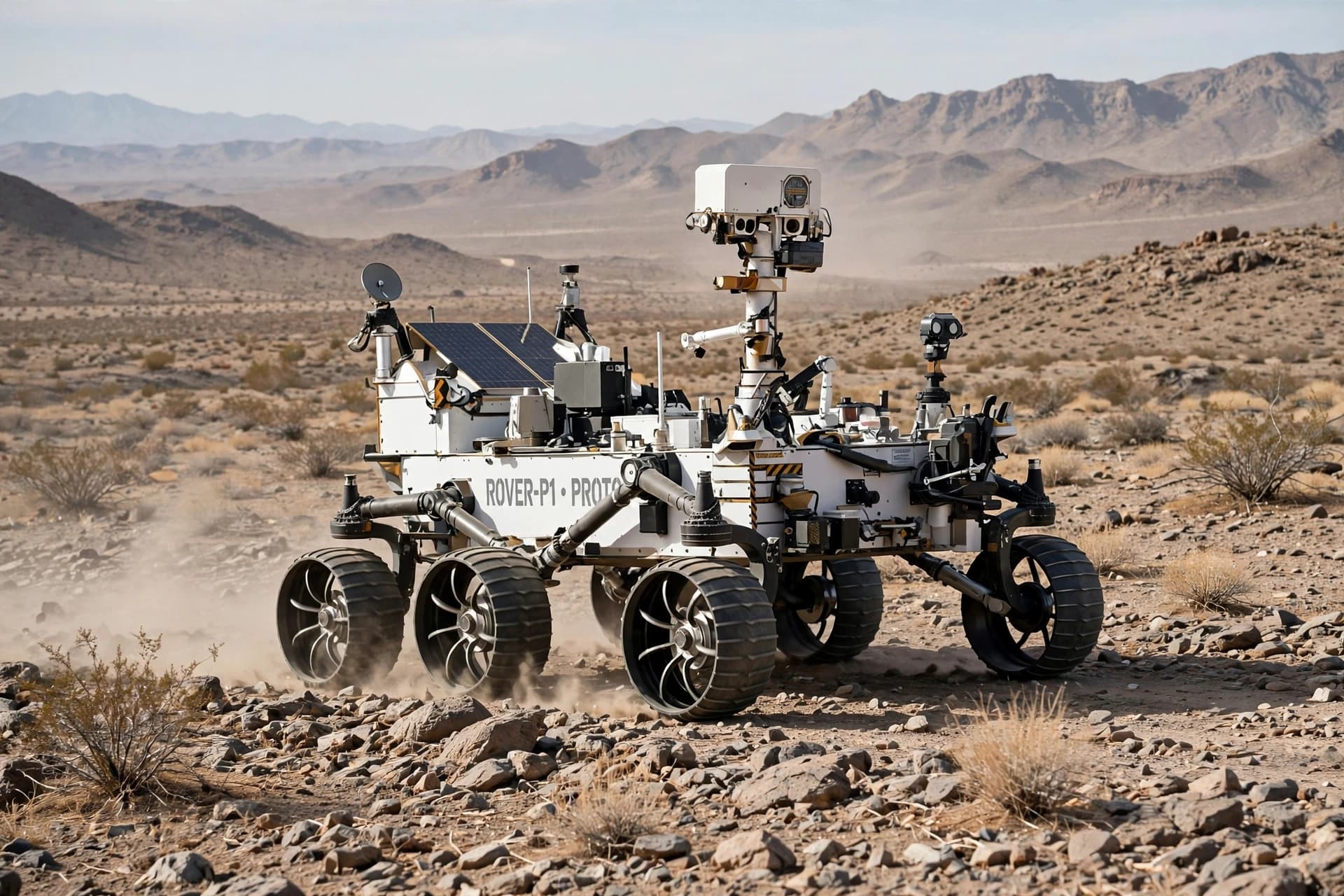
In the Tabernas desert of southern Spain, where the earth is baked to a pale ochre and the wind has carved the land into shapes that feel borrowed from another world, a six-wheeled machine moves slowly across the dust. It is called Charlie, and it is not on Mars—not yet—but for the engineers and scientists watching from a control center in Turin, Italy, the distinction between simulation and reality has begun to blur in productive ways. The European Space Agency, together with Airbus and European research partners, has spent weeks putting a prototype of the Rosalind Franklin rover through its paces in this arid corner of Andalusia, testing the autonomous navigation systems that will one day guide the real rover across the surface of the Red Planet .
The choice of location is deliberate. Tabernas, with its barren terrain, soft clay soils, and extreme dryness, bears a striking resemblance to Oxia Planum, the region near the Martian equator where Rosalind Franklin is expected to land in 2030 . Professor Susanne Schwenzer, a planetary mineralogist at the Open University and field geologist for the ExoMars tests, explained that the layered terrain of the Spanish desert mirrors the geological structure of the landing site, where older layers lie beneath younger ones, preserving a record of ancient water and, perhaps, ancient life . The visual similarity is so pronounced that one visiting journalist confessed to momentarily forgetting they were still on Earth .
The trials are not merely about testing hardware. They are about training the people who will operate the rover from a distance of 140 million miles, where a signal takes anywhere from four to forty-five minutes to travel in each direction . Real-time control is impossible under such conditions. Instead, the rover must be capable of navigating autonomously between predetermined points, covering distances of sixty to seventy meters per day across terrain that operators may not be able to see in advance . Vincent Schaeffer, a team leader at Airbus Defence and Space, described the objective succinctly: the rover is designed “to travel long distances safely rather than quickly” .
The scientific ambition of the Rosalind Franklin mission is considerable. Unlike previous rovers that have scratched only a few inches into the Martian surface, Rosalind Franklin will drill approximately two meters below ground, far enough to reach material shielded from the sterilizing radiation that has bombarded Mars for billions of years . At that depth, scientists hope to find organic molecules—biomarkers that could indicate whether life ever existed on the planet. The rover carries a suite of instruments, including a panoramic camera developed by University College London and an infrared spectrometer from Aberystwyth University, along with a ground-penetrating radar called WISDOM that peers beneath the surface to identify suitable drilling sites .
The implications of finding life on Mars would extend far beyond the Red Planet itself. Schwenzer raised the possibility of panspermia—the idea that life could have traveled between Earth and Mars, perhaps carried on meteorites during the late heavy bombardment some four billion years ago, when both planets were habitable and asteroids were striking them with regularity . If life emerged independently on Mars, it would suggest that life is a common outcome of planetary conditions rather than a singular accident. If it shared a common origin with Earth’s life, the implications would be equally profound. As Schwenzer put it, “Finding life would be an amazingly big deal. It’s almost frightening to think about it, because it changes everything” .
The road to this moment has not been smooth. Originally planned for launch in the early 2020s, the ExoMars mission was delayed first by the COVID-19 pandemic and then by the Russian invasion of Ukraine, which necessitated the replacement of Russian components . The rover represents more than a decade of preparation and an investment of nearly one billion pounds . The prototype Charlie, built with cheaper parts that can be repaired or replaced, serves as an emulation of the real rover, which sits in an ultra-clean room in Turin, awaiting its journey . For the teams involved, the pressure to succeed is considerable, and the margin for error is effectively zero.
The field trials in Tabernas are scheduled to conclude in early October, after which the data collected will inform the final preparations for the 2028 launch . The rover will then begin its long transit to Mars, arriving in 2030 to begin a mission that could answer one of humanity’s oldest and most persistent questions. For now, Charlie continues its slow circuits through the Spanish dust, a rehearsal for a performance that will take place on a stage no human has ever visited, in search of a truth that has eluded us since we first looked up at the red light in the night sky and wondered.
AI Image Disclaimer: All images in this article are AI-generated illustrations and do not depict actual events or equipment.
Sources: European Space Agency, Reuters, Daily Mail, Yahoo News, AnewZ, La Vanguardia
Published by Banx Network. This article is part of the Banx decentralized media programme, powered by the BXE token on the XRP Ledger.