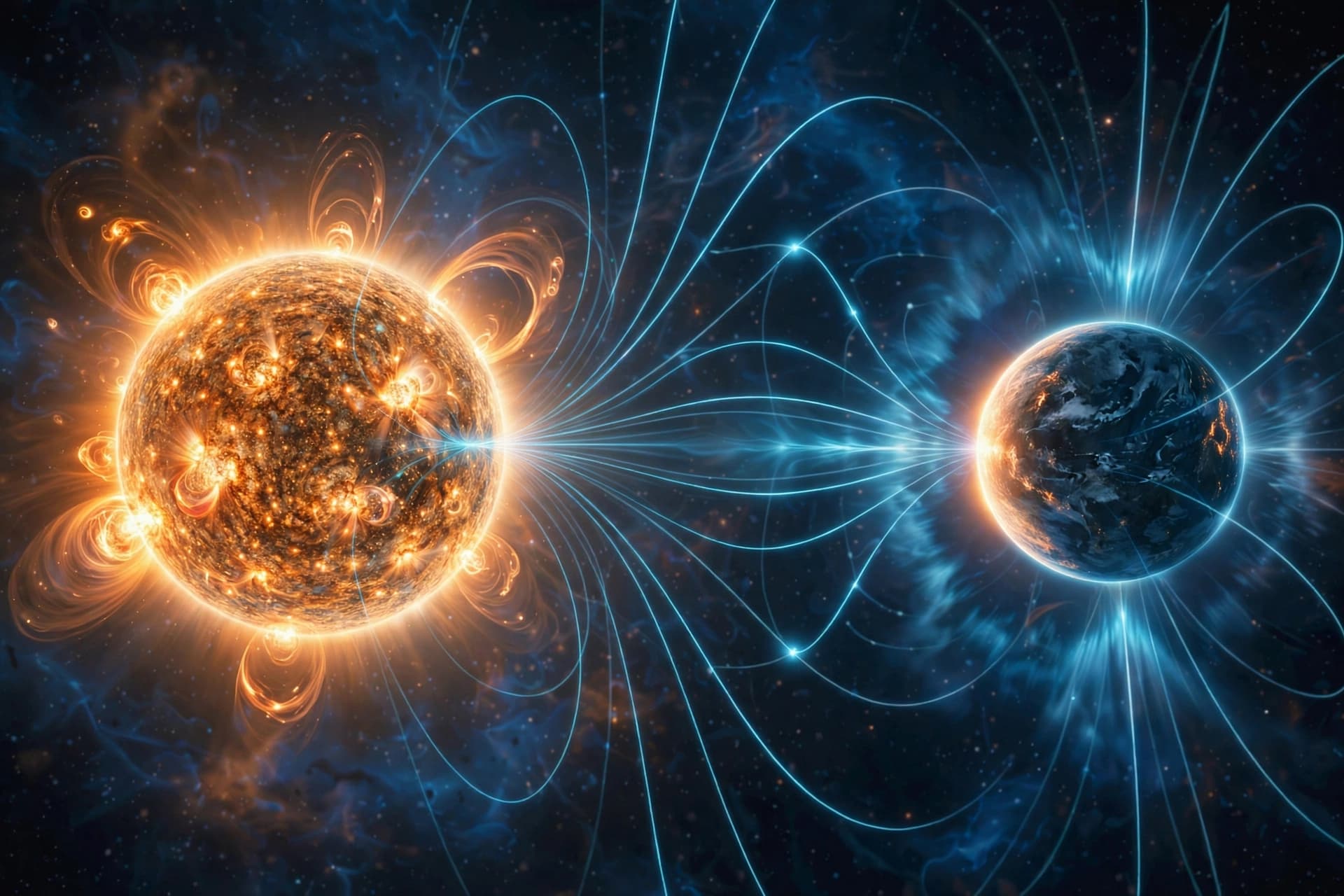
In the colossal silence of the cosmos, where time seems to stretch like wind through ancient trees, two city-sized neutron stars pirouette ever closer. Their dance is unseen by human eyes but etched into the fabric of space and time. In the last moments before their embrace, a tapestry of invisible forces begins to weave itself—threads of magnetic energy twisting, reconnecting, and surging like currents in an ocean of light. These tangled magnetospheres, invisible yet potent, are the focus of new research that invites us to listen more deeply to the universe’s hidden harmonies.
At NASA’s Goddard Space Flight Center, scientists have spent countless hours with the Pleiades supercomputer exploring what happens in those last breaths before neutron stars merge. What once seemed like a theoretical swirl of magnetism has been rendered into vivid simulation, revealing structures far more complex than a static field around a lone star. Here, two magnetospheres begin to intertwine, break apart, and reconnect in a dynamic choreography that could reshape how we interpret cosmic signals.
These simulations are more than abstract beauty—they suggest that as neutron stars draw closer, they might release X-rays and medium-energy gamma rays in the moments before collision. If future observatories can catch these pre-merger flashes, they may offer an early warning of the dramatic climax that follows.
The final coalescence is itself a spectacle: two dense stellar remnants spiraling inward under gravity’s inexorable pull, unleashing gravitational waves and producing a short gamma-ray burst, one of the universe’s most powerful explosions. This event can also forge a kilonova, a transient blaze radiating thousands of times more brightly than a classical nova, and disperse heavy elements like gold and platinum into space.
Yet there are more quiet whispers in this cosmic finale. Astronomers are beginning to identify new ways that neutron star mergers might signal their coming, such as unique X-ray flares that could accompany the intertwined magnetic fields in their final orbits.
As our instruments grow ever more sensitive and our observational networks more coordinated, the tangled magnetospheres and their fleeting radiance may offer a richer language with which to understand these extraordinary astrophysical events. In listening to these whispers of light and magnetism, we are reminded of the deep, resonant connections that bind all phenomena—from the vastness of the cosmos to our own quiet curiosity.
AI Image Disclaimer (Rotated) Visuals are created with AI tools and are not real photographs.
Sources NASA Science – NASA Researchers Probe Tangled Magnetospheres of Merging Neutron Stars NASA SVS – NASA Supercomputer Probes Tangled Magnetospheres of Merging Neutron Stars NASA – Breakthrough Study Confirms Cause of Short Gamma-Ray Bursts NASA Science – Neutron Star Collision Creates Kilonova NASA – A New Signal for a Neutron Star Collision Discovered
Published by Banx Network. This article is part of the Banx decentralized media programme, powered by the BXE token on the XRP Ledger.