There is a quiet but firm truth that has been spoken in Quebec for generations, one that refuses to be buried beneath the noise of election campaigns and referendum debates. When a province speaks of leaving a country, it speaks as though the land itself belongs to the conversation. But the land has its own memory, and its own peoples, and they have not been asked. That is the reminder Indigenous leaders are offering as Quebec moves toward another possible referendum on sovereignty.
"Quebec can't unilaterally just say that they're leaving, there are historical land grievances, there's traditional territories that we need to talk about," said Mohawk Council of Kahnawà:ke Grand Chief Cody Diabo . He argues that a referendum is out of the question, pointing to the fact that much of the province's territory belongs to First Nations. "The lines that are on the map right now, those lines were imposed by the Crown and then the federal government—First Nations weren't included in that" .
The legal framework supports this position. A 1998 Supreme Court of Canada ruling barred Quebec from unilaterally splitting from Canada. Paired with existing constitutional law, that decision means the province cannot legally separate without involving and consulting First Nations and Inuit communities . Nadir André, an Aboriginal and Natural Resources lawyer based in Kahnawà:ke, noted that even in 1995—when the last referendum was defeated by a razor-thin margin—many First Nations and Inuit communities were against separation. What has changed since then, he argues, is the legal reality and the growth of international frameworks like the United Nations Declaration on the Rights of Indigenous Peoples .
For Francis Verreault-Paul, chief of the Assembly of First Nations Quebec-Labrador, it is too early to be for or against a referendum. But he has questions that must be answered first. "How are we going to really work on this together? How is the National Assembly in Quebec going to recognize us First Nations as governments?" . He wants to ensure First Nations rights are respected, to see UNDRIP fully implemented, and to advance issues that impact communities—housing, infrastructure, public safety, education, and self-determination .
The Parti Québécois has taken steps to engage. In May, Paul St-Pierre Plamondon consulted with Verreault-Paul and more than 40 chiefs on his Livre bleu, a 500-page document outlining steps to create an independent Quebec. Each chief was asked to give feedback on a dedicated chapter addressing Indigenous relations . Verreault-Paul called it a good first step, praising the PQ leader for being "transparent and clear," but said more consultations would be needed at every stage . Still, the Mohawk Council of Kahnawà:ke formally rejected the Blue Book, citing the absence of consultation with Kahnawà:ke and the failure to uphold UNDRIP .
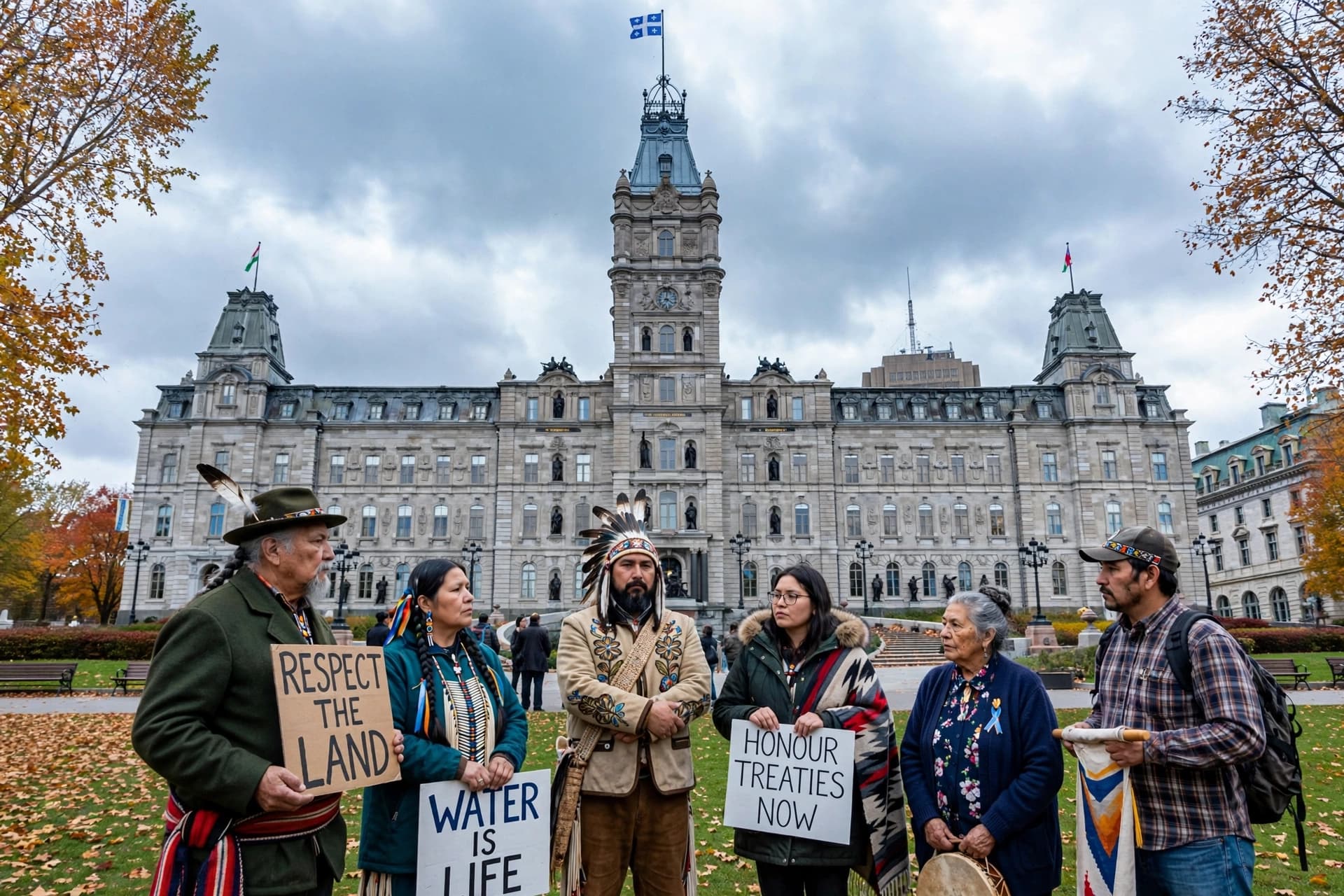
The conversation is not abstract. As the National Day for Truth and Reconciliation approached, First Nations leaders gathered in front of the National Assembly to deliver a message to all parties: "The future of Quebec will not be built against us, nor without us" . Anishnabe Chief Lucien Wabanonik put it plainly: "There will be no access to the territory without the free and informed consent of our nations and our peoples" . For a province contemplating its own sovereignty, the question of whose land it stands on is not a detail to be set aside. It is the ground itself.
AI Image Disclaimer: The accompanying images in this report were created with artificial intelligence and are intended for conceptual representation only.
Sources: CBC News, Radio-Canada, Le Devoir, Mohawk Council of Kahnawà:ke, Yahoo News Canada
Published by Banx Network. This article is part of the Banx decentralized media programme, powered by the BXE token on the XRP Ledger.