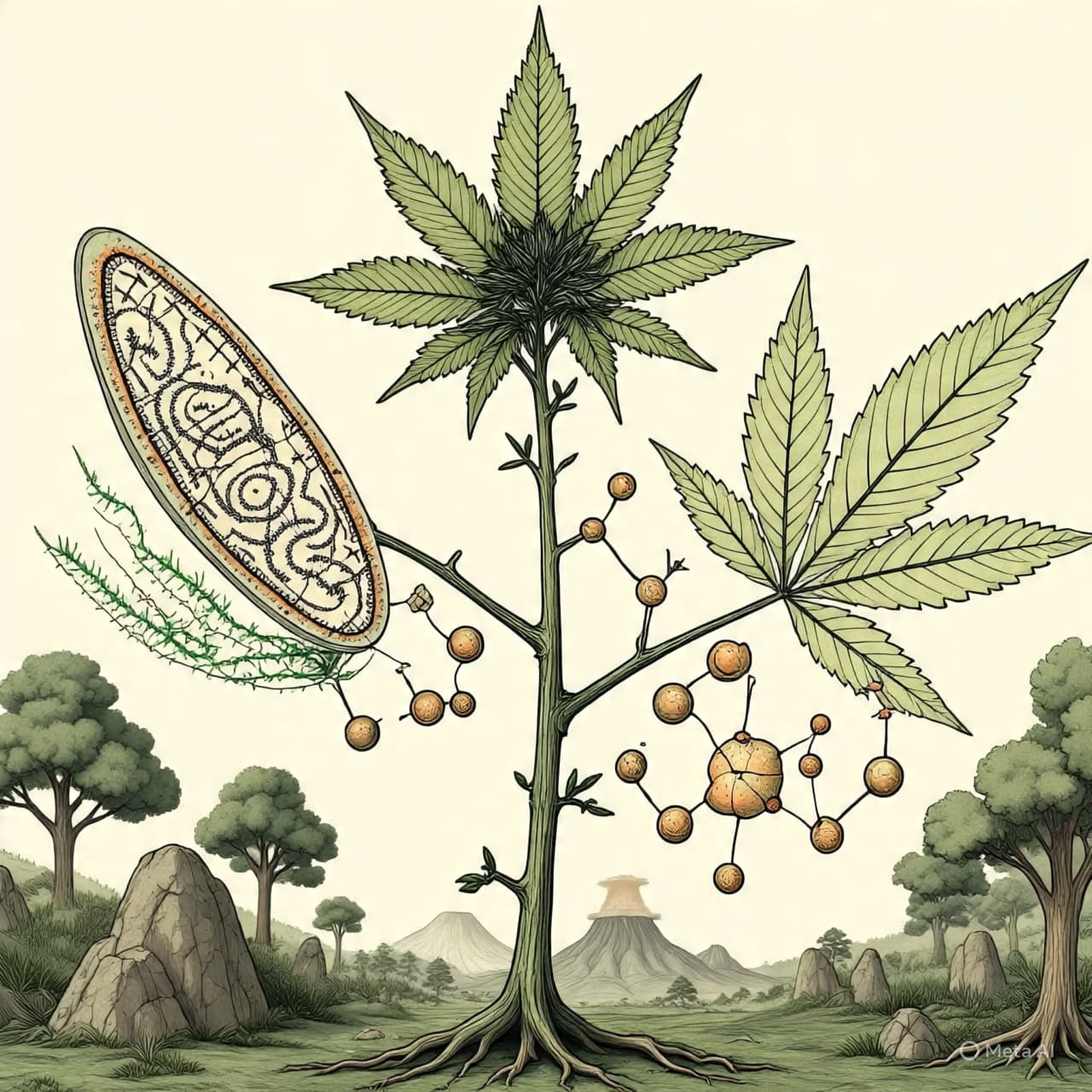
Long before laboratories learned to isolate molecules and give them precise names, a quiet conversation was already unfolding between a plant and its surroundings. Cannabis, rooted in ancient soils, did not set out to intoxicate or heal; it simply responded, season after season, to light, stress, and survival. Like ink slowly spreading through parchment, its chemistry deepened over time, not by intention but by adaptation. What we now call cannabinoids were once just subtle variations in a living system, shaped by pressure rather than design.
Scientific research tracing the evolutionary history of cannabis suggests that its ability to produce cannabinoids emerged gradually, intertwined with environmental challenges. Early ancestors of the plant likely produced simpler chemical compounds, common among many flowering plants, used to deter pests or manage ultraviolet exposure. Over millions of years, genetic shifts refined these pathways, allowing cannabis to synthesize more specialized molecules. Cannabinoids, in this view, are not anomalies but echoes of an ancient botanical dialogue with climate, predators, and geography.
Studies examining cannabis genomes reveal that key enzymes responsible for cannabinoid production evolved through duplication and modification of existing genes. This process, common in plant evolution, allowed cannabis to experiment chemically without abandoning its core biological functions. As certain compounds proved advantageous perhaps discouraging herbivores or protecting reproductive tissues they were preserved and enhanced. What appears today as a complex chemical signature is, at heart, a record of small evolutionary bets that paid off.
Researchers also note that cannabinoids likely did not emerge all at once or for a single purpose. Different compounds may have served different roles depending on where cannabis grew. In harsher, sunnier regions, chemical protection from radiation may have mattered most. In others, bitterness or toxicity could have discouraged animals from feeding too freely. Over time, these varied pressures shaped a versatile chemical toolkit rather than a single defining trait.
Modern human use of cannabis, whether medicinal or recreational, arrived very late in this story. Humans did not invent cannabinoids; they recognized and repurposed them. Selective breeding amplified certain traits, increasing concentrations of compounds that once appeared only in modest amounts. Yet beneath modern cultivation lies the same evolutionary framework, one that predates agriculture and pharmacology by vast stretches of time.
Understanding how cannabis developed its chemical abilities also reframes current debates around the plant. It reminds us that cannabinoids are not artificial intrusions into nature, but natural outcomes of evolutionary processes shared by many species. Cannabis simply followed its own path, guided by pressure rather than preference, chemistry rather than culture.
Today, as research continues to map the plant’s genetic and biochemical history, the story grows clearer but not less poetic. Cannabis did not wake one day endowed with cannabinoids; it learned them slowly, through the patient logic of survival. That quiet lesson, written into its genes, is what science is now learning to read.
AI Image Disclaimer Illustrations were produced with AI and serve as conceptual depictions.
Sources Nature Science Proceedings of the National Academy of Sciences Scientific American The Guardian
Published by Banx Network. This article is part of the Banx decentralized media programme, powered by the BXE token on the XRP Ledger.