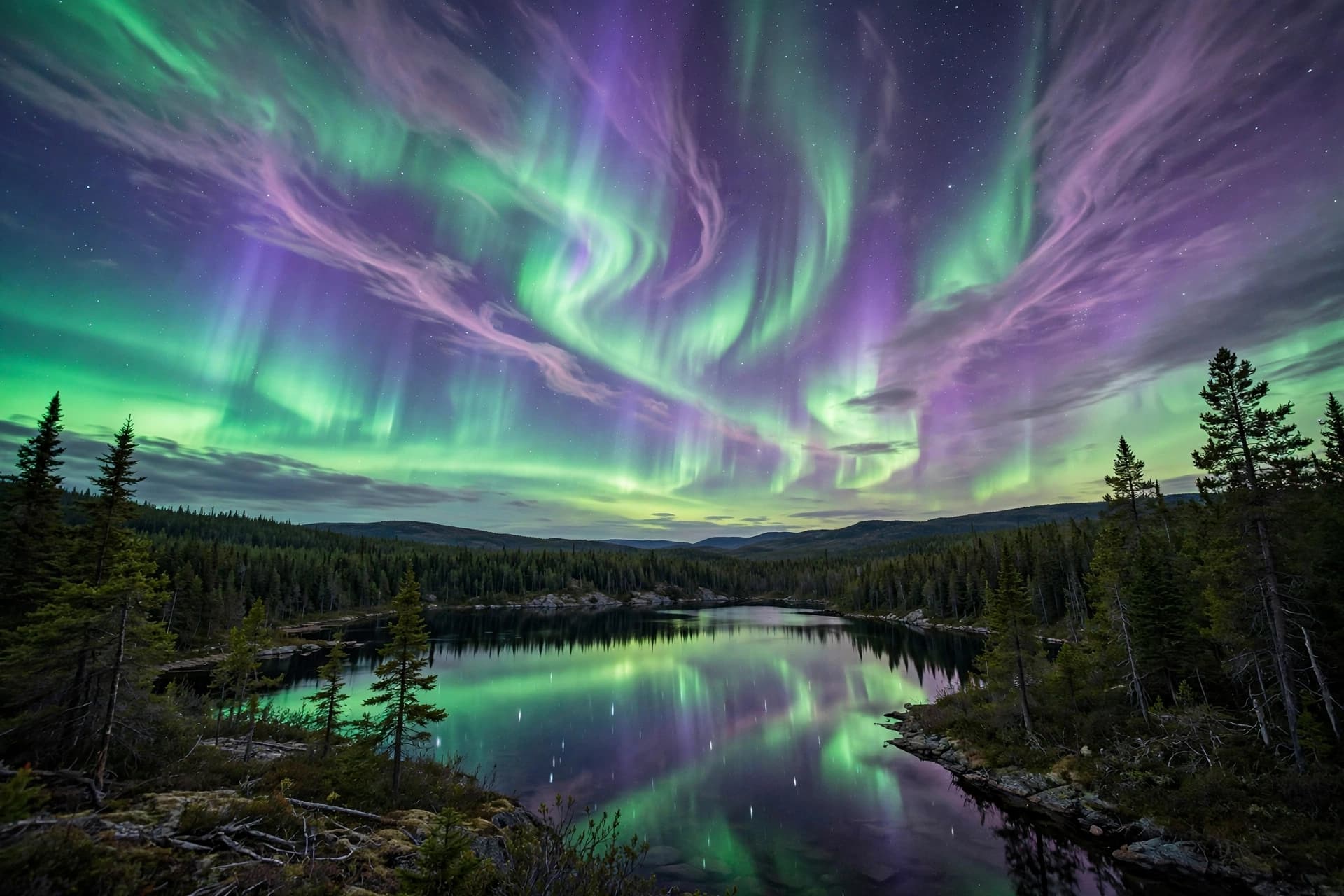
There is a particular wonder in looking up at the night sky and seeing colors that do not belong there—ribbons of green and red and purple, dancing across the darkness, visible in places where they are rarely seen. This weekend, that wonder may be available to millions of people across the northern United States, as multiple solar eruptions send charged particles toward Earth and supercharge the aurora borealis.
The activity began on October 6, when sunspot region AR4549 unleashed an M1.4-class solar flare and an associated coronal mass ejection—a vast cloud of plasma and magnetic field that is now hurtling toward Earth at roughly 560 kilometers per second . A second CME followed, and a third erupted on October 8. The National Oceanic and Atmospheric Administration's Space Weather Prediction Center has issued a G2 geomagnetic storm watch for October 9, with conditions expected to reach moderate levels .
For aurora watchers, the forecast is promising. During G2 storms, the northern lights have been observed as far south as New York and Idaho . Current forecasts suggest the aurora could be visible across northern states including Washington, Idaho, Montana, North Dakota, South Dakota, Minnesota, Wisconsin, Michigan, and Maine, with the possibility of extending into states like Oregon, Wyoming, Nebraska, Iowa, Illinois, Indiana, Ohio, Pennsylvania, and New York if conditions intensify .
The timing of the eruptions is a factor in their favor. The Moon will be below the horizon during peak aurora-watching hours this weekend, meaning darker skies and better viewing conditions . The best windows for observation are typically between 10 p.m. and 2 a.m. local time, though auroral activity can occur at any time during the night.
What makes this event particularly notable is the sequence of eruptions. The first two CMEs, both from October 6, could arrive in relatively quick succession, delivering what space weather physicist Tamitha Skov described as a "one-two punch" to Earth's magnetic field . A third CME, associated with a smaller flare, may deliver a glancing blow around October 10 or 11, potentially prolonging the geomagnetic activity .
Scientists caution that the exact strength of the storm—and how far south the aurora reaches—remains uncertain. Much depends on the magnetic orientation of the incoming CMEs when they arrive. If their magnetic fields are oriented southward, they couple efficiently with Earth's magnetosphere and produce stronger storms. If oriented northward, the effect is weaker . Even an Earth-directed CME does not guarantee a spectacular display.
For those hoping to see the lights, the advice is to get away from city lights, find a spot with a clear view of the northern horizon, and give your eyes time to adjust to the darkness. The aurora may appear as a faint glow at first, or it may burst into bright, moving curtains of color. The eruptions are on their way. The sky, as always, will decide what it shows.
AI Image Disclaimer: All images in this article are AI-generated and are intended for illustrative purposes only.
Sources: NOAA Space Weather Prediction Center, Space.com, BBC Sky at Night Magazine, ABC News
Published by Banx Network. This article is part of the Banx decentralized media programme, powered by the BXE token on the XRP Ledger.

.jpg&w=3840&q=75 "September 2026 Was the Second-Warmest on Record, With Global Temperatures Above 1.5°C for a Second Month")