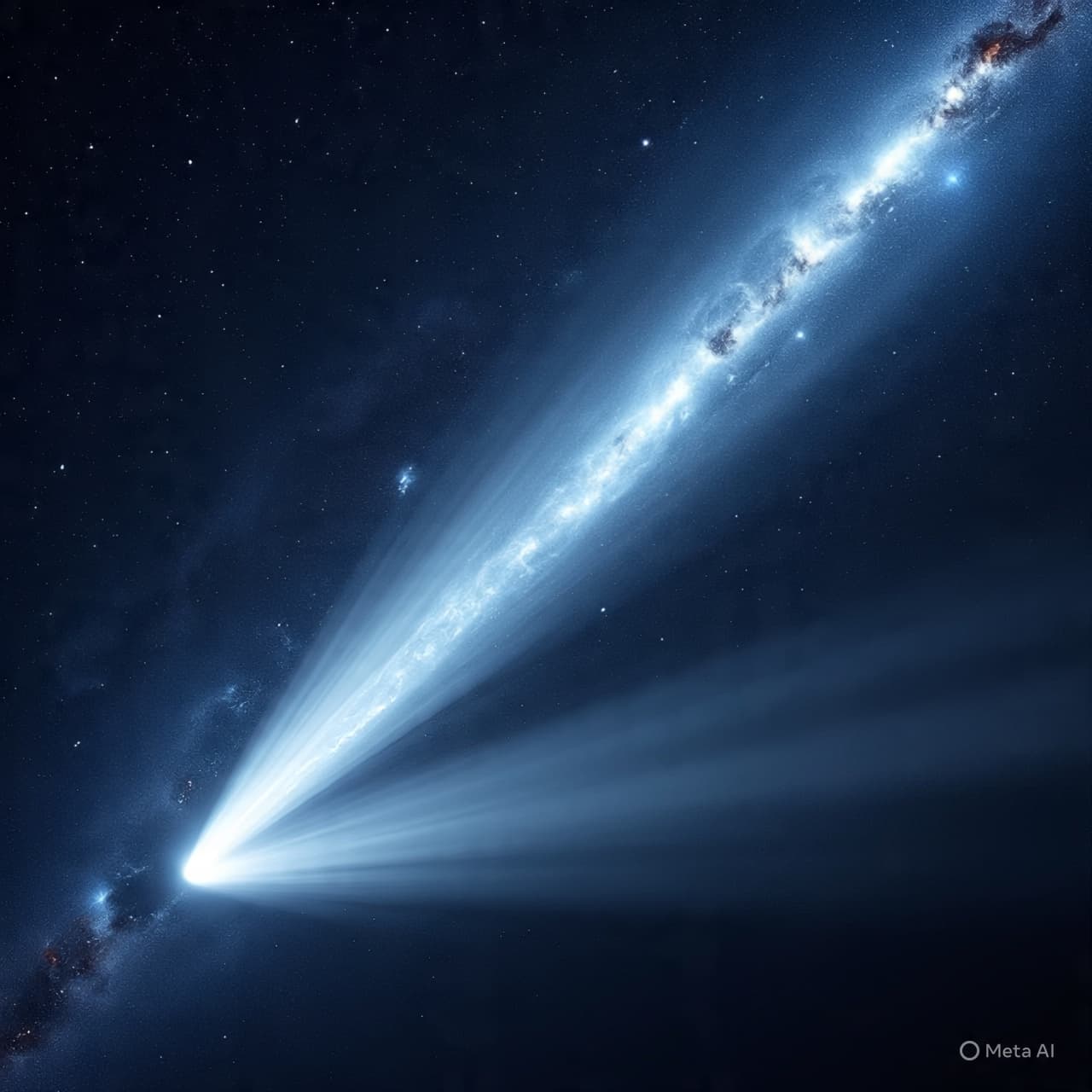
In the quiet hours just before dawn, the sky holds a kind of hush — a soft glow on the horizon, the world still half-asleep, and above it a tiny spark of the unknown. It is in this liminal space that the cosmic visitor known as 3I/ATLAS has begun to appear, a wanderer from far beyond our own star system, offering a subtle but profound invitation: look up, witness a spark of the distant.
This interstellar comet was discovered in July 2025 by the Asteroid Terrestrial‑impact Last Alert System (ATLAS) survey, and has been confirmed as only the third known object to journey into our solar system from another star system. Its path is hyperbolic — meaning it is not bound to our Sun, but simply passing through. Astronomers estimate its closest approach to the Sun occurred around October 30, 2025, at about 1.35–1.4 astronomical units from the Sun, still outside Earth’s orbit. Though it will remain at least over 1.5 times the Earth-Sun distance from us, and thus won’t become naked-eye visible, it presents a rare chance for telescopic observers.
More than just a transient visitor, 3I/ATLAS brings with it clues about environments beyond our solar system. Observations show it began developing a tail and a coma — the dusty, gaseous envelope of a comet — as it warmed by the Sun. Its speed is extraordinary, and its composition hints at foreign origins: one study suggests a surprisingly high ratio of carbon dioxide to water ice, compared with typical solar-system comets.
For sky watchers wishing to spot it, here’s how you might proceed:
Choose a dark location with a clear eastern horizon, before dawn. Use a telescope or a larger binoculars set-up: the comet is faint (magnitude ≈ 12 or dimmer) so a small amateur telescope may struggle. Focus on dates when the object emerges from solar glare — since the comet was near the Sun’s direction in late October, the best viewing window opens in November and December. Track its approximate location using sky charts or online ephemerides, and pay attention to its motion: as an interstellar visitor, it moves relatively quickly compared to stars and background objects. As you gaze into the pre-dawn light, think of this comet not merely as a point of light but as a messenger: a chunk of ice and dust that formed around another star, journeyed through the galaxy, and now sweeps through our neighborhood. It reminds us of the vastness of space, of other star systems we cannot yet visit, and of the fragile window we have to witness such moments.
In the end, 3I/ATLAS will continue on its way, never to return — a one-time visitor that passes by almost unnoticed in human time. But for those who look up gently at dawn, it offers a fleeting connection to the unknown beyond our Sun.
The interstellar comet 3I/ATLAS poses no threat to Earth and will continue on its path outward from our Sun after its brief visit. Scientists are observing it with ground-based and space-based telescopes, gathering data that may reveal insights not only about our solar system but about the formation of planetary systems elsewhere. For now, if you have the means and the patience to scan the pre-dawn sky, you may glimpse a cosmic traveler born in another star system — quietly reminding us of how much there is still to explore.
AI Image Disclaimer Illustrations were produced with AI and serve as conceptual depictions.
Sources NASA (Science blog) Space.com ScienceAlert LiveScience European Space Agency (ESA)
Published by Banx Network. This article is part of the Banx decentralized media programme, powered by the BXE token on the XRP Ledger.