Key Highlights
- Discovery:Astronomers have recovered the exoplanet 51 Eridani b from the glare of its host star.
- Technique:The new method, called FLIP, enhances sensitivity by up to fifteen times.
- Implications:This breakthrough could lead to the discovery of more hidden exoplanets.
[Introduction] Astronomers have made a significant breakthrough in the quest to observe distant planets, successfully recovering the exoplanet 51 Eridani b from the overwhelming glare of its host star using a novel technique known as FLIP (Physics-based Learning for Imaging Planets). This advancement, led by a team from Northwestern University, represents a major leap in our ability to detect and study exoplanets that have previously eluded observation due to the brightness of their stars.
[The Challenge of Observing Exoplanets] Observing planets orbiting other stars poses a unique challenge for astronomers. The brightness of stars can overshadow the light emitted by their orbiting planets, making it nearly impossible to capture clear images. Traditional methods, such as using coronagraphs to block starlight, have limitations that often leave astronomers unable to see these distant worlds. The James Webb Space Telescope (JWST), despite its advanced capabilities, has struggled with this issue, leading to the development of innovative solutions like FLIP.
[The FLIP Technique] FLIP combines physics-based modeling with machine learning to create a digital twin of the JWST. This virtual model simulates how light interacts with the telescope's mirrors and detectors, allowing astronomers to fine-tune the model to account for various imperfections. By subtracting the simulated glare from the actual images, the team achieved a remarkable improvement in sensitivity, making it possible to detect planets that were previously hidden in the starlight.
[Revealing 51 Eridani b] The team applied the FLIP technique to reanalyze JWST observations of the star system 51 Eridani, located approximately 97 light-years away. Previously known to host the giant planet 51 Eridani b, this exoplanet had remained obscured by the star's brightness since its discovery in 2015. With the application of FLIP, astronomers were able to reveal the planet, which is about eleven times the mass of Jupiter, showcasing the potential of this new method to uncover hidden celestial bodies.
[Broader Implications for Exoplanet Research] The implications of this discovery extend beyond just 51 Eridani b. Since the confirmation of the first exoplanets over thirty-five years ago, astronomers have primarily identified larger and hotter planets, often due to the limitations of current observational techniques. The FLIP method opens the door to discovering smaller, Earth-like planets that have been hidden from view, suggesting that many more worlds may exist than we currently know.
[Future Prospects] FLIP is not just a solution for the JWST; it is a software tool that can be applied to existing and future astronomical data without the need for new hardware. This innovative approach could significantly enhance our understanding of the universe and aid in the design of future missions, such as NASA's proposed Habitable Worlds Observatory, which aims to directly image Earth-like planets around sun-like stars.
In conclusion, the recovery of 51 Eridani b marks a pivotal moment in exoplanet research, demonstrating that with ingenuity and advanced techniques, astronomers can unveil the mysteries hidden in the glare of distant stars.
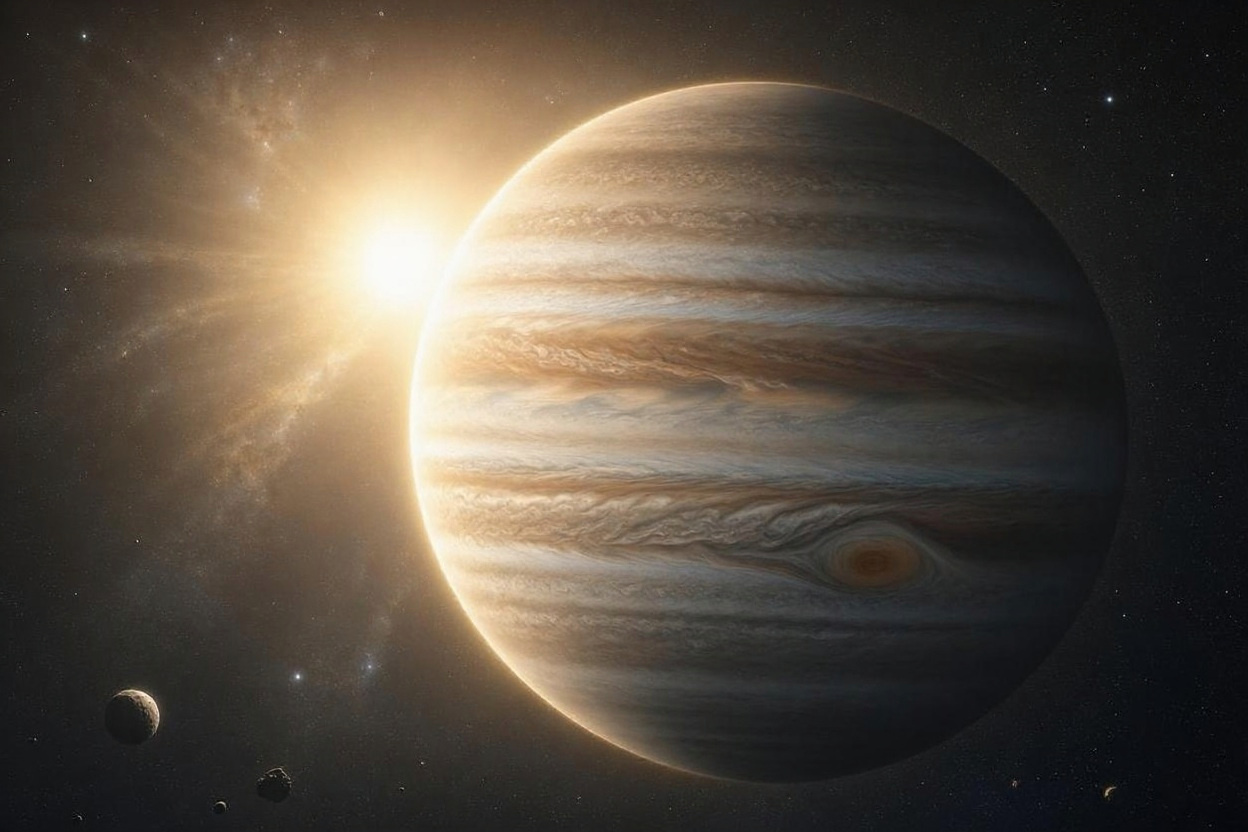
Image note: The image accompanying this article is an AI-generated illustration and is not the actual JWST data or the planet.
Published by Banx Network. This article is part of the Banx decentralized media programme, powered by the BXE token on the XRP Ledger.