Key Highlights
- Discovery:Astronomers have identified an invisible object in a binary system.
- Mass Range:The object has a calculated mass of 2.20 solar masses, potentially filling a cosmic mass gap.
- Research Publication:Findings accepted for publication in Science Advances.
[Discovery of an Invisible Object]
Astronomers have made a groundbreaking discovery in the cosmic mass gap, a region between neutron stars and black holes where few objects have been found. This gap represents a significant mystery in astrophysics, as neutron stars typically have masses between two and two and a half solar masses, while black holes start at around five solar masses. The newly identified object, located in the binary system designated J0008+0128, has a mass estimated at 2.20 solar masses, with a range from 1.8 to 2.8 solar masses, potentially placing it squarely within this elusive mass gap.
[Details of the Binary System]
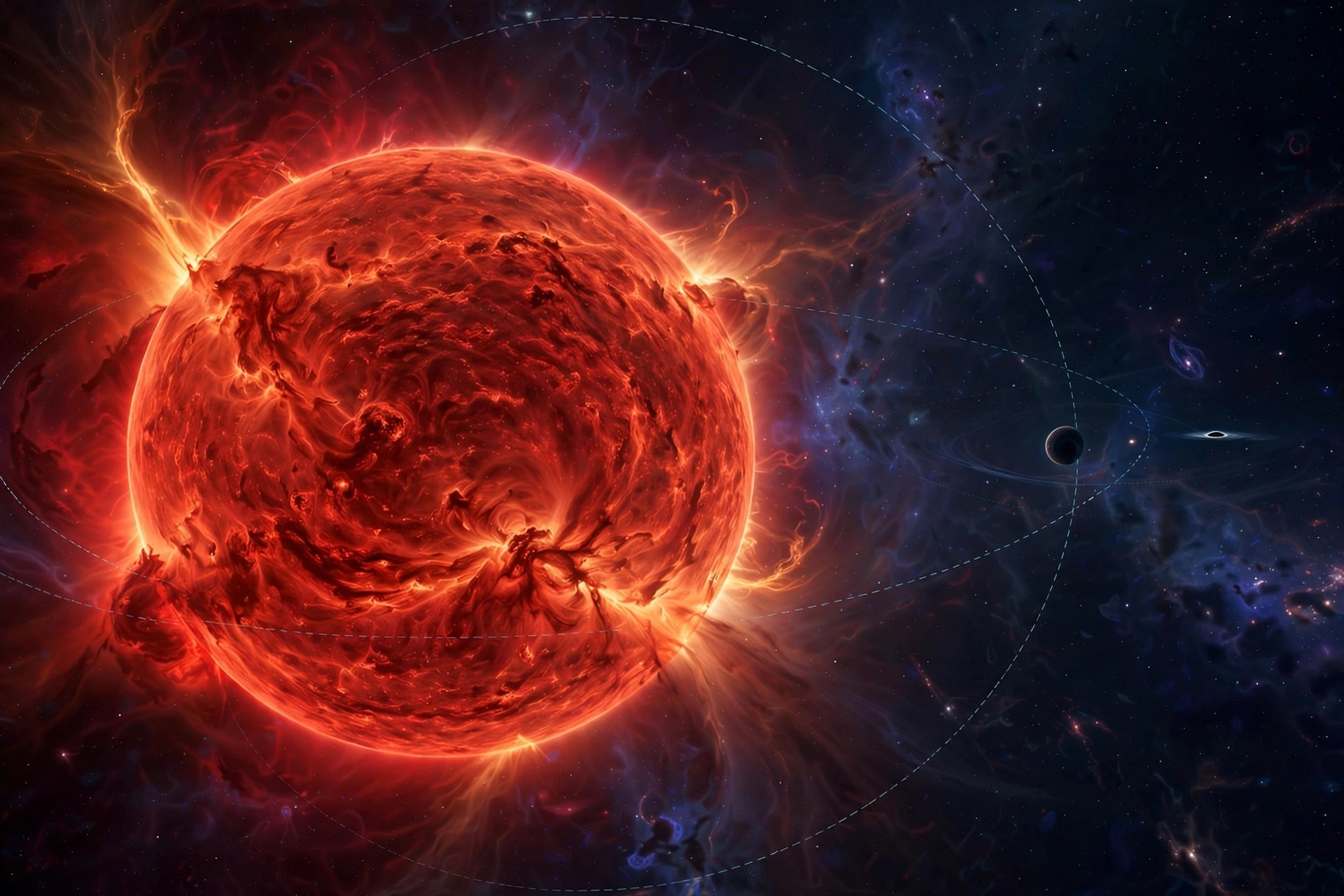
The binary system J0008+0128 is particularly intriguing due to its unusual characteristics. The red giant star in this system orbits its unseen companion every 3.3 years, a relatively wide separation for such binaries. Despite this distance, the orbit is nearly circular, with an eccentricity of just 0.09. This circularity is puzzling, as typical supernova explosions, which create neutron stars, usually impart a kick that distorts the orbit. The combination of a wide and circular orbit suggests a gentler evolutionary history or possibly a more complex formation scenario.
[Research Methodology]
To understand the dynamics of J0008+0128, researchers conducted over 300,000 simulations of binary evolution. They sought to find a pathway that could explain the observed parameters of the system. However, none of the standard models—such as mass transfer, supernova kicks, or common envelope evolution—successfully replicated the findings. This indicates that while the system is not impossible, current models may be incomplete, highlighting the universe's capacity to surprise astronomers with unexpected phenomena.
[Possible Explanations for the Object]
Several hypotheses exist regarding the nature of the unseen companion. It could be a neutron star that formed with an unusually high mass, resulting from a supernova that expelled minimal material. Alternatively, it might be the remnant of a triple system where two inner compact objects merged while the red giant maintained a safe distance. Another possibility is that it is a low-mass black hole, existing just above the neutron star limit. Observations using the Einstein Probe and the FAST telescope have not detected any signals from the object, which aligns with the characteristics of a quiet, non-accreting neutron star but does not eliminate other possibilities.
[Implications of the Discovery]
If confirmed as a supermassive neutron star, this object's mass could significantly constrain the equation of state for dense matter, which governs how nuclear material behaves under extreme pressures and densities. The boundary between neutron stars and black holes is not merely a numerical threshold; it serves as a critical test of fundamental physics. Each new discovery near this boundary refines our understanding of where it lies and the factors that determine it.
The research has been accepted for publication in Science Advances, and astronomers plan further observations to refine the orbit and search for any signs of a closer companion. While the mass gap remains a topic of intrigue, the discovery of this candidate object in the orbit of a red giant star marks a significant step toward unraveling the mysteries of stellar evolution and the nature of compact objects in the universe.
The images accompanying this article are AI-generated illustrations and are not actual astronomical photographs.
Published by Banx Network. This article is part of the Banx decentralized media programme, powered by the BXE token on the XRP Ledger.