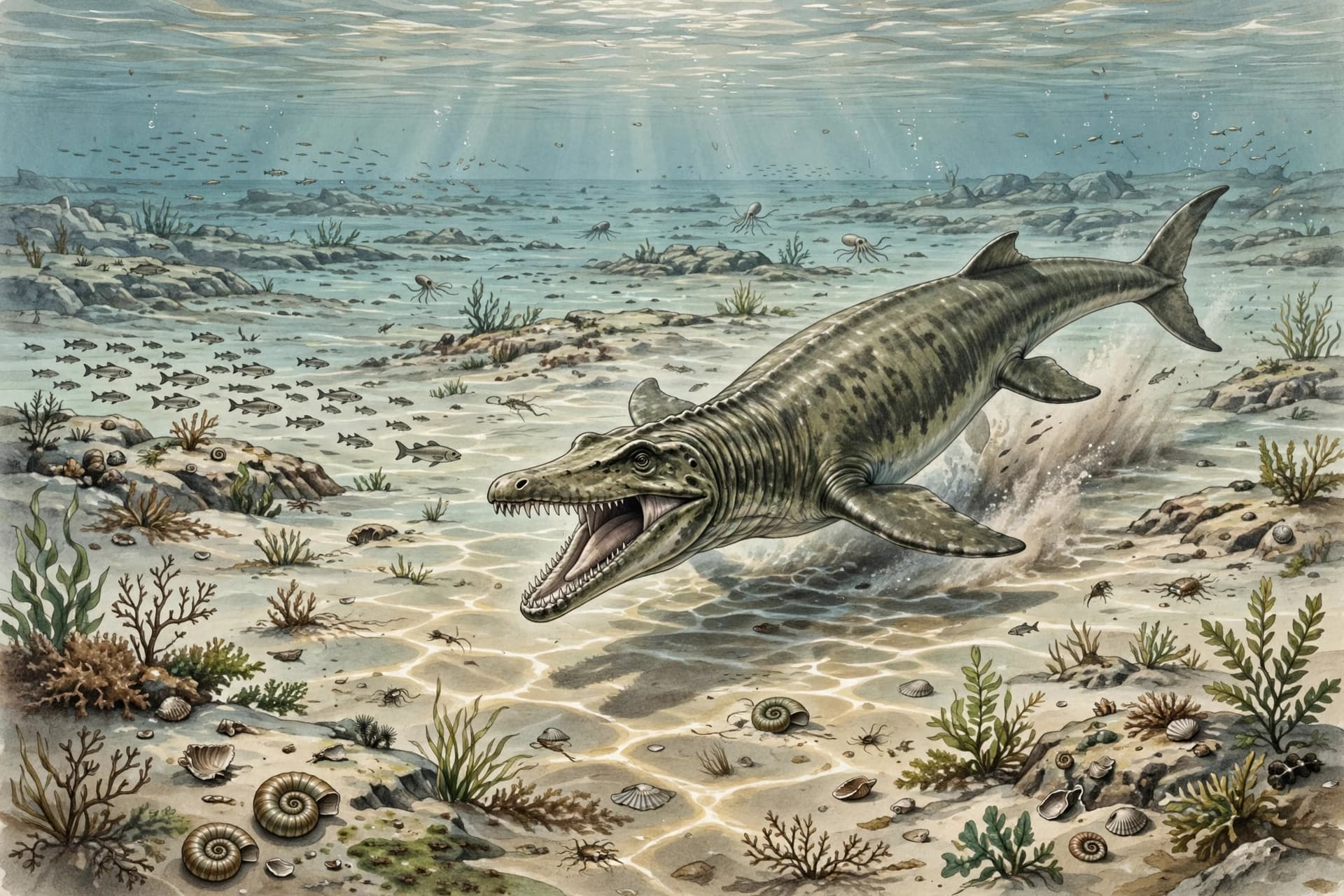
There is a particular kind of hunter that does not chase, but waits—coiled, still, patient, until the moment arrives and the water itself seems to explode. In the age of dinosaurs, while T. rex ruled the land, the oceans belonged to mosasaurs: giant marine reptiles, some stretching fifteen meters long, with tails built for power and jaws wide enough to swallow prey whole. A new study suggests that not all of them hunted the same way—some were ambush specialists, and some were pursuit predators, and the difference was written in their tails.
Researchers at Rutgers University reconstructed the bodies of four mosasaur species from fossil skeletons and applied physics to estimate how quickly each could surge forward with a single tail stroke. The results, published in Current Biology, reveal a clear split in hunting strategies .
A particularly large Tylosaurus could have reached about 15 miles per hour with one powerful sweep of its tail—a brief burst, not sustained speed. Platecarpus was even faster for its body size. Both had a longer, more flexible section of the tail that allowed them to curl it farther before sweeping it back, generating greater thrust. The advantage came largely from how far the tail could curl, a factor that mattered more than muscle power or water resistance .
Mosasaurus and Plotosaurus, by contrast, were built differently. Their tails were suited for sustained, tuna-like swimming rather than sudden bursts. “That doesn’t mean Plotosaurus was slow,” said Kiersten Formoso, who led the study. “Its tail was built for sustained, tuna-like swimming rather than sudden bursts” .
The findings align with other clues about mosasaur lifestyles, including studies of bite force, tooth wear, and fossil chemistry. The ambush specialists likely hunted in shallow seas where a sudden lunge could seize prey before it could escape. The pursuit predators roamed the open ocean, chasing down their meals over distance .
Formoso’s team modeled a movement they call a “slam-start”—the animal curls its tail to one side, then forcefully sweeps it back, pushing against the water like a swimmer pushing off a pool wall. To reconstruct missing tail muscles, they drew on the anatomy of living lizards, including Komodo dragons
To the authors’ knowledge, this is the first study to put numbers on burst swimming performance in any marine reptile from the age of dinosaurs. They are making their tools publicly available so other researchers can apply the approach to additional extinct swimmers .
For Formoso, the work rests on a simple truth: the physical rules that govern swimming today also applied millions of years ago. “Physics is physics,” she said . And in the ancient oceans, physics determined whether a predator waited in ambush or chased its prey across the open water.
AI Image Disclaimer: Visuals in this article are AI-generated and do not depict actual specimens or events.
Sources: Rutgers University, Current Biology, EurekAlert, Public Now
Published by Banx Network. This article is part of the Banx decentralized media programme, powered by the BXE token on the XRP Ledger.