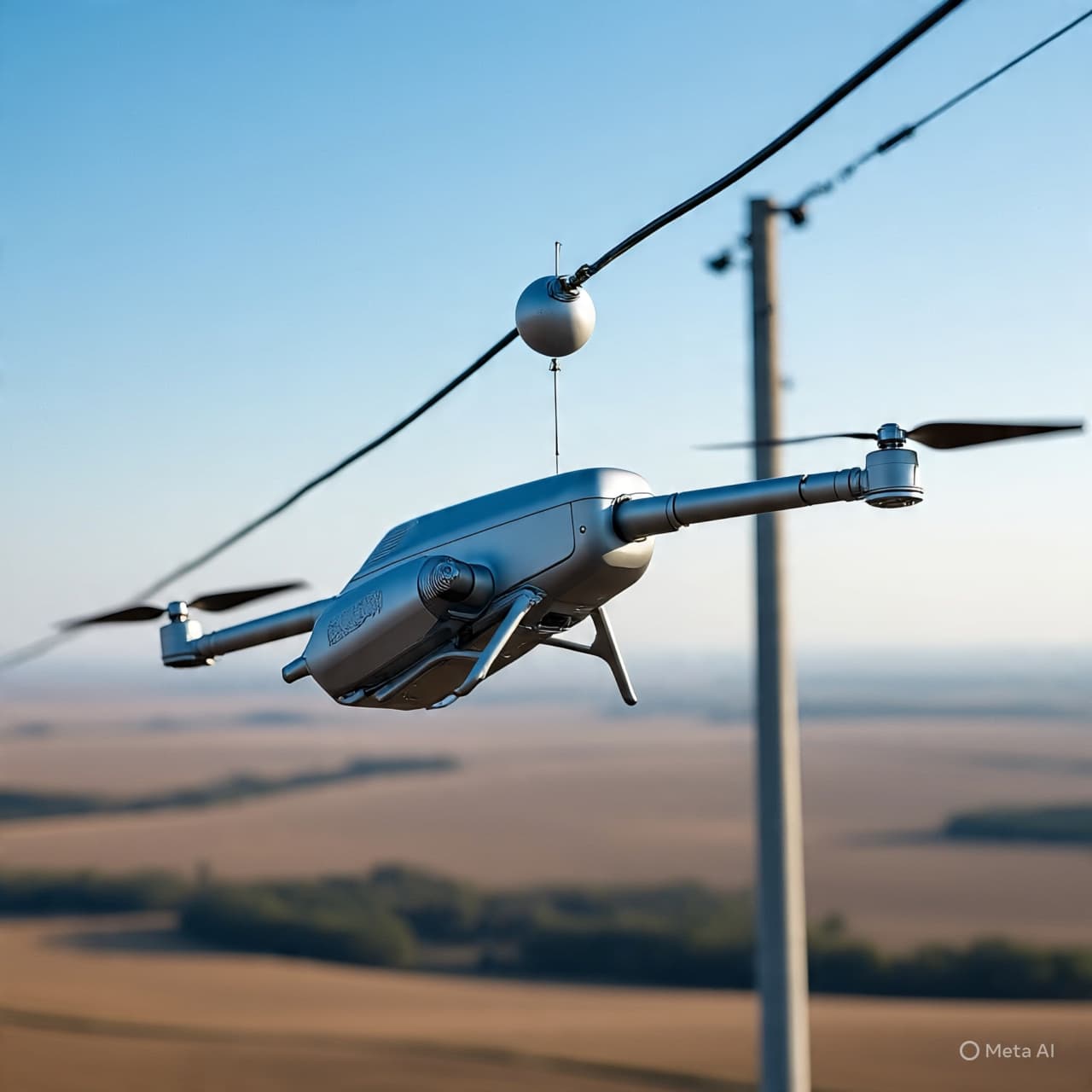
At first glance, the power lines stretching across fields and cities appear unchanged — steel veins suspended against the sky, carrying electricity with quiet obedience. Yet above them, almost unnoticed, something new has begun to hover. Small, spherical objects, delivered by drones with the care of a watchmaker, are settling onto these wires, offering not spectacle, but insight.
These devices, informally called “magic balls,” are advanced sensors designed to measure the real-time conditions of high-voltage transmission lines. They track temperature, humidity, and other environmental factors that directly affect how much electricity a line can safely carry. For decades, utilities have relied on fixed estimates, erring on the side of caution. The result has often been unused capacity — energy waiting to flow, held back by uncertainty.
Installed by drones rather than human crews, the sensors can be attached in minutes, even to live lines. This shift alone marks a quiet turning point. What once required shutdowns, heavy equipment, and significant risk can now be done swiftly from the air, reducing cost, disruption, and danger. It is less a dramatic overhaul than a gentle correction — technology stepping in to listen more closely.
The implications are substantial. As renewable energy sources like wind and solar expand, grids are being asked to adapt faster than they were ever designed to. Real-time data allows operators to increase capacity when conditions are favorable, sometimes by significant margins, without building new infrastructure. In an era of rising demand and long permitting timelines, this efficiency feels less like innovation and more like necessity.
Industry voices describe the moment with a mix of urgency and quiet astonishment. “It’s never been like this,” one expert observed, pointing to the convergence of electrification, climate pressure, and digital tools. The sensors do not create energy, but they reveal opportunity — hidden space within systems long thought to be full.
In the United States, pilot projects and early deployments suggest growing interest. Utilities, facing aging infrastructure and mounting expectations, are looking for solutions that do not require years of construction. These small spheres, unobtrusive and precise, offer a different path — one built on awareness rather than expansion.
Still, adoption will move at the measured pace of regulation, trust, and proof. Technologies that touch critical infrastructure are rarely rushed. But as more data accumulates, and as drones continue their careful work along the wires, the grid itself may begin to feel less rigid, more responsive.
Sometimes change does not arrive with thunder. Sometimes it comes as a quiet object, placed gently on a line, asking us simply to pay closer attention.
AI Image Disclaimer Illustrations were produced with AI and serve as conceptual depictions.
Sources Yahoo Tech The Cool Down Fast Company Star Tribune DroneLife
Published by Banx Network. This article is part of the Banx decentralized media programme, powered by the BXE token on the XRP Ledger.