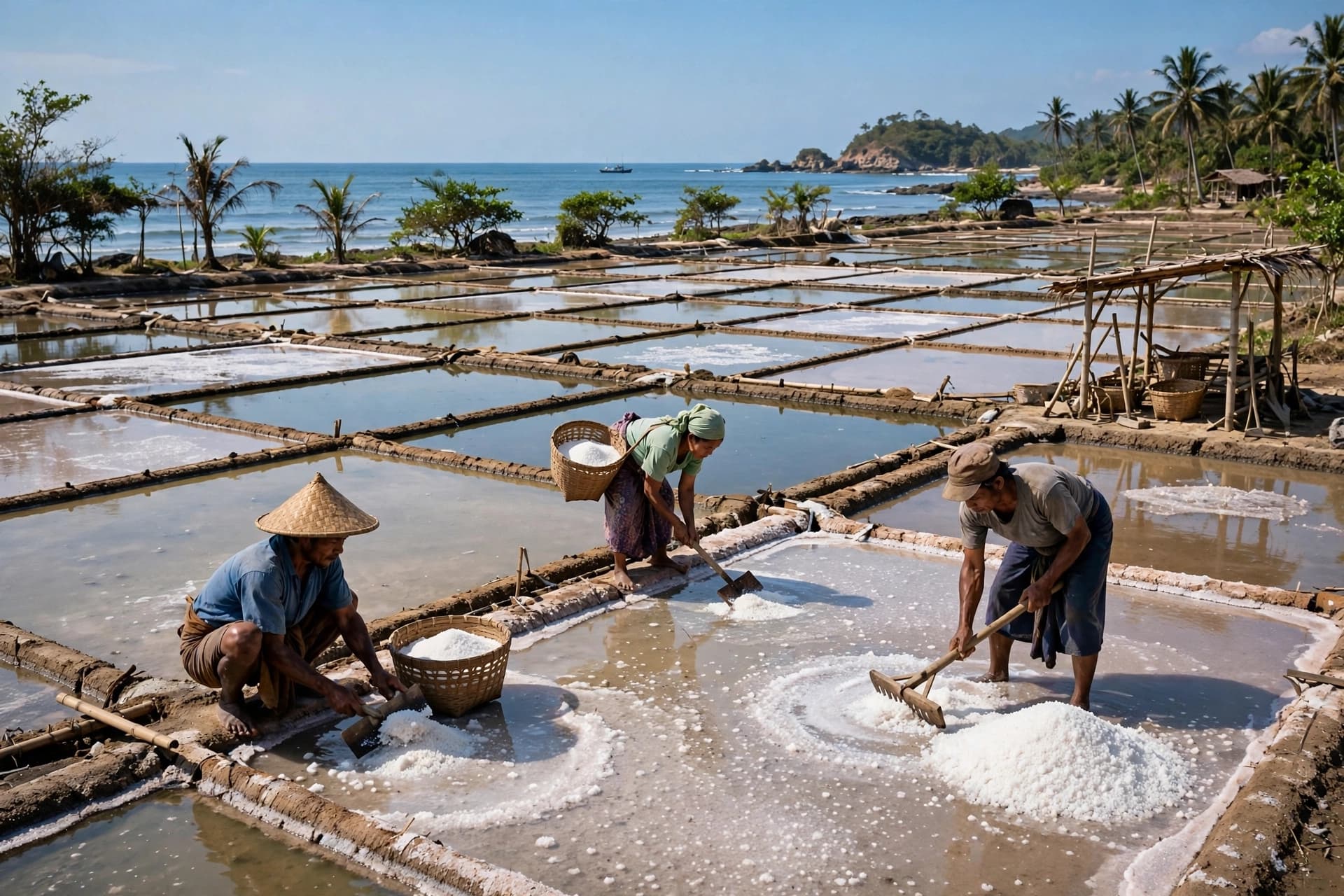
Along Indonesia’s northern coast, the sun can become both clock and worker. Day after day, seawater sits beneath the heat, gradually surrendering its moisture until what remains is a field of white crystals.
This year, unusually dry conditions have created favorable circumstances for Indonesia’s traditional salt producers. In Cirebon, West Java, salt output reached nearly 600 metric tons in July, compared with only about 25 to 30 tons during the same period a year earlier.
The dramatic increase illustrates how strongly salt production depends on uninterrupted sunshine. Unlike many industrial processes, traditional salt farming relies heavily on natural evaporation, meaning rainfall can quickly interrupt production.
For farmers working along the coast, a prolonged dry period can therefore bring a rare window of opportunity. Seawater is moved into shallow ponds, where sunlight gradually removes the water and leaves concentrated salt behind.
The process is simple in appearance but closely tied to weather. Clouds, rain and humidity can slow evaporation, while long stretches of sunshine allow salt crystals to develop more rapidly.
The current season has also highlighted the contrast between different parts of Indonesia’s agricultural economy. While drought can create difficulties for crops that depend on regular rainfall, salt farmers can benefit from the same absence of rain.
Cirebon’s production is particularly notable because traditional producers often work with relatively low-tech methods. Their success depends less on sophisticated machinery than on access to suitable coastal land, seawater and a reliable period of sunshine.
The increase in production can also contribute to local economic activity. Salt harvesting supports farmers, laborers, transport workers and traders, connecting the coastal ponds with markets farther inland.
Yet the favorable conditions are not permanent. Weather patterns can shift quickly, and a return of heavier rainfall could once again slow production.
For now, the salt fields along Indonesia’s coast are taking advantage of the dry season. The sharp rise in Cirebon’s July output demonstrates how a change in the weather can transform the rhythm of an entire coastal industry, turning sunlight into a valuable harvest.
AI Image Disclaimer: The following visuals are AI-generated conceptual representations and are not photographs of actual Indonesian salt farms.
Sources: Reuters
Published by Banx Network. This article is part of the Banx decentralized media programme, powered by the BXE token on the XRP Ledger.