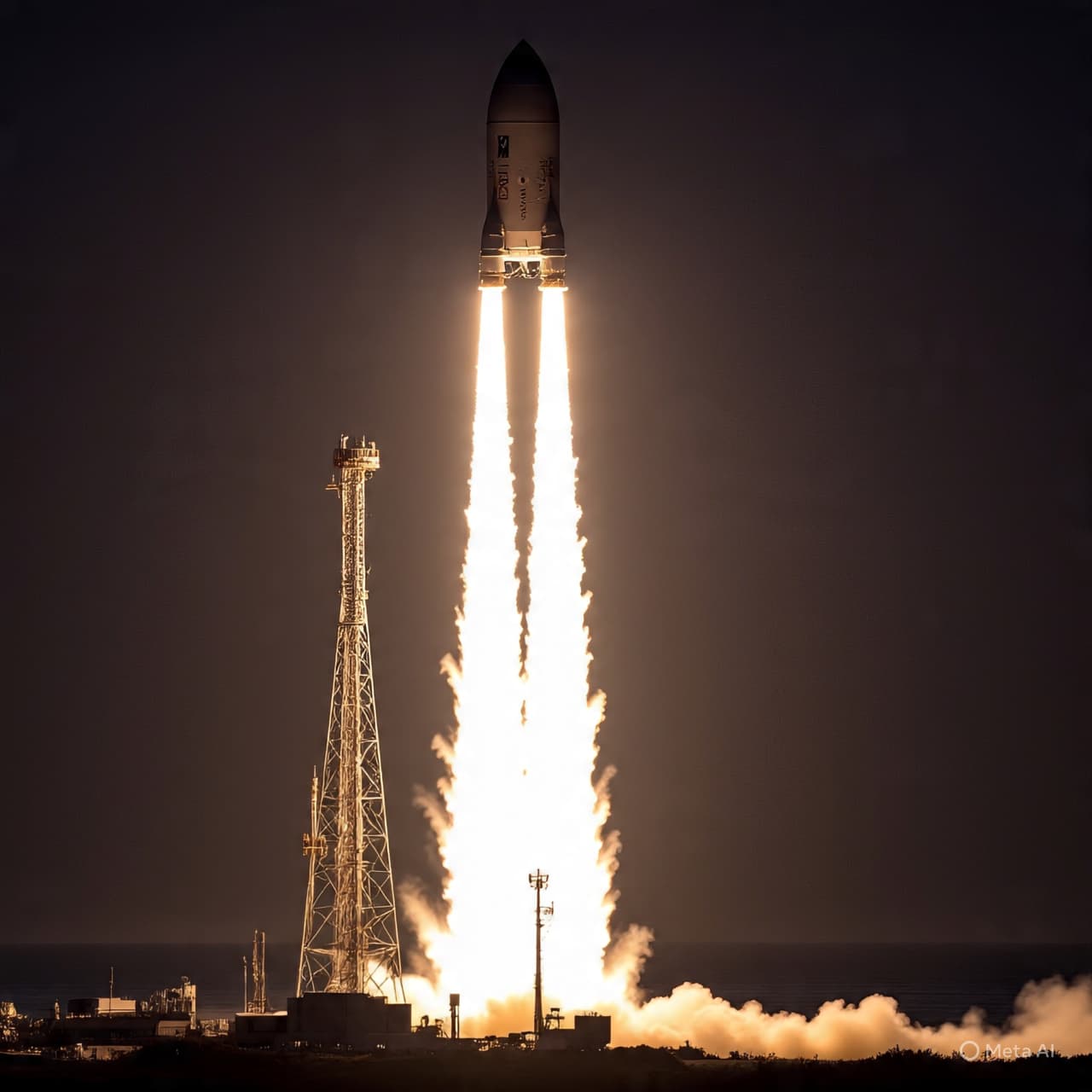
Along Florida’s eastern shoreline, where the Atlantic folds gently against Cape Canaveral, night gave way to a controlled blaze of light. The launch tower stood still against the dark sky, and for a moment the world seemed suspended between silence and ignition. Then engines awakened, and a SpaceX Falcon 9 lifted slowly from the pad, carrying four astronauts toward the International Space Station.
The ascent unfolded with a familiarity that has become characteristic of NASA’s Commercial Crew Program. As reported by Reuters and the Associated Press, the rocket climbed cleanly through the atmosphere, its first stage later separating and returning toward Earth for a controlled landing. Above it, the Crew Dragon capsule continued forward, tracing a precise arc into low Earth orbit.
Inside the spacecraft, the astronauts began the measured transition from gravity to weightlessness. Screens glowed softly in the capsule’s interior as systems checked and rechecked their course. The journey to the ISS—traveling at roughly 17,500 miles per hour around the Earth—would take several hours of orbital adjustments before docking procedures could begin. NASA officials noted that the mission represents a routine crew rotation, designed to maintain a continuous human presence aboard the station.
The International Space Station itself, a collaborative effort involving NASA, Roscosmos, the European Space Agency, JAXA, and the Canadian Space Agency, has circled the planet for more than two decades. According to Bloomberg, these regular rotations reflect both the operational maturity of commercial launch systems and the enduring international partnership that sustains the orbiting laboratory. Within its modules, experiments continue in fields ranging from biomedical research to materials science and climate observation.
As the Crew Dragon approached, automated systems guided it toward a forward docking port. The station, bright against the curve of Earth, moved in silent coordination with the incoming capsule. Docking—carefully timed and precisely executed—completed the spacecraft’s journey from Florida’s shoreline to orbit. Soon after, the hatch opened and greetings were exchanged in microgravity, an ordinary ritual in an extraordinary setting.
Crew transitions carry both technical and human dimensions. The arriving astronauts will assume responsibility for ongoing research, station maintenance, and preparations for future experiments. Meanwhile, members of the departing crew are expected to return to Earth in the coming days, bringing home months of data and lived experience in space. NASA has emphasized that such rotations ensure operational continuity aboard the ISS, even as broader ambitions—including lunar exploration under the Artemis program—continue to take shape.
From the ground, the International Space Station appears as a brief, luminous crossing at dusk or dawn. Inside, it remains a place of steady work and repetition, where sunrise and sunset unfold sixteen times each day. The arrival of four new astronauts does not interrupt that rhythm; it sustains it.
And so, above weather systems and shifting continents, the station continues its orbit. Fire on a launchpad becomes a distant memory, replaced by the soft hum of life-support systems and the quiet drift of cables in weightlessness. The journey has ended, and another has begun—one more chapter in the long conversation between Earth and the space just beyond it.
Published by Banx Network. This article is part of the Banx decentralized media programme, powered by the BXE token on the XRP Ledger.