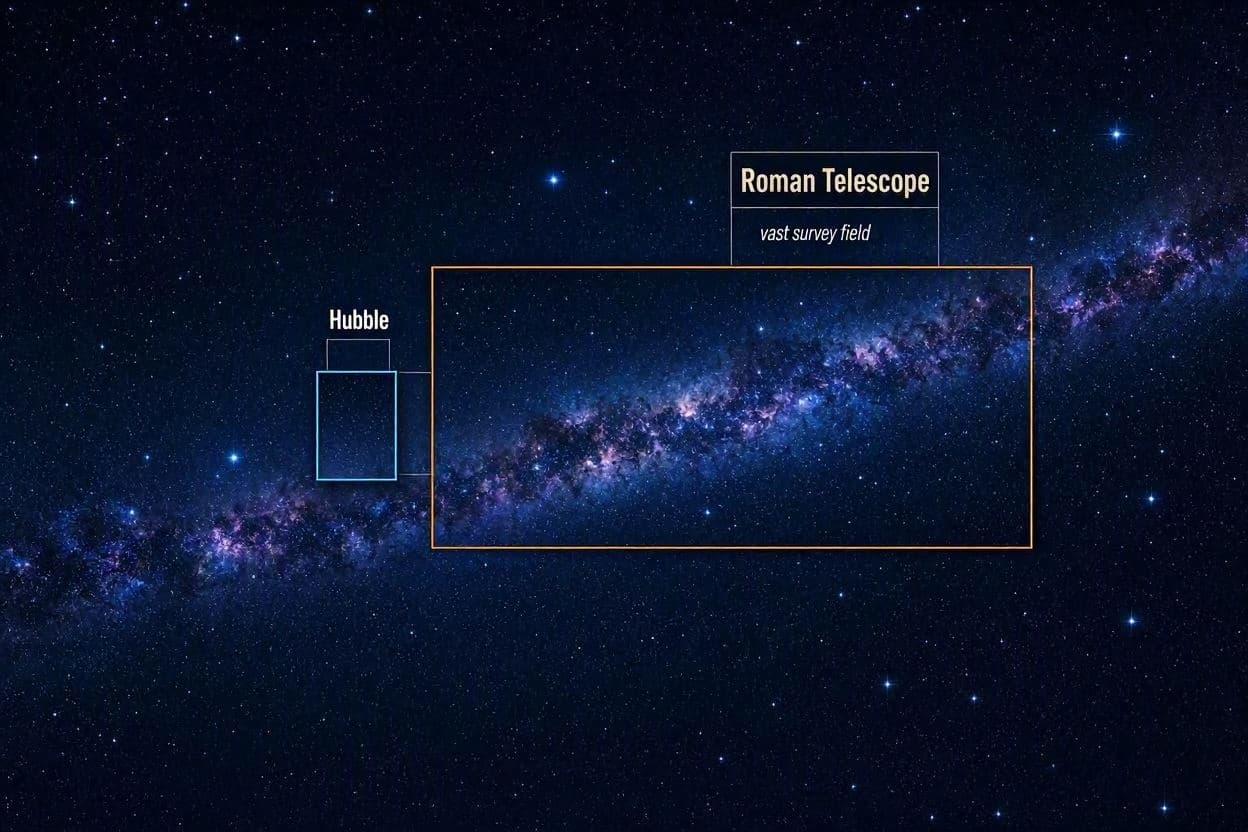
There are eyes that see deeply, and there are eyes that see broadly. For decades, the Hubble Space Telescope has been the former, capturing stunning details of distant galaxies with unparalleled clarity. Now, with the James Webb Space Telescope adding infrared vision to our toolkit, we are poised for a new era of discovery. But it is the upcoming Nancy Grace Roman Space Telescope that promises to change the scale of our vision, offering a field of view so vast it dwarfs its predecessors.
Scheduled for launch in late 2026, the Roman Telescope is designed to survey the sky with a breadth that Hubble and Webb combined cannot match. While its mirror is similar in size to Hubble’s, its optics are engineered to capture an area of the sky 100 times larger in a single observation. This wide-angle lens on the universe will allow astronomers to map billions of objects, creating a cosmic census that was previously impossible.
The significance of this capability lies in its ability to address some of the most profound mysteries of cosmology. Dark energy and dark matter, which make up the majority of the universe’s content, are best studied through large-scale surveys. By observing millions of galaxies and supernovae, Roman will help scientists understand how the universe has expanded over time and what forces are driving its acceleration.
Unlike Hubble, which focuses on specific targets for detailed study, Roman will act as a scout, identifying interesting phenomena for further investigation by other telescopes. It will find the needles in the haystack, pointing the way for more specialized instruments to examine them in detail. This collaborative approach maximizes the scientific return of all space-based observatories.
The telescope’s infrared capabilities will also allow it to peer through dust clouds that obscure visible light, revealing star-forming regions and exoplanets that are otherwise hidden. This ability to see the unseen will expand our understanding of planetary formation and the potential for life beyond our solar system. It is a tool for discovery in the truest sense, opening windows to parts of the cosmos we have barely glimpsed.
Named after Nancy Grace Roman, NASA’s first chief of astronomy, the telescope honors a pioneer who championed the idea of space-based observation. Her vision laid the groundwork for Hubble, and now, her namesake continues that legacy by pushing the boundaries of what we can see. It is a fitting tribute to a woman who understood that to understand the universe, we must look at it in new ways.
As the launch date approaches, anticipation builds among the scientific community. The Roman Telescope is not just a new instrument; it is a new way of seeing. It promises to fill in the gaps in our cosmic map, providing a broader context for the detailed images we already cherish. In its wide gaze, we may find the answers to questions we have not yet thought to ask.
The visuals included here are AI-generated creations designed to visualize the conceptual nature of the story.
Sources: ScienceDaily, ESA Official Website, NASA SVS, YouTube (SciShow/Veritasium style channels), ADS Abstracts
Published by Banx Network. This article is part of the Banx decentralized media programme, powered by the BXE token on the XRP Ledger.