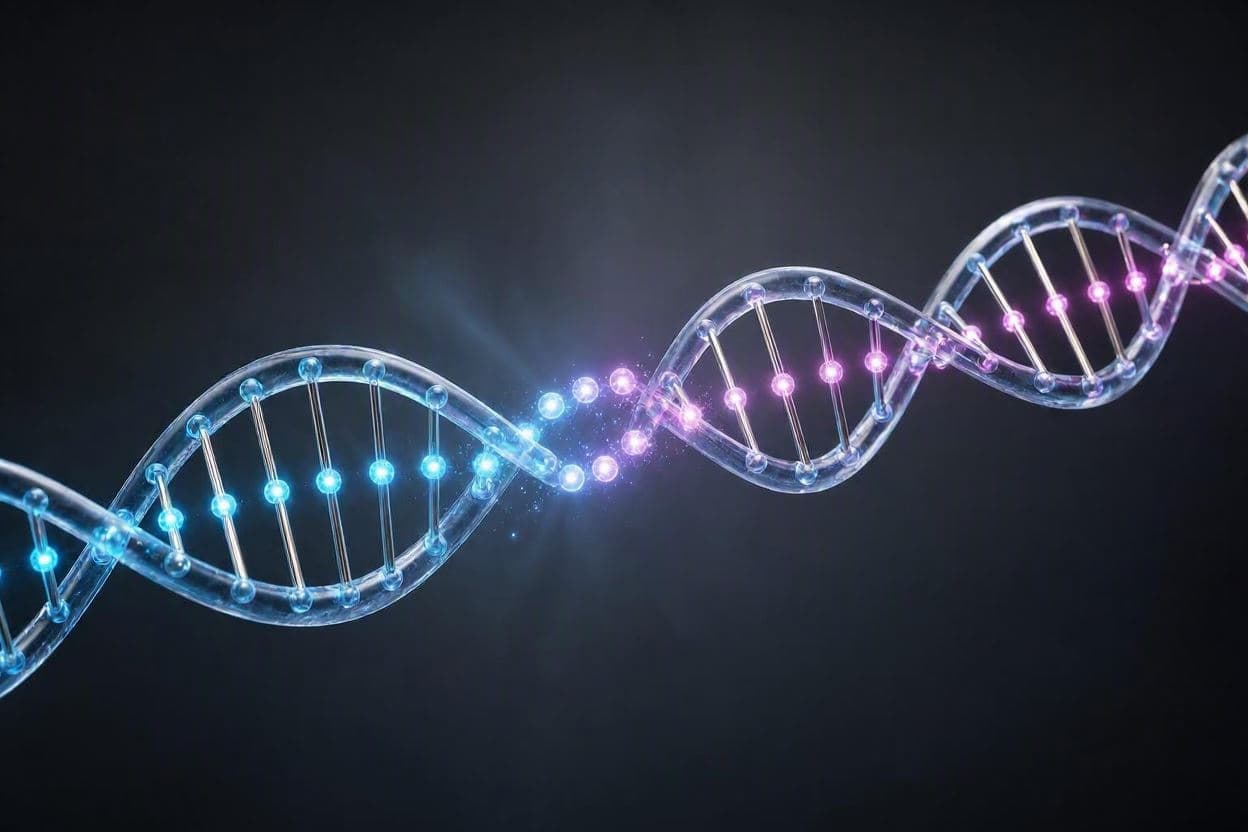
At the heart of every living cell lies a molecule of exquisite complexity: DNA. For decades, scientists have understood its double-helix structure, but the precise mechanism by which two single strands find each other and zip together has remained a subject of theoretical debate. Now, researchers have captured this elusive moment for the first time, solving a long-standing mystery about how DNA overcomes its own electrical repulsion to form the foundation of life.
DNA strands are negatively charged, which means they naturally repel each other. Yet, in the crowded environment of a cell, they must pair up accurately to replicate genetic information. The new study, published by researchers at the University of Sheffield, used advanced microscopy techniques to observe this process in real time. They discovered that the strands do not simply collide and stick; instead, they engage in a delicate dance of alignment and stabilization, facilitated by counterions in the surrounding fluid.
The observations reveal that positively charged ions, such as magnesium, play a crucial role in shielding the negative charges of the DNA backbone. This shielding allows the strands to come close enough for hydrogen bonds to form between the base pairs. Once a few bases align correctly, the rest of the strand zips up rapidly, like a fastener closing. This "nucleation" step is critical for ensuring accuracy and speed in genetic replication.
This discovery has profound implications for our understanding of genetic diseases and biotechnology. Many errors in DNA replication can lead to mutations and health issues. By understanding the mechanics of strand pairing, scientists can develop better methods for gene editing and synthetic biology. It also informs the design of DNA-based nanomaterials, which rely on precise self-assembly for functionality.
The technology used to capture this event involved anchoring one end of a DNA strand to a surface while allowing the other to move freely. High-speed cameras and fluorescent markers allowed researchers to track the movement and binding of the strands with unprecedented resolution. This level of detail was previously impossible, making the study a breakthrough in molecular biophysics.
For the scientific community, this finding validates decades of theoretical models while adding new nuances to the picture. It highlights the importance of the cellular environment in facilitating biological processes, showing that DNA does not operate in isolation but in concert with its surroundings. This holistic view is essential for advancing our knowledge of life at the molecular level.
The public response to such discoveries often reflects a deep fascination with the machinery of life. Understanding how DNA works at such a fundamental level reinforces the wonder of biological complexity. It reminds us that even the smallest components of our bodies operate with precision and elegance, governed by the laws of physics and chemistry.
As research continues, the insights gained from this study will likely lead to new innovations in medicine and materials science. The solution to this decades-old mystery is not just an academic achievement but a stepping stone to future breakthroughs. It is a reminder that even in well-trodden fields, there are still secrets waiting to be uncovered.
AI Image Disclaimer: The illustrations for this article are AI-generated to represent the molecular structure of DNA and the concept of strand pairing, using abstract and scientific imagery rather than real microscopic footage.
Sources: Phys.org, University of Sheffield, Mirage News, The Star
Published by Banx Network. This article is part of the Banx decentralized media programme, powered by the BXE token on the XRP Ledger.