
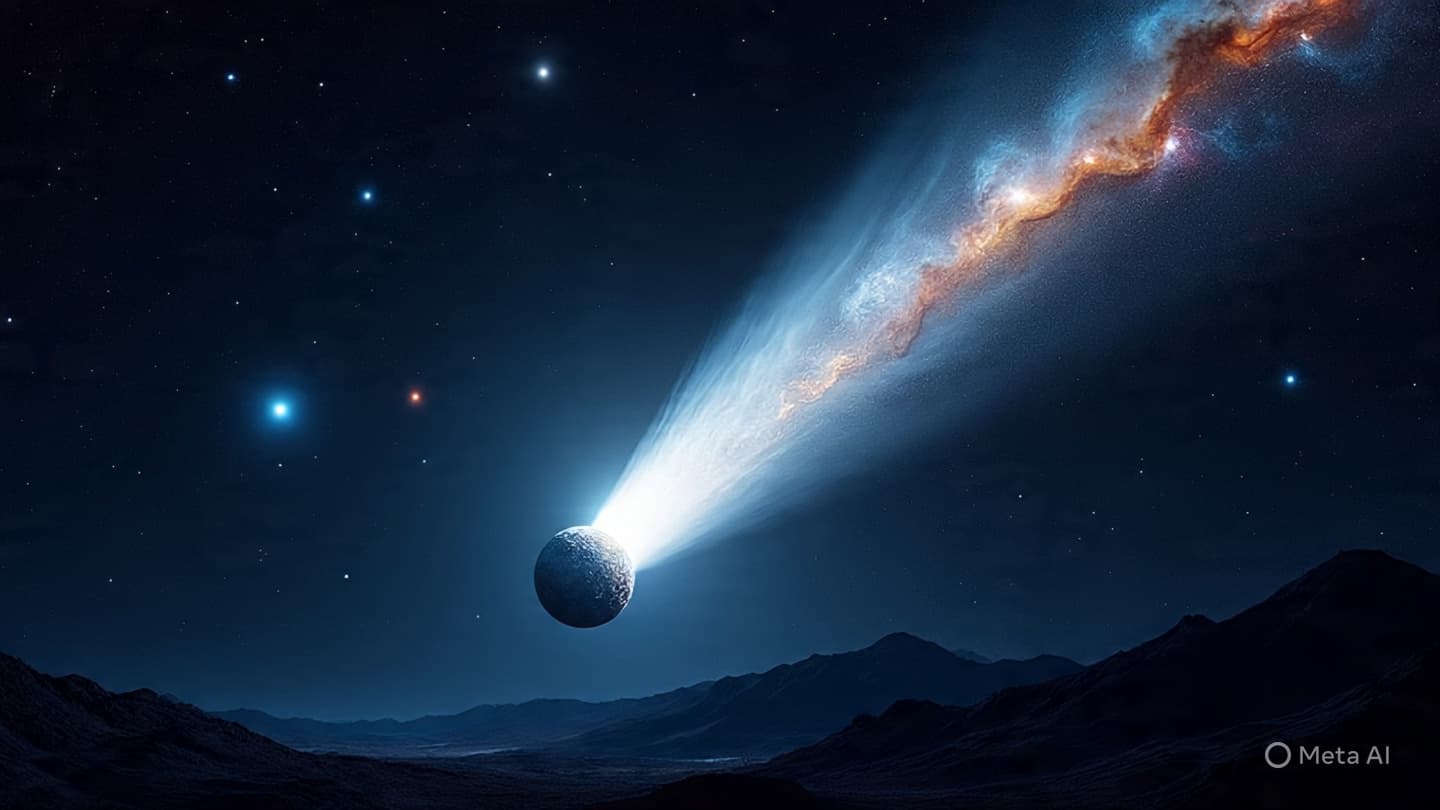
Scientists have released a new deep-space color image and analysis of interstellar comet 3I/ATLAS, offering fresh insight into objects originating beyond the solar system. The data was captured during the European Space Agency’s Jupiter Icy Moons Explorer (JUICE) mission.
The JUICE spacecraft, launched to study Jupiter and its icy moons, has demonstrated its scientific versatility by observing objects outside its primary mission scope. The detection of 3I/ATLAS highlights the growing capability of space missions to contribute to multiple areas of research simultaneously.
Interstellar comets are rare visitors that originate from outside the solar system, making them valuable for understanding the composition and conditions of distant star systems. Previous detections, such as ‘Oumuamua and 2I/Borisov, have already challenged existing models of comet formation.
The newly captured image provides enhanced color data, allowing scientists to analyze the comet’s surface composition and activity in greater detail. Early findings suggest variations in dust and gas emissions, which may differ from those observed in solar system comets.
Researchers say the data could help refine theories about how interstellar objects form and travel across vast distances before entering other star systems. It also provides clues about the chemical makeup of regions far beyond the Sun’s influence.
The JUICE mission’s ability to capture such data en route to Jupiter underscores the importance of flexible mission design. Instruments originally intended for planetary observation are now contributing to broader astrophysical research.
The findings also demonstrate the growing role of international collaboration in space science, with data being analyzed by teams across Europe and other regions. This collaborative approach accelerates the interpretation and application of new discoveries.
As JUICE continues its journey, scientists expect further opportunities to observe unexpected phenomena, expanding the mission’s scientific impact.
The study of interstellar comet 3I/ATLAS adds to a growing body of knowledge about the universe beyond the solar system, reinforcing the value of deep-space exploration in answering fundamental scientific questions.
AI Image Disclaimer: These visuals are AI-generated for illustrative use only.
Sources: European Space Agency Reuters Nature Astronomy BBC Science
Published by Banx Network. This article is part of the Banx decentralized media programme, powered by the BXE token on the XRP Ledger.



