There is a particular rarity in a fossil that arrives not as a skeleton but as a single specimen, one that survived the crush of time while nearly three hundred thousand others in the same deposit did not. In the Daohugou Biota of Inner Mongolia, a team from the Nanjing Institute of Geology and Palaeontology has described a creature that lived roughly 165 million years ago, a six-legged predator larger than any of its living relatives, and in doing so has challenged a assumption about the earliest body plans of the group that includes insects.
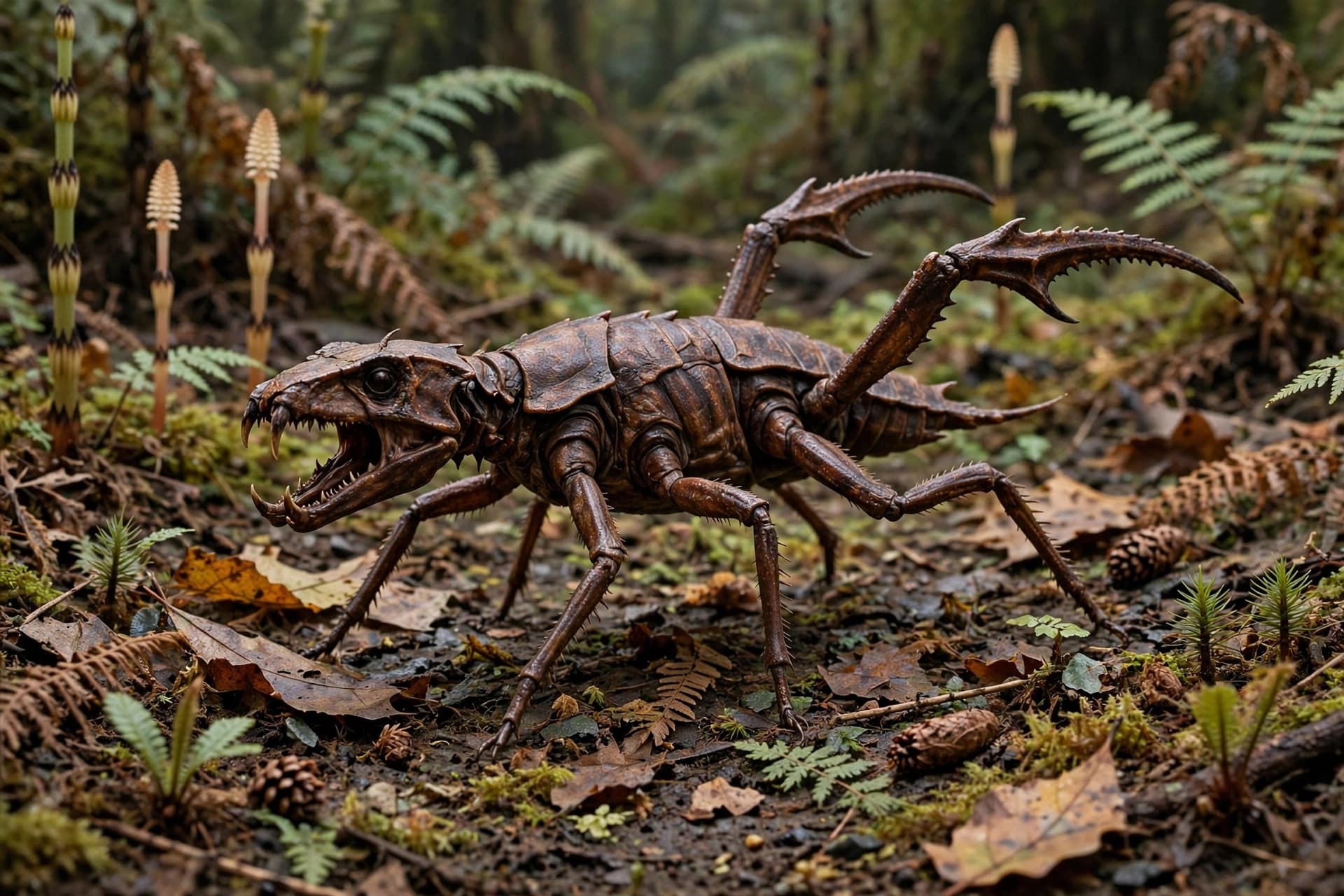
The creature has been named Sinojapyx giganteus—the "Chinese giant japyx," after the superfamily to which it belongs. It is a dipluran, a two-pronged bristletail, a lineage of non-insect hexapods that today are small, secretive, and dwell in soil and leaf litter. Most living diplurans measure less than two centimeters. This one exceeded five centimeters, more than twice the length of any known relative, and it occupied a place in the Jurassic soil food web that today belongs to scorpions and centipedes .
What makes the fossil significant is not only its size but its mouth. Conventionally, diplurans and their kin were thought to have entognathous mouthparts—recessed within the head capsule, hidden from view. Sinojapyx, however, has ectognathous mouthparts, exposed and protruding, a feature previously thought to belong only to insects. The finding suggests that the common ancestor of all hexapods may have had exposed mouthparts, and that the hidden mouthparts of modern diplurans, springtails, and proturans evolved independently, not from a single shared ancestor .
The creature's tail appendages, the cerci that give diplurans their name, offer another clue. In living japygoids, the cerci are hardened pincers with teeth on the inner edge, used for grasping prey. In Sinojapyx, the cerci are symmetrical and smooth, without denticles, a form that appears transitional—a stage between the sensory appendages of more primitive diplurans and the sophisticated weapons of their descendants . The fossil, in other words, captures evolution in the middle of a sentence.
The environment in which it lived was warm and humid, a forest floor of decaying leaves and soft soil. There, a predator five centimeters long, armed with strong mandibles and grasping cerci, would have hunted smaller invertebrates, hiding in the litter and striking from cover. It is a niche that no dipluran fills today, and its existence suggests that the group's modern obscurity is not a permanent condition but a consequence of extinction and competition.
The research, published in the Proceedings of the Royal Society B, does not rewrite the entire history of hexapods. But it fills a gap in the fossil record that had been empty for more than a hundred million years, and it offers a reminder that the small and hidden creatures of the present were not always so. The giant of Daohugou was a predator in its time, and its descendants, diminished in size and concealed in the soil, carry a trace of that former stature.
---
AI Image Disclaimer: The visuals in this article are generated by artificial intelligence and are intended for illustrative purposes only.
Sources: Proceedings of the Royal Society B, Chinese Academy of Sciences, JoVE, Figshare
Published by Banx Network. This article is part of the Banx decentralized media programme, powered by the BXE token on the XRP Ledger.