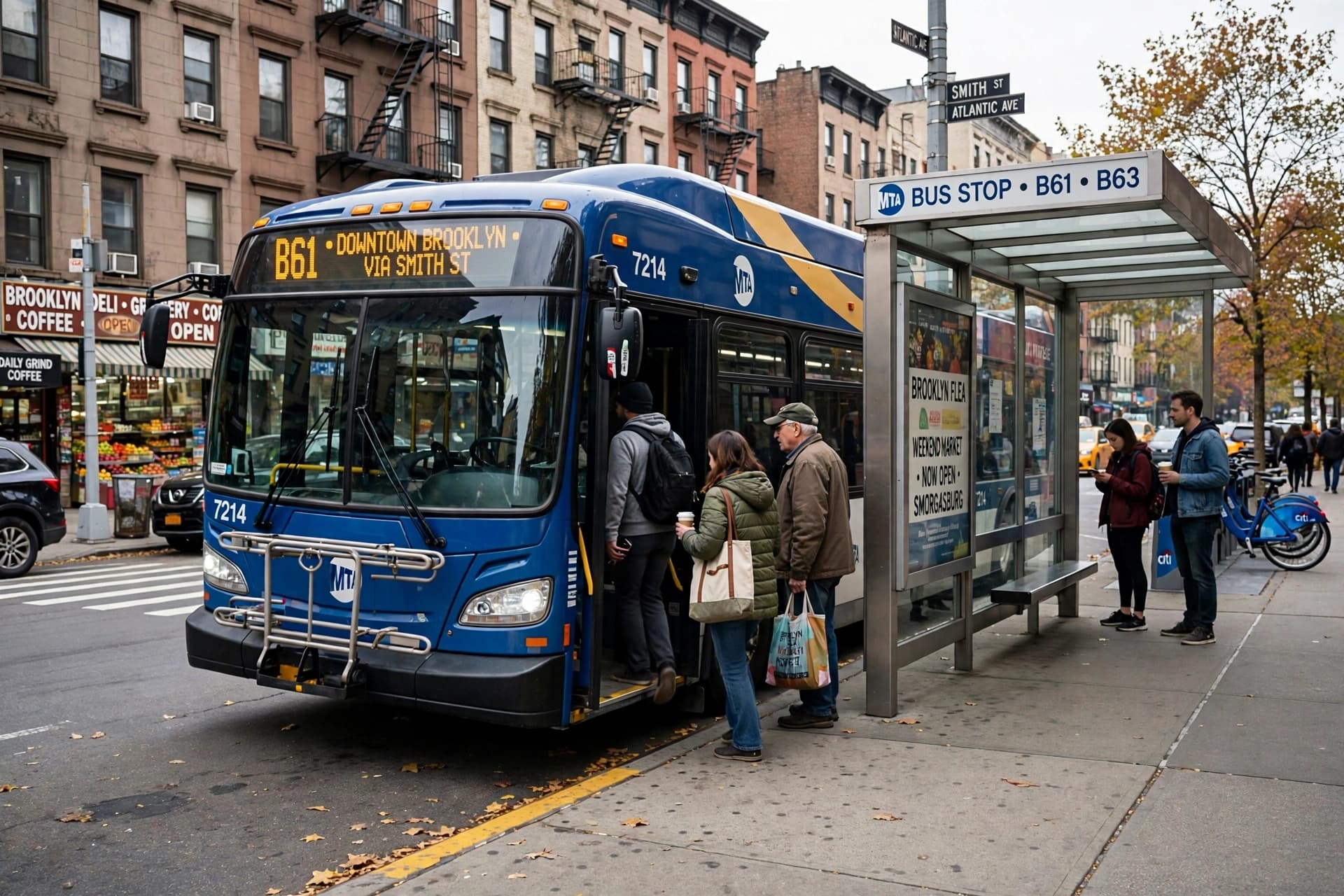
The bus is one of the last truly public rooms in a city of private spaces. Strangers sit shoulder to shoulder, carrying groceries and fatigue and the quiet arithmetic of getting through a day. When the enforcement of a three-dollar fare becomes a physical struggle on a sidewalk in Brooklyn, the question that follows is not really about the money. It is about what kind of room the bus is meant to be, and who has the authority to police its boundaries.
The Metropolitan Transportation Authority announced Thursday that it was suspending its bus fare enforcement program, known as the EAGLE teams, after two altercations between inspectors and passengers came to light . The decision followed the release of surveillance footage showing four inspectors tackling Kyle Taylor, a fifty-three-year-old school aide, to the ground in Brownsville on October 6 after a dispute over whether he had paid his fare .
Taylor said he had paid using an OMNY card and requested a paper transfer slip for a second bus, worried about being charged twice. When he exited the B14, inspectors asked him to prove he had paid, but he had already inserted the transfer into the farebox . The video shows the inspectors pushing him against a bus shelter and wrestling him to the pavement. He was taken to a hospital and has said he will sue, accusing the authority of disproportionately targeting people of color .
MTA Chair and CEO Janno Lieber said he was ordering an immediate "safety stand-down" after learning not only of the Taylor incident but of a second, older episode that had not been reported to leadership for months . "I was not happy that leadership of the MTA, and even New York City Transit, didn't even hear about that episode until more than a week afterward," Lieber said. "I'm not willing to keep our teams active in the field until I know all protocols are followed" .
The EAGLE program employs roughly 350 unarmed inspectors who issue tickets to riders who cannot verify payment. They are not police officers and do not have the authority to arrest or detain passengers . The program was expanded this year after the MetroCard was discontinued and most riders switched to the OMNY digital payment system. Fare evasion on buses has soared since the pandemic, with nearly half of the city's 2.6 million daily bus riders skipping payment, costing the authority an estimated 562 million dollars last year .
Transit advocates welcomed the suspension. "Aggressive tactics that hurt people and slow down the bus cannot meet New Yorkers' needs or address public transit's persistent fiscal challenges," said Betsy Plum of the Riders Alliance . The union representing the inspectors did not immediately respond to requests for comment.
What the suspension does not resolve is the underlying tension that produced the program in the first place. The buses need revenue. The riders need to feel safe. The inspectors need clear protocols that protect both the public and themselves. For now, the teams remain on payroll, assigned to training and other duties, while an internal investigation led by a former NYPD transit chief examines what went wrong and why it took so long for leadership to learn of it .
Images in this article are AI-generated for illustrative purposes.
Sources: The New York Times, New York Daily News, ABC7 New York, News 12 Brooklyn
Published by Banx Network. This article is part of the Banx decentralized media programme, powered by the BXE token on the XRP Ledger.