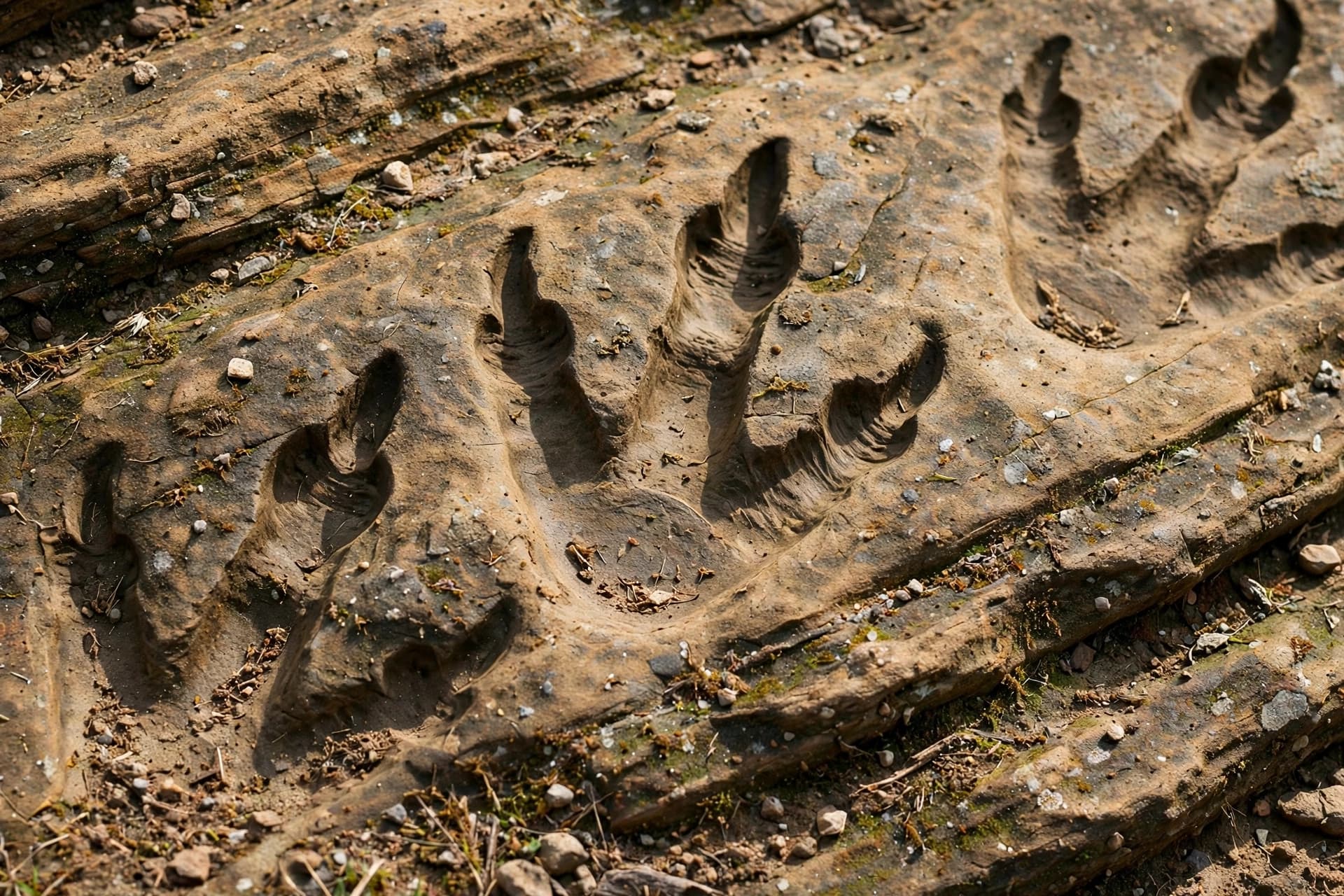
In the dusty badlands of New Mexico, where the earth reveals its ancient secrets layer by layer, a remarkable discovery was made not by a seasoned paleontologist but by a school teacher on a casual hike. Thomas P. Kay, while scouting a campsite, stumbled upon a series of large footprints preserved in stone. These were not just any tracks; they were the first-ever known trackway of an adult Tyrannosaurus rex, dating back 66.5 million years. This find is a poignant reminder that wonder is accessible to all, and that history often lies waiting for those who take the time to look down.
The discovery of dinosaur tracks is rare, but finding a sequence from an adult T. rex is unprecedented. Most previous finds have been from juveniles or isolated prints. This trackway, consisting of several consecutive steps, provides a unique glimpse into the movement and behavior of the king of dinosaurs. It transforms T. rex from a static skeleton in a museum into a living, breathing creature that once walked this very land. It invites us to imagine the weight of its step and the rhythm of its stride.
The tracks were found in the Raton Formation, a geological layer known for preserving fossils from the late Cretaceous period. Each footprint measures about 3 feet long, indicating a massive animal weighing several tons. The depth and shape of the impressions suggest a heavy, bipedal gait, consistent with what we know of T. rex anatomy. Paleontologists who later studied the site confirmed the identification, noting the distinctive three-toed pattern and the lack of heel marks, which is typical for theropod dinosaurs.
For scientists, the trackway offers valuable data on the locomotion of large theropods. By analyzing the stride length and width, researchers can estimate the speed at which the dinosaur was moving. Preliminary calculations suggest a walking pace, rather than a run, providing insight into the daily activities of these apex predators. This information complements skeletal studies, offering a dynamic perspective on how T. rex interacted with its environment. It is a piece of the puzzle that bones alone cannot provide.
The involvement of an amateur discoverer highlights the importance of citizen science in paleontology. Many significant finds are made by hobbyists and local residents who know the land intimately. Their observations often lead professional researchers to sites that might otherwise remain hidden. This collaboration between amateurs and experts enriches the field, fostering a sense of shared ownership and stewardship of natural heritage. It is a model that encourages public engagement and education.
The preservation of the tracks is due to a specific set of geological conditions. The mud in which the T. rex walked must have been firm enough to hold the shape but soft enough to register the detail. Over millions of years, this mud hardened into stone, protecting the impressions from erosion. Such perfect preservation is rare, making the site a valuable resource for study. It serves as a time capsule, capturing a moment from the distant past in exquisite detail.
For the local community, the discovery is a source of pride and interest. It puts their region on the map of paleontological significance, attracting visitors and researchers alike. Educational programs are being developed to share the story of the T. rex trackway, inspiring students to explore science and nature. The find demonstrates that learning can happen anywhere, not just in classrooms. It is a testament to the power of curiosity and observation.
As research continues, scientists hope to find more tracks in the area, potentially revealing a path or a gathering site. Each new discovery adds to our understanding of dinosaur social behavior and ecology. The T. rex trackway is just the beginning of a larger story, one that is still being written by the earth itself. It reminds us that the past is not dead but alive in the rocks beneath our feet.
The discovery of the first adult T. rex trackway by a school teacher is a celebration of curiosity and the unexpected joys of exploration. It bridges the gap between the present and the deep past, allowing us to walk alongside a giant. In these ancient footprints, we find a connection to a world long gone, reminding us of the enduring legacy of life on Earth.
AI Image Disclaimer: The images accompanying this article are AI-generated illustrations designed to depict dinosaur tracks and prehistoric landscapes without showing the specific real-world site.
Sources: NBC News National Geographic Smithsonian Magazine
Published by Banx Network. This article is part of the Banx decentralized media programme, powered by the BXE token on the XRP Ledger.