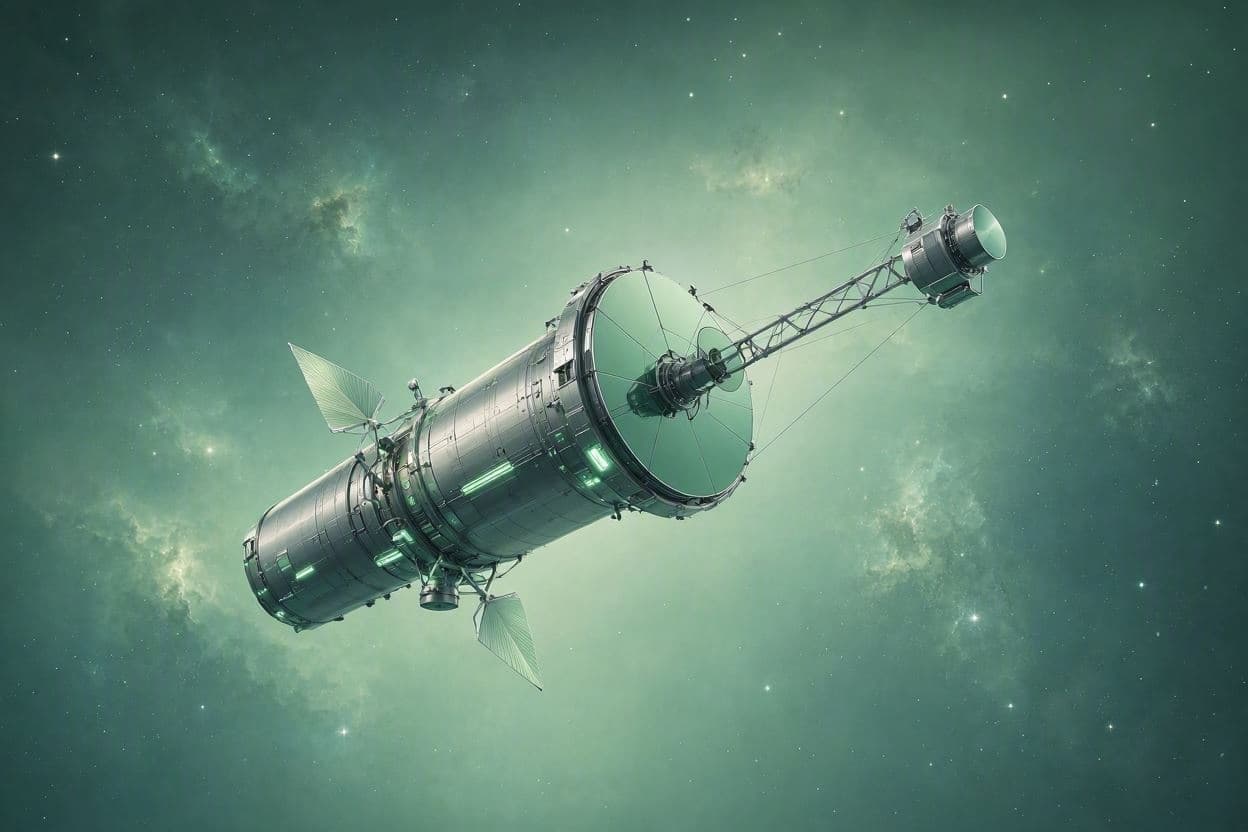
In the vast, silent theater of the cosmos, where light travels for eons to reach our eyes, a new observer is preparing to take its place. NASA’s Nancy Grace Roman Space Telescope has released its first test image, and it is unlike anything we have seen before. The stars, typically depicted as white or blue pinpricks against the black void, appear in striking shades of neon green. This unusual coloration is not a sign of alien life or cosmic anomaly, but rather a technical artifact of the testing process, yet it signals the dawn of a new era in astronomical discovery. It is a visual promise of the groundbreaking science to come.
The Roman telescope, named after the "mother of Hubble," is designed to survey the sky with unprecedented speed and precision. Its wide field of view allows it to capture large swaths of the universe in a single snapshot, making it ideal for studying dark energy, exoplanets, and infrared astrophysics. The test image, while preliminary, demonstrates the instrument’s sensitivity and resolution. The neon-green hue results from the specific filters and calibration methods used during the initial checks, a reminder that even in space, technology requires fine-tuning before it can reveal the true colors of the universe.
For astronomers, this milestone is deeply emotional. Years of planning, engineering, and patience have culminated in this moment. The telescope’s ability to detect faint infrared light means it can peer through dust clouds that obscure visible light, revealing hidden stellar nurseries and distant galaxies. The potential for discovery is immense, ranging from finding Earth-like planets to understanding the mysterious forces accelerating the universe’s expansion. It is a tool built not just to see, but to understand.
The public reaction to the image has been one of wonder and curiosity. Social media platforms buzzed with questions about the green stars, leading to educational opportunities for scientists to explain the nature of infrared imaging. This engagement is crucial, as public support often drives funding and interest in space exploration. By sharing these early glimpses, NASA invites everyone to participate in the journey of discovery. It transforms complex science into a shared human experience.
Beyond the aesthetic appeal, the technical success of the test bodes well for the mission’s future operations. The telescope’s coronagraph, a device designed to block out starlight to reveal orbiting planets, is also undergoing rigorous testing. If successful, it could directly image exoplanets for the first time, providing data on their atmospheres and potential habitability. This capability represents a significant leap forward in the search for life beyond our solar system. It is a step toward answering one of humanity’s oldest questions.
The Roman telescope joins a growing fleet of space observatories, including the James Webb Space Telescope. Rather than competing, these instruments complement each other, offering different perspectives on the cosmos. While Webb focuses on deep, detailed views of specific objects, Roman will conduct broad surveys, mapping the structure of the universe. Together, they form a comprehensive network of observation, enhancing our collective knowledge. It is a collaborative effort that transcends national borders.
As the telescope moves closer to its full operational status, anticipation builds within the scientific community. Researchers are already proposing studies that will utilize its unique capabilities. The data it generates will likely challenge existing theories and inspire new ones. It is a reminder that science is not static but a dynamic process of inquiry and revision. Each image, each spectrum, adds a piece to the puzzle of existence.
In the end, the neon-green stars are a symbol of potential. They represent the threshold between what we know and what we have yet to discover. As the Roman telescope begins its mission, it carries with it the hopes of scientists and dreamers alike. We are indeed on our way to groundbreaking science, guided by the light of distant suns and the ingenuity of human curiosity. The universe is waiting to be seen in a new light.
AI Image Disclaimer: The visual representations included here are AI-generated illustrations designed to depict space telescopes and abstract cosmic scenes, not actual photographs of the specific test image or the Roman telescope in orbit.
Sources: NASA Space.com Syfy Wire
Published by Banx Network. This article is part of the Banx decentralized media programme, powered by the BXE token on the XRP Ledger.