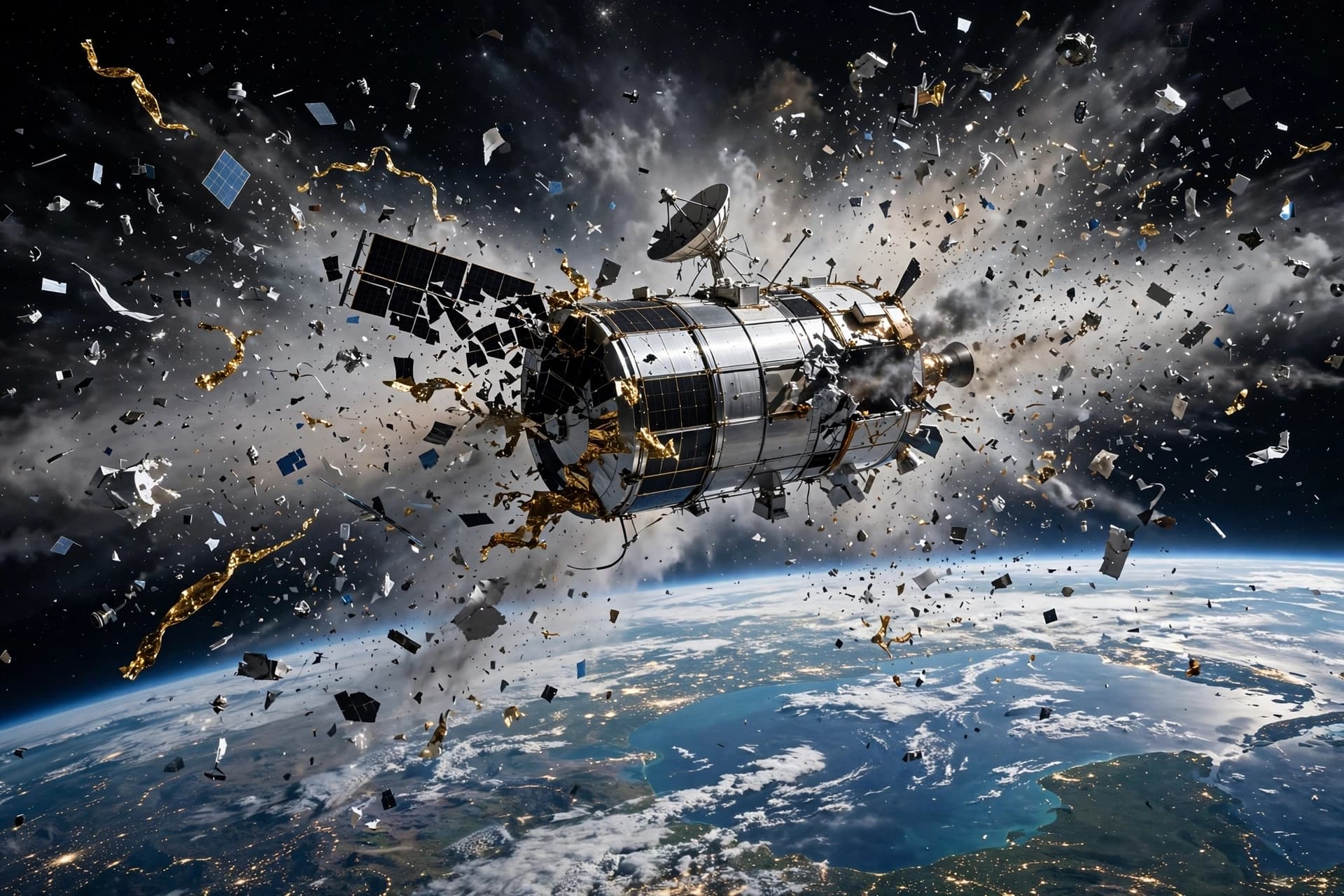
There is a strange symmetry in a spy satellite that spent decades silently listening to the Soviet Union, only to vanish in a cloud of debris that no one saw coming. On September 13, 2026, a Cold War-era American intelligence satellite known as USA-32—nicknamed Farrah III—broke apart in low Earth orbit, 775 kilometers above the planet . The U.S. Space Force confirmed the fragmentation four days later. The cause remains unknown.
USA-32 was launched on September 5, 1988, aboard a Titan II rocket as part of a classified National Reconnaissance Office program . Its mission, only fully declassified earlier this year, was to intercept Soviet radar and radio signals from space . The satellite was a large, cylindrical spacecraft—described by experts as resembling a "tuna can"—and was the third in a series nicknamed after actress Farrah Fawcett, following the NRO's practice of naming its secret satellites after famous figures from the 1970s and 1980s .
The satellite likely ceased functioning decades ago and had been silently orbiting Earth ever since. Then, without warning, it shattered. Private satellite-tracking company s2a systems photographed the largest remaining fragment in the night sky, confirming the severity of the event . Simulations suggest the debris spread into a vast ring around Earth within 24 hours .
What caused the breakup is still a mystery. Collisions with other satellites or known space debris are considered unlikely, as no other spacecraft was reported struck, and such impacts can usually be predicted . A more probable explanation is simple aging. After 38 years of exposure to the harsh environment of low Earth orbit, a pressurized propellant tank or a battery cell may have ruptured . "Old spacecraft carry batteries and leftover propellant," Spaceweather.com noted. "After 38 years of heating and cooling, a pressurized tank or a battery cell on USA 32 may have simply ruptured" .
The debris now poses a real concern. The region where USA-32 broke apart is home to at least 200 other satellites and already contains debris from a 2009 collision between American and Russian spacecraft . The newly created fragments remain unquantified, and their trajectories could eventually bring them into the path of the International Space Station or China's Tiangong station . As the debris drifts lower under the influence of gravity and atmospheric drag, avoidance maneuvers may become necessary.
The cause of the breakup may take months or years to determine, as researchers attempt to reverse-engineer the event by tracking fragments back to their origin. For now, a piece of Cold War history has become a hazard—a silent listener turned silent threat, circling the planet in pieces.
AI Image Disclaimer: The visual materials in this article were produced by artificial intelligence and are used solely for illustrative purposes.
Sources: Gizmodo, Yahoo Tech, Discover Magazine, RTS, Live Science
Published by Banx Network. This article is part of the Banx decentralized media programme, powered by the BXE token on the XRP Ledger.