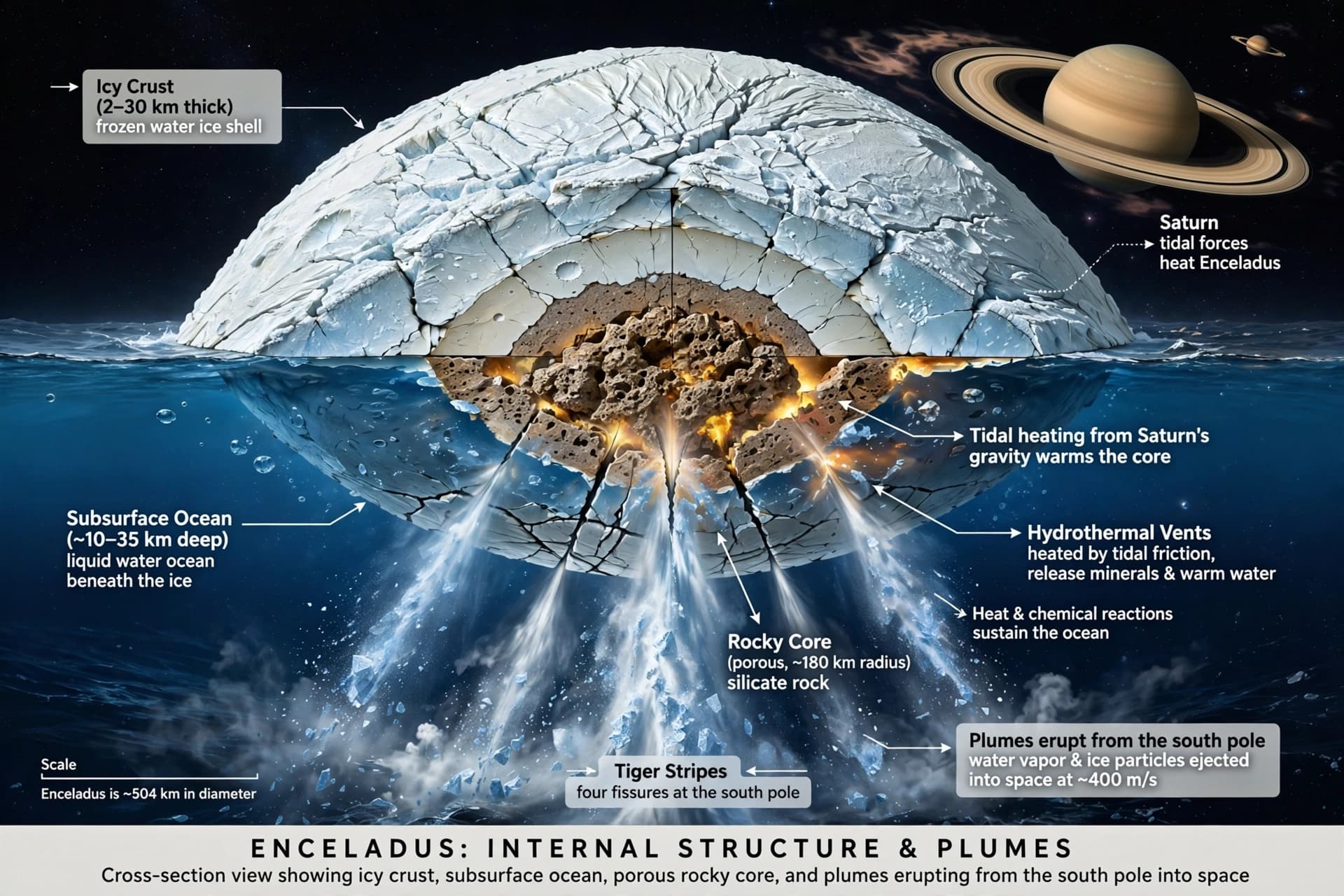
There is a quiet promise hidden in the plumes of Enceladus, a small moon of Saturn that has become one of the most compelling places to look for life beyond Earth. For years, scientists have known that beneath its icy crust lies a global ocean of liquid water, and that geysers near its south pole shoot samples of that ocean into space. The challenge has always been whether a future spacecraft could detect the faint chemical traces of life within those icy particles. New research suggests the answer may be easier than anyone expected.
Two studies published in Science Advances by researchers at Freie Universität Berlin, led by Professor Frank Postberg and Dr. Vanessa Helmbrecht, offer a dual reason for optimism. The first explains how Enceladus itself may be preparing concentrated samples for analysis. The second shows that certain Earth microbes could survive in conditions that mimic the moon's hidden ocean .
The key to the first discovery is how ocean droplets freeze as they travel through cracks in the ice shell. Scientists had assumed these droplets froze almost instantly. But laboratory experiments and a reexamination of Cassini data revealed a slower, more delicate process. As droplets rise and cool, dissolved salts and organic compounds separate from each other and become concentrated in different regions within the freezing ice . Sodium chloride, sodium carbonate, and other substances segregate into distinct pockets.
As these frozen droplets accelerate upward at speeds up to 1,000 kilometers per hour, they smash into the icy walls of the cracks, shattering into tiny fragments. Each fragment may contain a highly concentrated sample of just one component from the ocean. "Enceladus actually does a lot of the work for us in preparing samples for analysis that usually take a lot of effort in chemical labs on Earth," Postberg said .
For the search for life, this is significant. If a droplet contained material from a microbial cell, that material could be concentrated into a small number of ice particles in relatively pure form. A future spacecraft analyzing many particles might encounter one rich in biosignatures, making detection with existing technology far more feasible .
The second study adds another layer of plausibility. Researchers tested a methane-producing microorganism called Methanothermococcus okinawensis, an archaeon found near hydrothermal vents on Earth. They simulated the chemical conditions of Enceladus's ocean—highly alkaline, with limited carbon dioxide—and found that the microbe could survive and produce methane . This does not prove life exists there, but it demonstrates that the environment could support at least some forms of microbial metabolism.
Together, the findings strengthen Enceladus's position as a target for astrobiology missions. The proposed NASA Enceladus Orbilander and the European Space Agency's L4 mission concept are both designed to sample the plumes and search for biosignatures . The research suggests that when those missions fly, the moon may have already done much of the preparatory work for them.
AI Image Disclaimer: The images accompanying this article were generated by artificial intelligence and are intended for conceptual illustration only.
Sources: Science Advances, Freie Universität Berlin, Universe Today, Universe Space Tech, Yahoo News
Published by Banx Network. This article is part of the Banx decentralized media programme, powered by the BXE token on the XRP Ledger.