There is a particular kind of blindness that comes from distance, a way in which the very far becomes the very simple. For decades, when astronomers studied the atmospheres of planets beyond our solar system, they saw them as rings—uniform halos of gas, averaged into a single spectrum, stripped of their complexity. But a planet's atmosphere is not a ring. It is a three-dimensional thing, shaped by wind and heat and the relentless geometry of a star's gravity. Now, for the first time, scientists have mapped one, and it is not a sphere. It is lopsided.
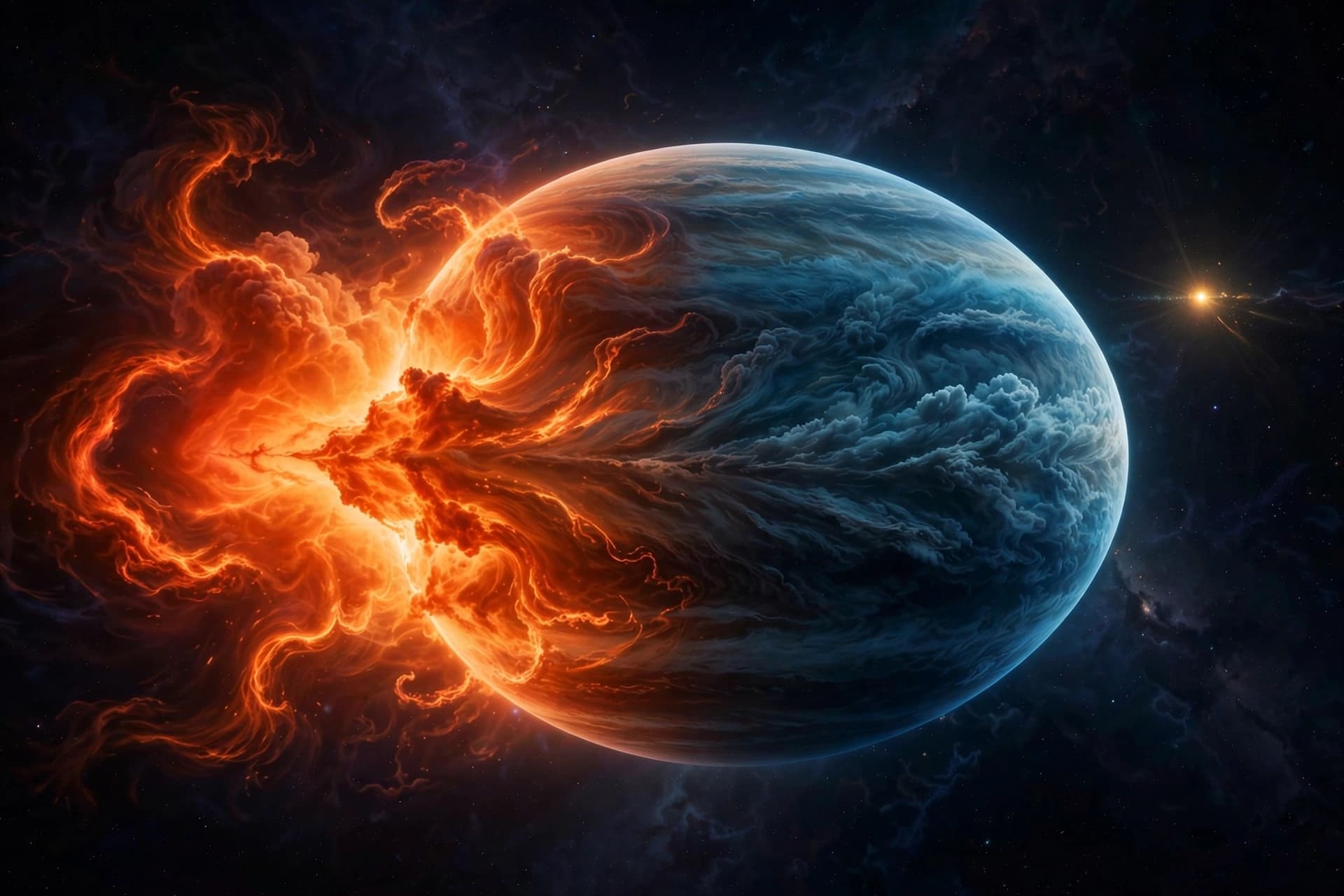
The planet is WASP-17b, a hot Jupiter some 1,300 light-years from Earth. It orbits its star every 3.7 days, so close that it is tidally locked—one side forever facing the star, the other forever in darkness . The temperature difference between the two sides drives winds of thousands of miles per hour, carrying heat from the day side to the night side. The result, as the new maps show, is an atmosphere that is inflated on one side and compressed on the other, more like an egg resting on its side than a perfect sphere.
The technique that made this possible is called "transmission strings," developed by Dr. David Grant at the University of Bristol and his colleagues. Traditional transmission spectroscopy averages the starlight that filters through the entire limb of the planet's atmosphere, blurring all its features into a single average spectrum. Transmission strings instead focuses on the moments of ingress and egress—the roughly 31 minutes when the planet is just crossing the edge of its star, and light shines through only small segments of its atmosphere . By analyzing those segments separately, the team could reconstruct the atmosphere's shape, piece by piece.
What they found confirmed what theorists had predicted. On the "evening" edge of the planet, where winds carry heat from the day side, the atmosphere is inflated to about 1.8 times the size of the "morning" edge . The temperature at the evening terminator reaches roughly 1,522 Kelvin, compared with about 858 Kelvin at the morning edge—a difference of some 650 degrees . The hot gas expands, the cool gas contracts, and the planet's silhouette becomes asymmetric.
The chemical composition, interestingly, is relatively uniform. Water vapor and carbon dioxide are distributed fairly evenly around the limb, despite the extreme temperature gradient. Methane and sulfur dioxide, however, show variations near the poles, surviving better away from the planet's jet streams . These are the kinds of details that averaged spectra could never reveal, the fine structure of a distant world's weather.
Dr. Lili Alderson of Cornell University, who led the study, described the result as a proof of concept. "This is proof of concept that planets are in fact 3D objects," she said, "and that consistently, as they go around their star, what we predict should be happening is happening" . The significance lies not only in what was found but in the method itself. Over 6,000 exoplanets have been confirmed, and the number of candidates is several times that. Transmission strings offers a way to study their atmospheres in three dimensions, one transit at a time.
The findings, published in Nature Astronomy, are the first empirical maps of an exoplanet's atmospheric shape. They do not resolve the planet into a photograph, nor do they reveal its surface or its clouds in any conventional sense. But they do something that averaged spectra could not: they show that the atmosphere has a shape, and that the shape is not simple. The far is not always simple. Sometimes it is merely far.
Image note: The visuals accompanying this article were generated using artificial intelligence and do not depict actual telescope data or imagery of WASP-17b.
Sources: The Conversation, EurekAlert, Universe Today, IFLScience, Nature Astronomy
Published by Banx Network. This article is part of the Banx decentralized media programme, powered by the BXE token on the XRP Ledger.