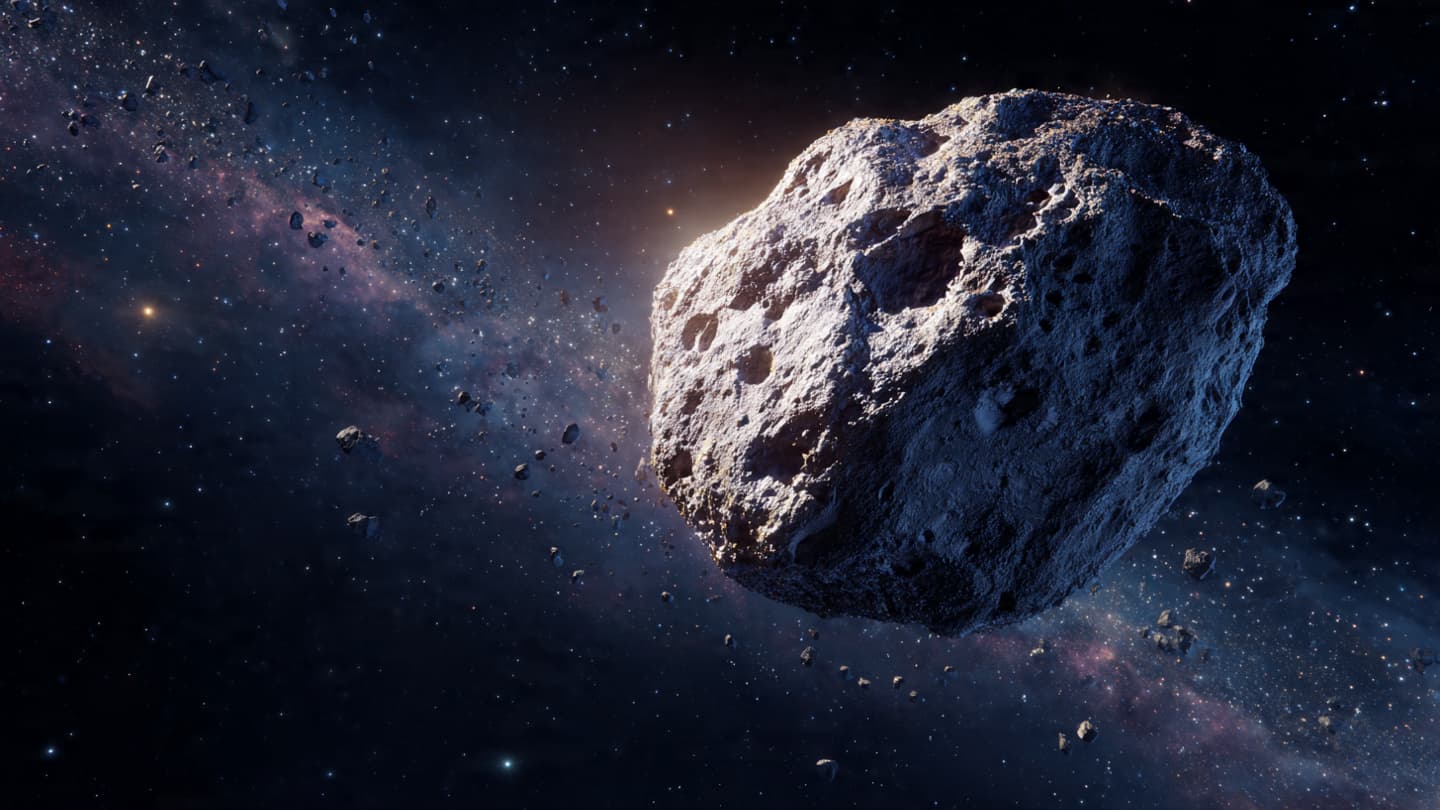
Far beyond the familiar horizon of Earth, space missions often unfold in silence, measured not by applause but by distance. The journey of NASA’s Psyche spacecraft carries that quiet sense of persistence as it continues its path toward one of the solar system’s most unusual destinations — a massive metal-rich asteroid believed to hold clues about planetary formation.
Launched as part of NASA’s broader scientific exploration program, the Psyche mission is designed to study asteroid 16 Psyche, located within the asteroid belt between Mars and Jupiter. Scientists believe the object may represent the exposed core of an early planetary body, offering researchers a rare opportunity to observe material usually hidden deep beneath planetary surfaces.
Before reaching the asteroid itself, the spacecraft is expected to perform a gravity assist maneuver near Mars. This technique allows the probe to use the planet’s gravitational pull to adjust speed and trajectory while conserving fuel. Engineers have described the maneuver as one of the mission’s important navigational milestones.
Researchers are especially interested in the asteroid’s metallic composition. Unlike many rocky or icy bodies observed throughout the solar system, Psyche may contain large amounts of iron and nickel. Some scientists compare its structure to Earth’s internal core, though they caution that much remains unknown until direct observation becomes possible.
The mission also reflects the growing sophistication of deep-space exploration technology. NASA equipped the spacecraft with advanced imaging systems, magnetometers, and communication experiments designed to improve scientific understanding and future interplanetary navigation. Engineers continue monitoring the probe closely as it travels through increasingly distant regions of space.
Interest in asteroid science has expanded significantly over the past decade. Beyond questions of planetary history, researchers believe asteroid studies may improve understanding of resource distribution throughout the solar system and help refine long-term planetary defense strategies. Missions like Psyche contribute valuable data to that evolving scientific effort.
Public fascination with the mission has grown as well. Images and animations released by NASA have sparked discussion across classrooms, observatories, and online communities. For many observers, the mission represents not only scientific ambition but also a reminder of humanity’s enduring curiosity about distant worlds.
Despite the excitement surrounding the project, scientists emphasize the importance of patience. Deep-space exploration unfolds across years rather than days, requiring careful coordination between engineering teams, astronomers, and mission planners. Each successful maneuver becomes one step within a much larger scientific timeline.
As the Psyche spacecraft approaches Mars on its long journey outward, the mission continues to symbolize both technical achievement and scientific wonder. In the quiet darkness beyond Earth, researchers hope the metallic asteroid waiting ahead may reveal fragments of a story that began billions of years ago.
AI Image Disclaimer: This article includes AI-generated visual interpretations created to support scientific storytelling and editorial presentation.
Sources: Reuters, NASA, Space.com
Published by Banx Network. This article is part of the Banx decentralized media programme, powered by the BXE token on the XRP Ledger.