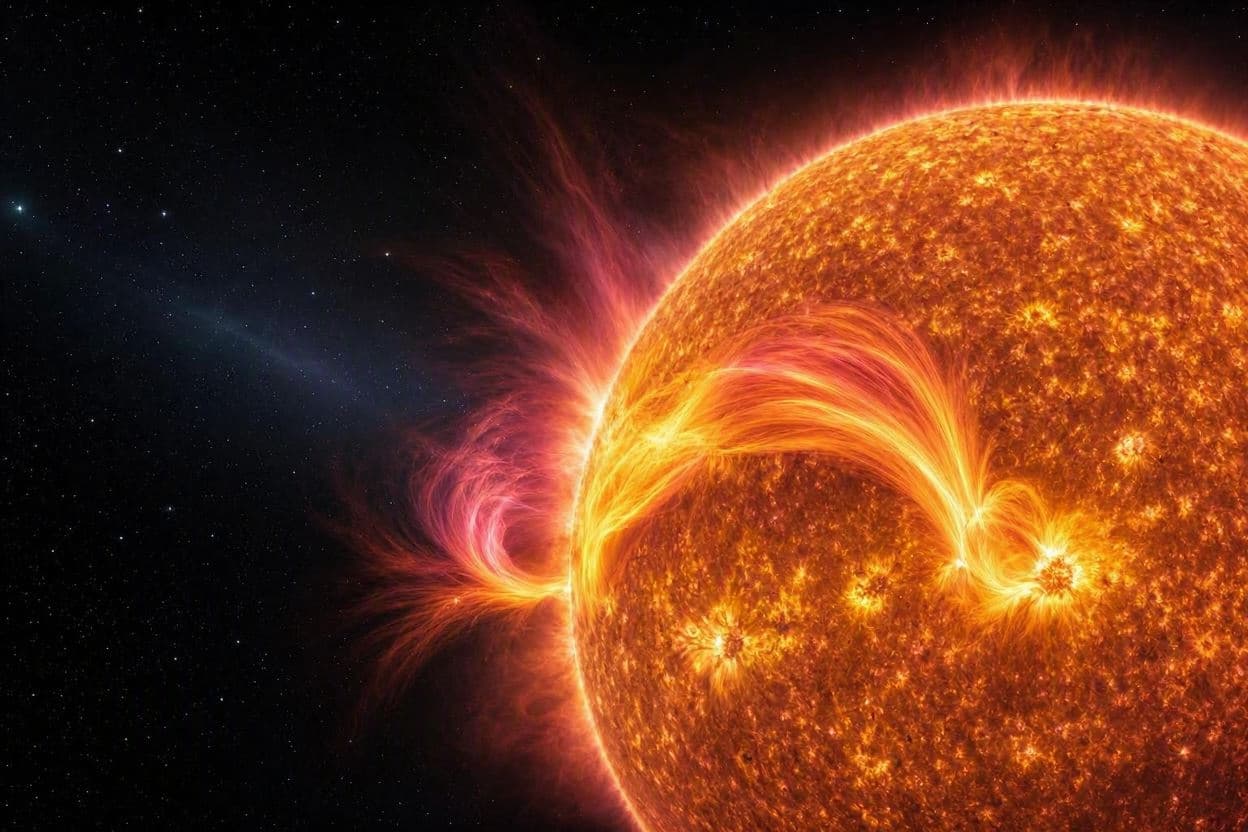
The Sun, our constant companion in the sky, is far from static. It is a dynamic star, prone to outbursts that send ripples of energy across the solar system. Recently, a significant portion of solar material was ejected into space, a phenomenon known as a coronal mass ejection. This event, while common in the life of our star, carries the potential to interact with Earth’s magnetic field, creating geomagnetic storms that can light up the skies and affect our technological infrastructure.
Coronal mass ejections, or CMEs, are massive bursts of solar wind and magnetic fields rising above the solar corona. When directed toward Earth, they can travel millions of miles, arriving within a few days. The recent ejection was notable for its size and speed, prompting space weather forecasters to issue alerts. Such events are part of the Sun’s natural cycle, which peaks approximately every eleven years, bringing increased activity and more frequent eruptions.
The interaction between these solar particles and Earth’s magnetosphere is a delicate dance. When the charged particles collide with our protective magnetic shield, they can cause disturbances known as geomagnetic storms. These storms can range from minor to severe, depending on the strength of the CME and the orientation of its magnetic field. While often harmless to humans on the ground, they can pose risks to satellites, power grids, and communication systems.
One of the most visible and beautiful effects of these storms is the aurora. The charged particles excite atoms in the upper atmosphere, causing them to emit light in vibrant shades of green, pink, and purple. For many, the prospect of seeing the northern lights at lower latitudes is a welcome side effect of solar activity. It is a reminder of the connection between our planet and the star that sustains it.
However, the potential for disruption requires careful monitoring. Space weather agencies around the world track solar activity closely, providing forecasts that allow industries to take preventive measures. Satellites can be put into safe modes, and power grid operators can adjust loads to mitigate risks. This preparedness is crucial in our increasingly technology-dependent society, where the effects of space weather can be far-reaching.
The recent event serves as a reminder of the Sun’s power and the importance of understanding space weather. As we rely more on satellite technology for navigation, communication, and climate monitoring, our vulnerability to solar storms increases. Research into solar dynamics helps improve prediction models, allowing for better preparation and response. It is a field of study that combines astronomy, physics, and engineering to protect our modern way of life.
Despite the potential risks, there is a sense of awe in witnessing these celestial events. The Sun’s eruptions are a display of raw energy, a testament to the nuclear fusion that powers it. Observing the effects of a CME, whether through scientific data or the beauty of an aurora, connects us to the broader cosmic environment. It is a humbling experience that highlights our place in the solar system.
As the solar storm approaches and passes, we are reminded of the dynamic nature of our star. The ejection of solar material is a natural process, one that has occurred for billions of years. By monitoring and understanding these events, we can better appreciate the forces at play and ensure the resilience of our technological systems. It is a balance of respect for nature’s power and confidence in our ability to adapt.
AI Image Disclaimer: The accompanying visuals are AI-generated artistic representations intended for illustration and do not depict actual solar imagery.
Sources: EarthSky Space Weather Live NOAA Space Weather Prediction Center Space.com
Published by Banx Network. This article is part of the Banx decentralized media programme, powered by the BXE token on the XRP Ledger.