
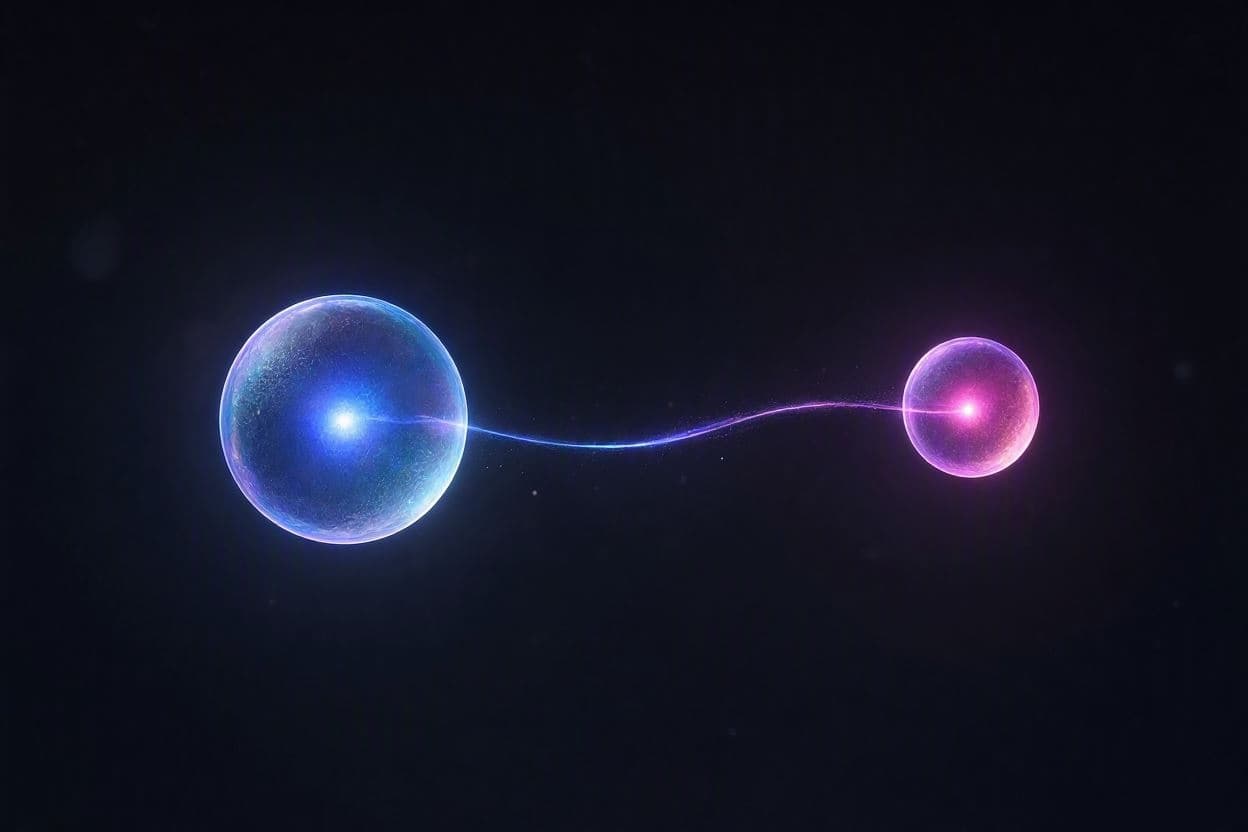
In the quiet hum of the Large Hadron Collider, where particles dance at speeds approaching light, there exists a realm where intuition often surrenders to mystery. We have long understood that the subatomic world operates by rules distinct from our daily experience, yet recent findings remind us that even within this established framework, surprises await those who look closely enough. The discovery that Z bosons may exhibit quantum entanglement is not merely a technical footnote; it is a gentle invitation to reconsider the delicate threads connecting the fundamental building blocks of our universe.
The ATLAS experiment, a monumental collaboration of scientists and engineers, has sifted through vast oceans of data to uncover a subtle pattern. This pattern suggests that Z bosons, particles responsible for carrying the weak nuclear force, can become entangled. Entanglement, famously described by Einstein as "spooky action at distance," implies that two particles remain connected such that the state of one instantly influences the other, regardless of the space between them. While this phenomenon is well-documented in photons and electrons, observing it in heavy, short-lived particles like the Z boson is a significant leap forward.
This finding does not overturn the Standard Model of particle physics but rather enriches its texture. It suggests that quantum correlations persist even in high-energy environments where particles are created and decay in fractions of a second. For physicists, this is akin to finding a familiar melody played in an unexpected key. It confirms that the principles of quantum mechanics are robust, extending their reach into regimes previously thought to be dominated by classical statistical behaviors.
The implications for our understanding of reality are profound yet understated. If heavy bosons can be entangled, it reinforces the idea that the universe is fundamentally interconnected at its deepest levels. This interconnectivity is not a metaphorical concept but a measurable physical property. It challenges us to think beyond isolated events and consider the web of relationships that define particle interactions. Such insights are crucial for refining our models of the early universe, where similar high-energy conditions prevailed.
Moreover, this discovery highlights the enduring value of meticulous data analysis. The signal was not loud or obvious; it required sophisticated algorithms and a deep understanding of background noise to isolate. It serves as a reminder that scientific progress often comes not from dramatic breakthroughs but from the patient accumulation of evidence. The teams involved have demonstrated that even in well-trodden fields, there is still much to learn if we listen carefully to what the data is saying.
From a technological perspective, understanding entanglement in diverse particle systems could have long-term benefits. While immediate applications may not be visible, the foundational knowledge gained here contributes to the broader field of quantum information science. As we learn to manipulate and measure these delicate states, we build the toolkit for future technologies that may one day harness quantum properties in ways we can currently only imagine.
The scientific community receives this news with a sense of cautious optimism. It is a validation of theoretical predictions and experimental precision. Yet, it also opens new questions. How widespread is this entanglement? What other particles might exhibit similar behaviors under different conditions? These questions will guide the next phase of research, ensuring that the quest for understanding remains as dynamic as the particles themselves.
As we reflect on this discovery, we are reminded that the universe is more intricate and interconnected than our everyday senses suggest. The ATLAS collaboration’s work offers a glimpse into this hidden order, inviting us to appreciate the elegance of physical laws. It is a testament to human curiosity and the relentless pursuit of knowledge, showing that even in the smallest corners of existence, there is always more to discover.
AI Image Disclaimer: The accompanying visual representations are generated by artificial intelligence to illustrate conceptual themes and do not depict actual experimental data.
Published by Banx Network. This article is part of the Banx decentralized media programme, powered by the BXE token on the XRP Ledger.



