
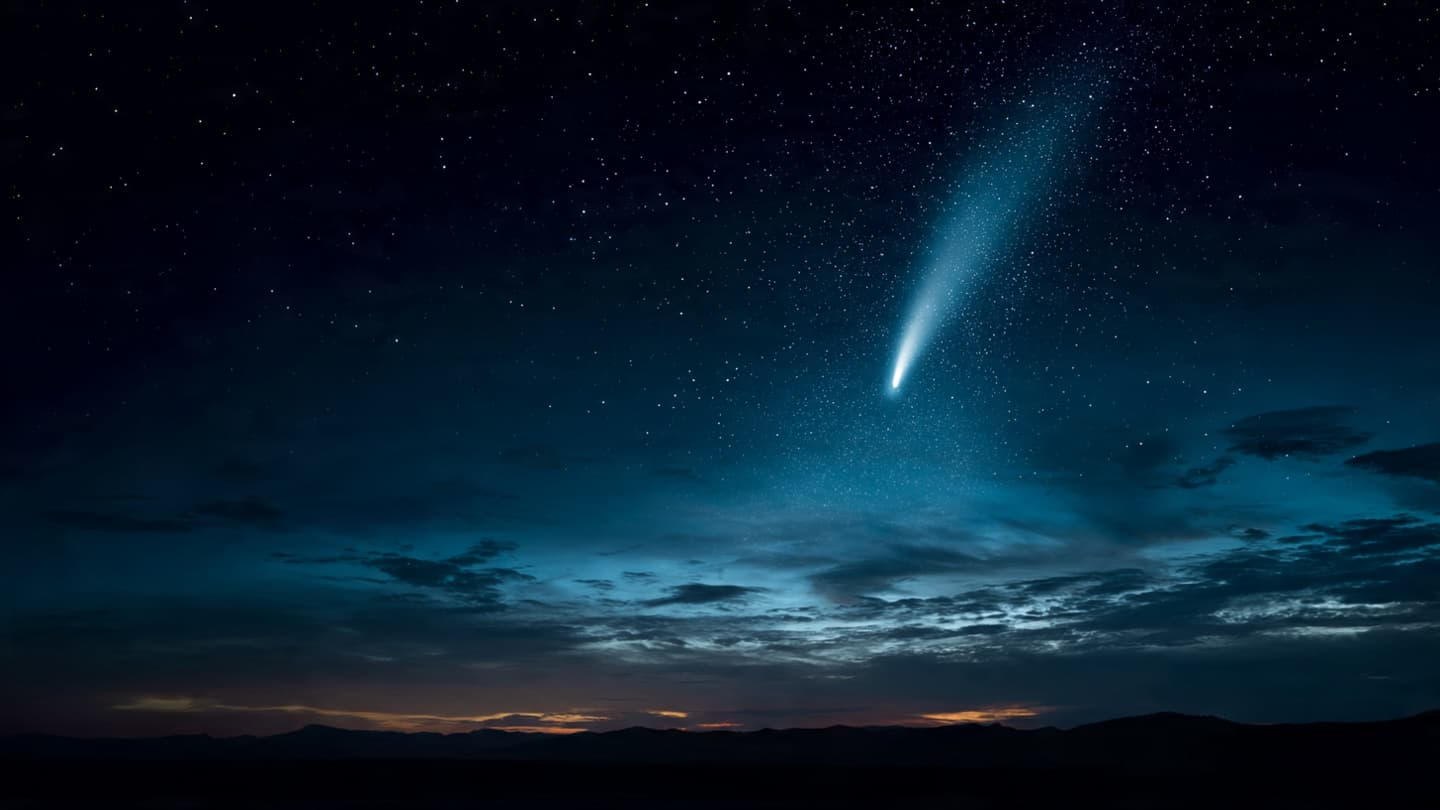
The night sky has always held a quiet power, inviting both curiosity and reflection. Over New Zealand, that sky recently revealed a rare visitor—Comet C/2025 R3 (PanSTARRS), passing through the solar system after an extraordinary journey.
Astronomers describe the comet as a long-period object, meaning it travels on an orbit that takes tens of thousands of years to complete. Its appearance offers a rare opportunity for observation and scientific study.
As it approaches the inner solar system, sunlight interacts with its icy composition, creating a faint glowing coma and a trailing tail of dust and gas. This visual phenomenon makes it visible under favorable conditions from Earth.
Observatories across the Southern Hemisphere have been tracking its movement to analyze its chemical composition. Early data suggests a mixture of primordial ice and organic compounds, offering insight into the early solar system.
Beyond scientific value, such celestial events often capture public imagination. Communities gather for night-sky observations, sharing a sense of connection under a common sky.
Scientists emphasize that comets like this serve as natural time capsules. They preserve materials from the formation of planetary systems billions of years ago, making them valuable for understanding cosmic history.
While the comet will eventually move beyond visible range, its data will continue to be studied long after its departure from Earth’s skies.
For a brief moment in cosmic time, Comet C/2025 R3 offers both knowledge and wonder, reminding observers of the vastness and continuity of the universe.
AI Image Disclaimer: Images in this article are AI-generated for editorial visualization purposes.
Sources (source verification check): NASA, Royal Astronomical Society, ScienceDaily Astronomy, RNZ Science, The Guardian Science Section
Published by Banx Network. This article is part of the Banx decentralized media programme, powered by the BXE token on the XRP Ledger.



