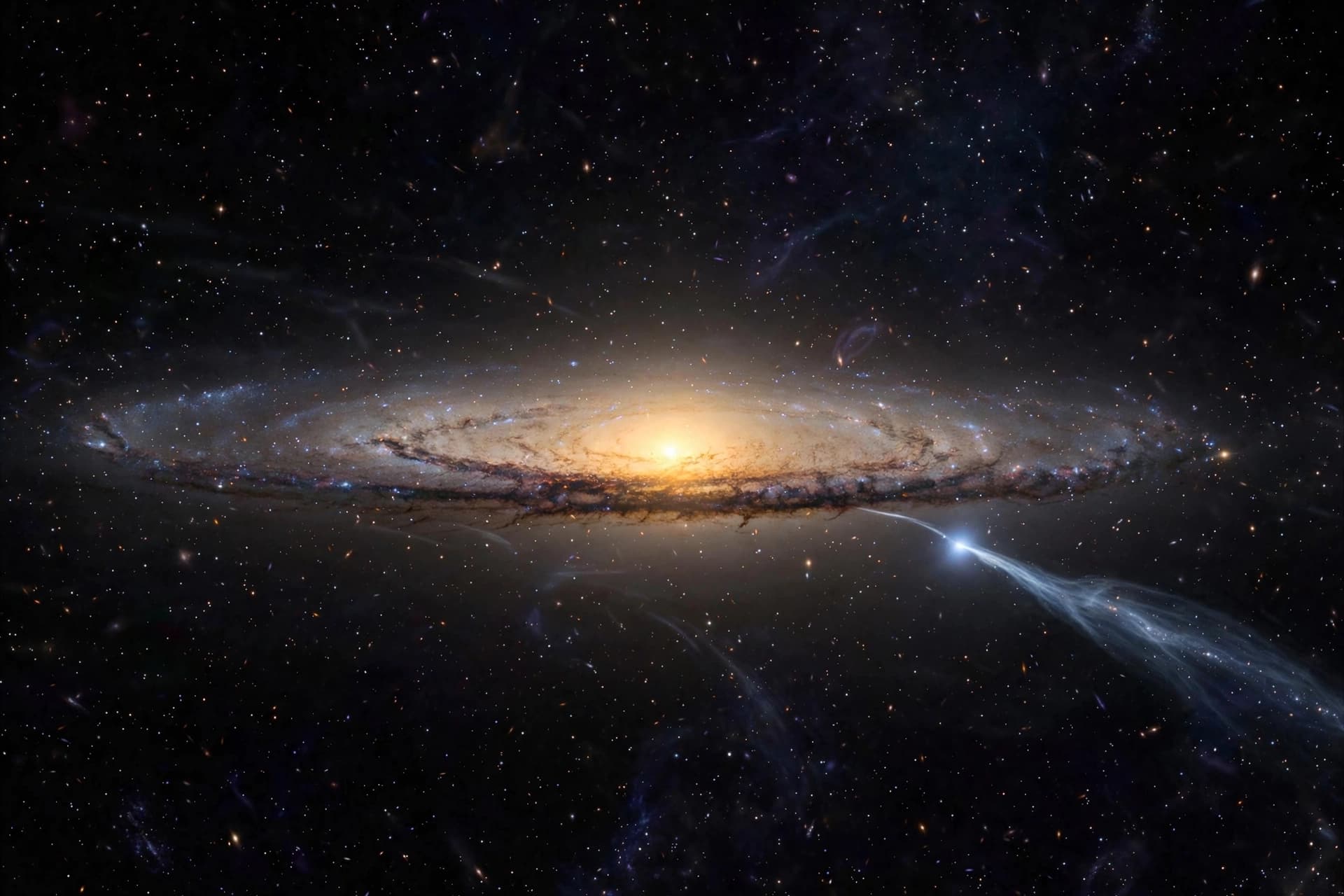
There is a particular kind of hope that comes when we point our instruments at the sky and hear something answer back—not a voice, not a message, but a signature. For decades, astronomers have detected radio emissions from distant stars and from brown dwarfs, but never from an exoplanet itself. The signals were always drowned in the noise of their host stars, indistinguishable from the stellar static. Now, for the first time, researchers have isolated a radio signal that comes directly from a planet beyond our solar system.
The signal originates from Beta Pictoris b, a gas giant approximately 64 light-years from Earth . Observations were conducted using the MeerKAT radio telescope array in South Africa across four sessions between 2025 and 2026 . The researchers, from the Harvard-Smithsonian Center for Astrophysics and the University of Oregon, detected short, repeating bursts of circularly polarized radio waves—the same type of emission produced by auroras on Earth and Jupiter .
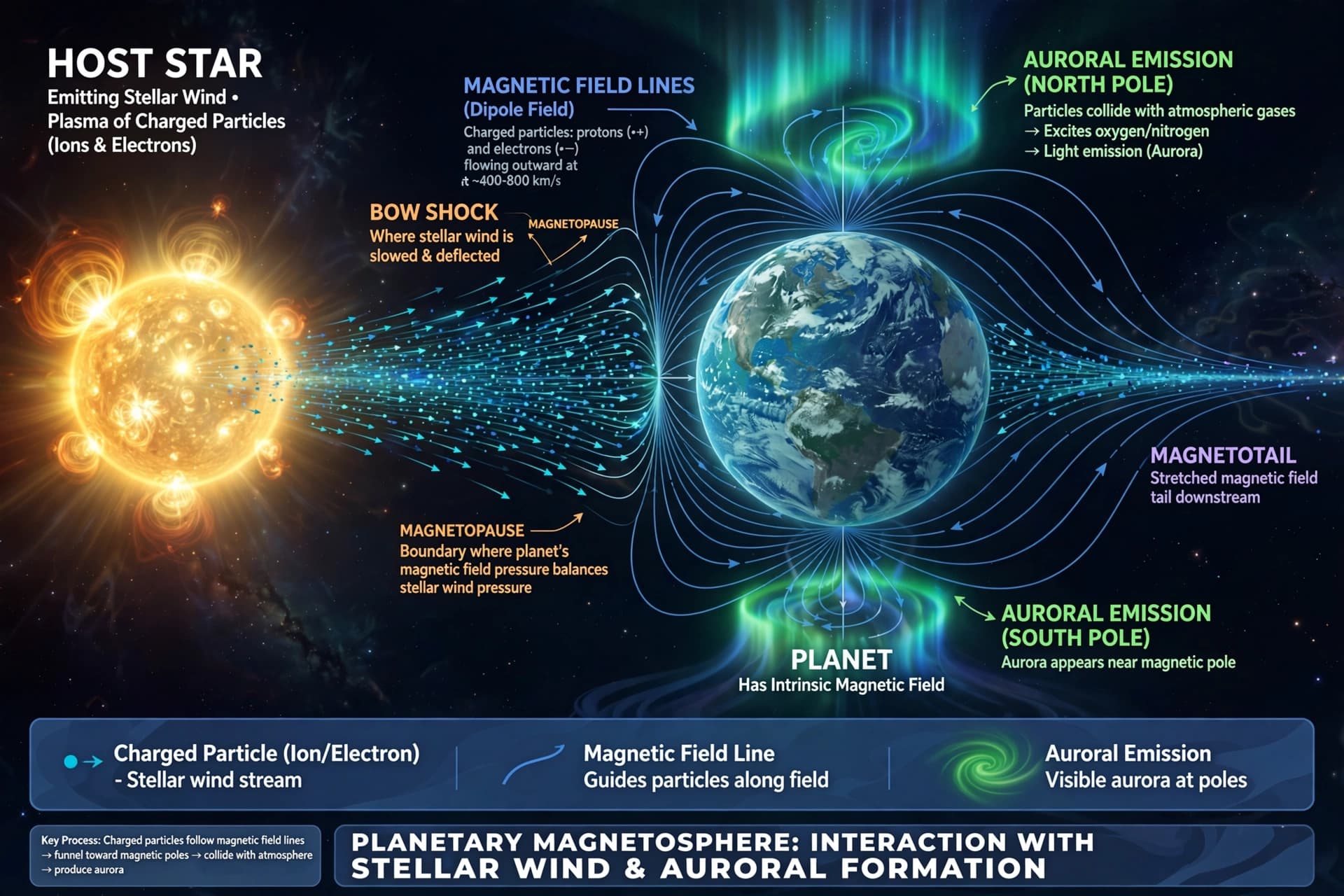
The signal is not a message. It is a natural phenomenon, generated by the same process that creates the Northern Lights: charged particles from the host star interact with the planet’s magnetic field and atmosphere, releasing energy as radio waves . “There are two natural processes that can produce radio emission on exoplanets,” said Suzanne Aigrain, a professor of astrophysics at Oxford. “One is magnetic reconnection. The other is auroras, like on Earth or Saturn, when energetic charged particles interact with the upper layers of the planet’s atmosphere. That is the second effect the scientists detected” .
What makes the detection significant is not the signal itself but what it reveals. By isolating the radio emission, researchers were able to measure the magnetic field of an exoplanet for the first time. Beta Pictoris b’s magnetic field is approximately 1,250 gauss—thousands of times stronger than Earth’s and 290 times stronger than Jupiter’s . The planet’s rapid rotation, completing one turn in just 8 to 9 hours, and its mass of 10 to 12 times that of Jupiter help explain the intensity .
The technical challenge was separating the planet’s faint signal from the overwhelming radio noise of its host star. The team used distant quasars—extremely bright galactic cores that appear nearly stationary in the sky—as calibration reference points, allowing them to pinpoint the source with confidence . “Astronomers have been looking for radio signals from exoplanets for a long time,” Aigrain said. “There were preliminary, indirect indications before, but this time a convincing direct proof has been obtained” .
Beta Pictoris b is a gas giant with no solid surface and is not considered habitable. But the technique has broader implications. Magnetic fields act as shields, protecting atmospheres from stellar winds and surfaces from harmful radiation. Mars lost its magnetic field and, with it, its atmosphere and surface water . The ability to remotely measure magnetic fields on distant planets will allow scientists to assess which rocky worlds might retain liquid water and potentially support life .
“Although auroral radio bursts are observed in Solar System planets and in some ultracool dwarfs, no radio detection has previously been unambiguously localised to an extrasolar planet rather than its host star,” the researchers wrote in their paper . The work is published as a preprint and has not yet been peer-reviewed, but it represents a new method for studying the magnetic environments of worlds beyond our solar system. For now, the signal is a natural phenomenon, not a greeting. But it is a beginning.
AI Image Disclaimer: The visuals accompanying this article were produced by artificial intelligence and are for illustrative purposes only.
Sources: The Sun, CNN Greece, Vietnam.vn, AiF, LiveScience
Published by Banx Network. This article is part of the Banx decentralized media programme, powered by the BXE token on the XRP Ledger.