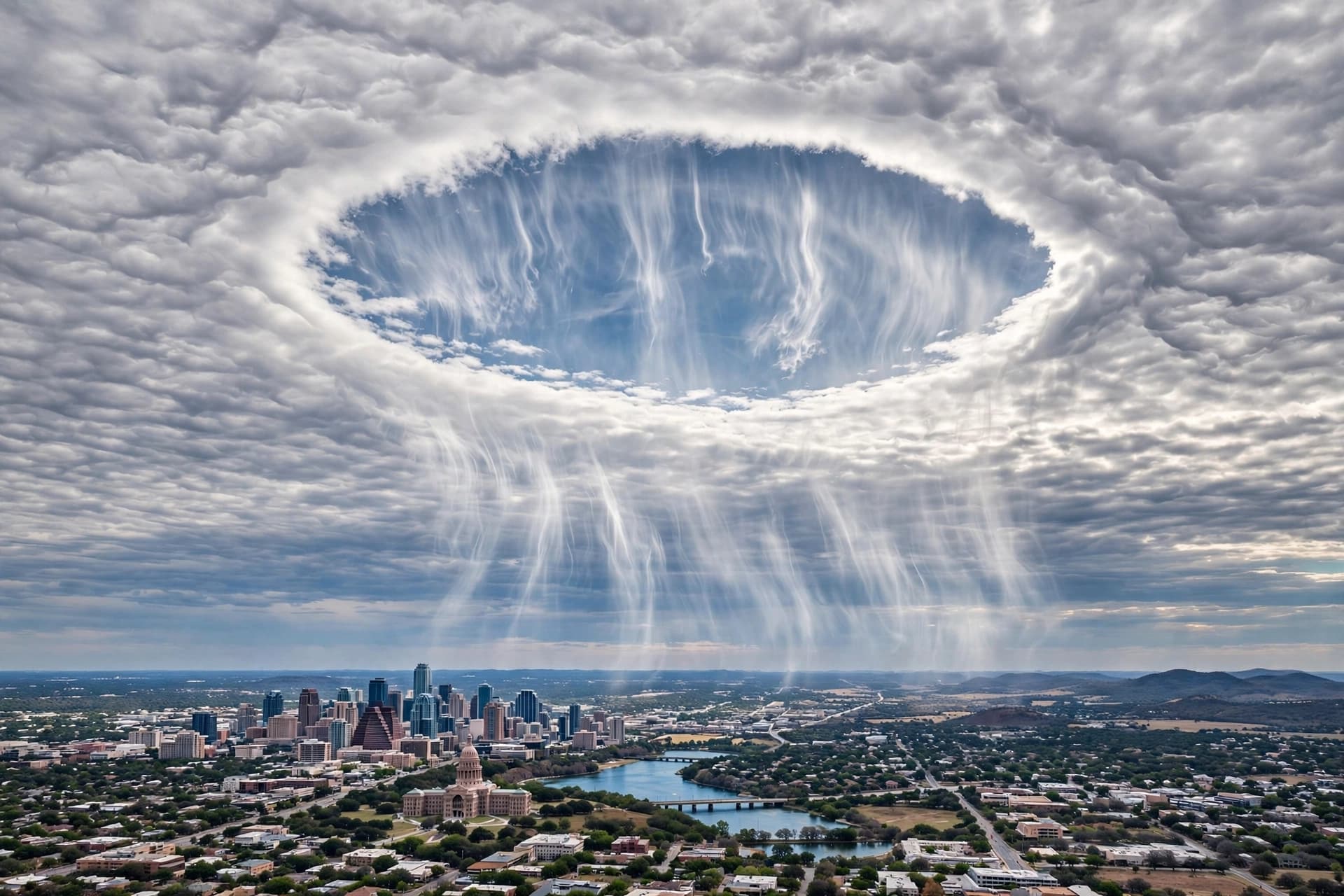
There is a particular delight in looking up and seeing something the sky has never shown you before—a shape that seems too deliberate to be accidental, too perfect to be random. On Saturday afternoon, residents of the Austin area were treated to such a sight: a vast, circular gap in the clouds, ringed by wispy streaks of falling ice, as if the sky had been punched through by an invisible hand.
The formation is known as a hole punch cloud, or fallstreak hole. It appeared in the region's altocumulus cloud deck on Saturday afternoon, leaving behind a "giant circle in the sky" that prompted curiosity among residents and meteorologists alike . The phenomenon is rare but not inexplicable, and its explanation lies in the delicate physics of supercooled water.
Altocumulus clouds are composed of water droplets that have been cooled below freezing but have not yet turned to ice—a state known as supercooled water. When an aircraft passes through such a cloud, the propellers or wings can introduce ice crystals, which then trigger a chain reaction. The supercooled droplets freeze rapidly and fall as virga, leaving behind a hole where the cloud once was . The streaks of falling ice that ring the hole are the visible evidence of that cascade.
Hole punch clouds are not uncommon in regions where aircraft traffic intersects with the right cloud conditions, but they remain striking enough to draw attention whenever they appear. The one over Austin on Saturday was particularly large and distinct, a perfect circle framed by the soft grey of altocumulus and the pale blue of an autumn sky . For the people who saw it—driving, walking, looking up from a backyard—it was a moment of unexpected beauty, the kind of thing that makes a person stop and point.
What makes such phenomena meaningful is not their rarity but their accessibility. You do not need a telescope or a laboratory to witness a hole punch cloud. You need only to be outside, to look up, and to notice when the sky does something unusual. In a world where so much of nature's spectacle requires planning and travel and expense, the sky offers its wonders for free, to anyone who happens to glance upward at the right moment.
The cloud dissipated, as clouds do, and the afternoon resumed its ordinary course. But for those who saw it, the memory remains: a perfect circle in the sky, a reminder that the atmosphere is not a static backdrop but a living system, capable of surprise. The sky over Austin is the same sky it has always been, but for a few hours on Saturday, it showed its capacity for the unexpected.
AI Image Disclaimer: This article includes AI-generated imagery created for illustrative purposes only.
Sources: KXAN, Hoodline
Published by Banx Network. This article is part of the Banx decentralized media programme, powered by the BXE token on the XRP Ledger.