There is a certain patience required to map a world you have never walked, to piece together the story of a planet's ancient oceans and vanished atmospheres from orbit and from the tracks of a single rover. China has been building that story for years, and now it has set a date for its most ambitious cartographic effort yet: a new-generation geological map of Mars, to be completed by the end of 2028.
The plan was revealed by Hou Zengqian, an academician of the Chinese Academy of Sciences and chief scientist of the Tianwen-3 Mars sample-return mission, at a symposium in Beijing. The map will aim to reconstruct the red planet's watery past and introduce a Chinese system for dividing Martian geologic time .
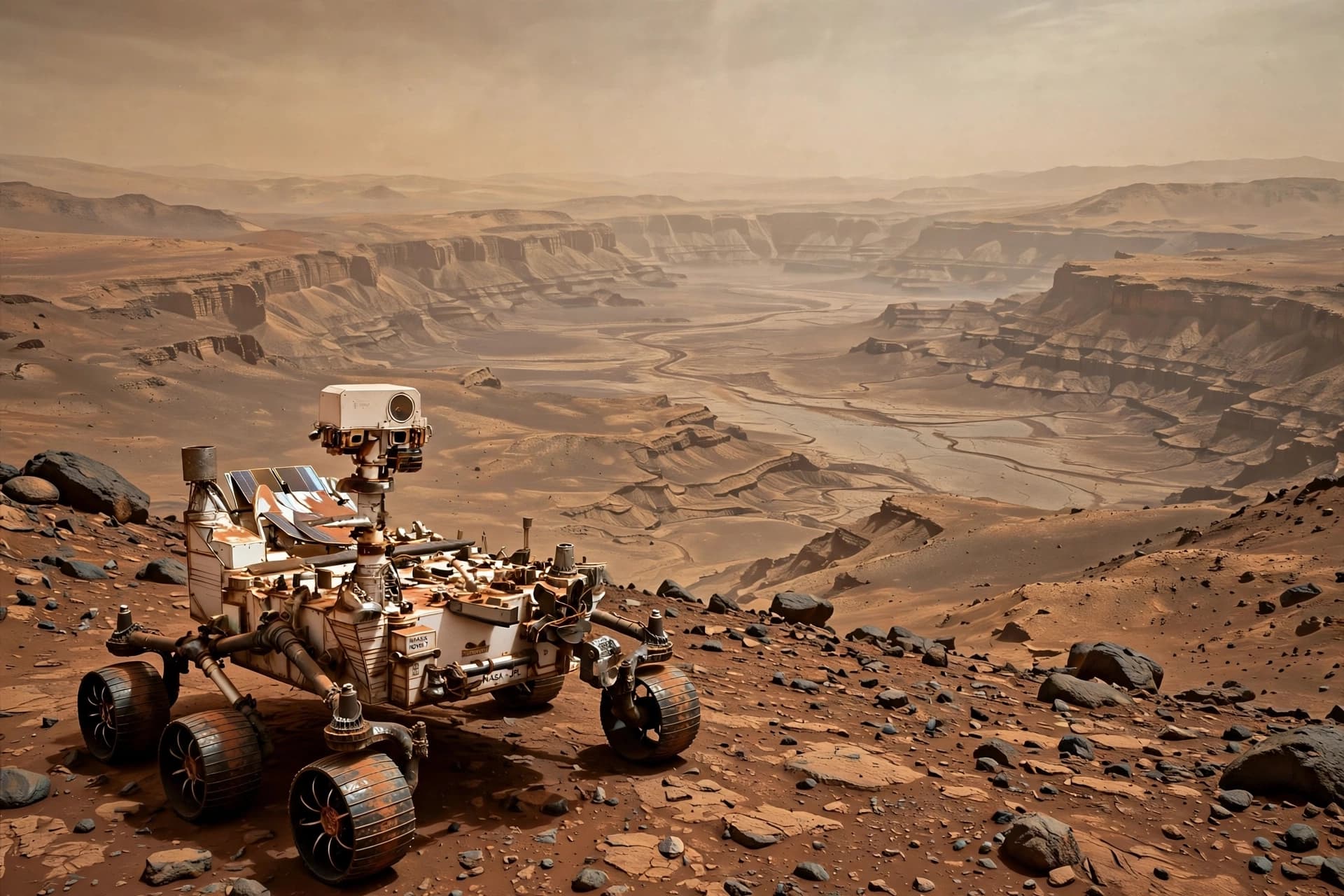
The foundation for this effort comes from Zhurong, the rover China landed in 2021 as part of its Tianwen-1 mission. Zhurong offered new clues about Mars's water history: evidence that a vast ancient ocean still existed some 3.5 billion years ago, and that short-lived floods may have occurred as recently as 1.6 billion years ago . These findings help fill gaps in the evidence chain of how Mars's ancient climate evolved.
The new map will also propose a Chinese scheme for dividing Martian geologic time. The current timeline splits Mars into the Noachian, Hesperian, and Amazonian periods, defined by the density of visible craters rather than absolute dates. China aims to make its new scheme an international consensus, Hou said .
The project will primarily use data from Tianwen-1, supplemented by information from U.S. and European Space Agency Mars probes. By fusing imagery, spectra, radar, gravity, and magnetic readings, the team will build a global database that couples the planet's multiple physical fields . Artificial intelligence will sit at the heart of interpretation, with geologists' expertise embedded in large models through rule engines to keep results explainable.
The deliverables due by the end of 2028 include a 1:5 million-scale Martian geologic map, a 1:50,000-scale map of the landing area, and a series of thematic atlases. The project will also release what it describes as the world's first intelligent geologic map of Mars, providing a template for future mapping of the moon, Venus, and asteroids .
Geologic mapping has been a core task of the Institute of Geology under the Chinese Academy of Geological Sciences for 70 years, its director Yang Zhiming noted. Its maps have extended from regional and national charts to the moon and now Mars. That work, he explained, has given China's planetary program the scientific grounding to decide where to go, what to explore, and why .
AI Image Disclaimer: The visual materials in this article were produced by artificial intelligence and are used solely for illustrative purposes.
Sources: Xinhua, ANTARA News, Institute of Geology, Chinese Academy of Geological Sciences
Published by Banx Network. This article is part of the Banx decentralized media programme, powered by the BXE token on the XRP Ledger.