Some answers hide in the least dignified places. When we stand before the elegant skeletons of dinosaurs in a museum hall, few of us imagine that a key to life's greatest mysteries might be sealed inside a lump of sixty-six-million-year-old dung. This is not irony; it is simply the quiet truth of paleontology. Grand narratives sometimes have to be read from the smallest remains.
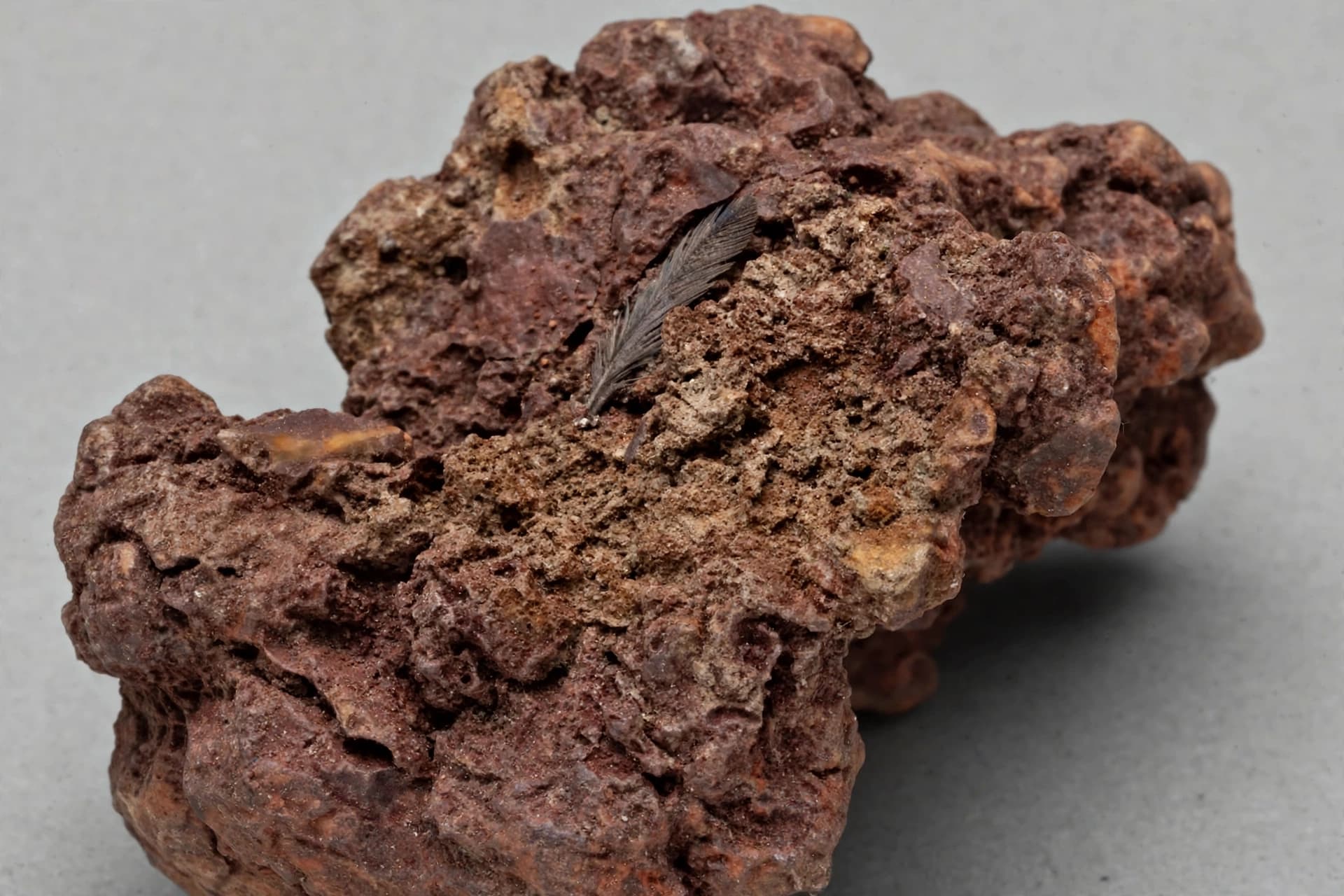
The fossil dropping, which scientists call a coprolite, was found in 2016 in Montana's Hell Creek Formation. At the time, David DeMar, a researcher with the University of Washington's Burke Museum, was collecting fish fossils when a dark reddish-brown nodule caught his eye. Under a magnifying lens, he saw something remarkable: a tiny feather resting on the rock's surface. It was the first feather specimen ever found in Hell Creek, despite a century and a half of fossil collecting there.
The coprolite's value went far beyond that first glimpse. Using micro-CT scanning, the team was able to see inside the specimen in three dimensions without damaging it. Within the dung, they found not only several feathers but also tiny gar fish scales and fragments of bird leg bones. The bone density pointed to a group called hesperornithiforms, diving birds that had lost the ability to fly and filled an ecological niche similar to today's loons. The fish scales told a more complete story: this bird had eaten a meal of fish shortly before being swallowed by a dinosaur.
The feathers themselves carried a deeper tale. Some had a central shaft with a square cross-section, strikingly similar to the flight feathers of modern birds, suggesting that this light yet stiff structure already existed sixty-six million years ago. Others, however, especially the body feathers meant for insulation, were more primitive, built from softer, thread-like filaments. This mix was not a design flaw. In a greenhouse world, such traits hardly mattered, until a single asteroid changed the rules.
Why only the neornithines, the ancestors of modern birds, survived the end-Cretaceous catastrophe has long been debated. One popular idea holds that living near water helped them dodge the worst of it. But hesperornithiforms were water birds too, and they fished, and they did not make it. Jingmai O'Connor, a paleontologist at Chicago's Field Museum, has offered a more delicate explanation: those primitive body feathers could not insulate well enough, and during the impact winter, when a shroud of dust blocked the sun and global temperatures plunged, that shortfall became fatal.
The hypothesis still needs more evidence. Scientists will need to find feathers from neornithines living just before the extinction and confirm that their body feathers lacked those "primitive" traits. O'Connor hopes more researchers will turn their attention to coprolites, those long-overlooked time capsules. After all, the story of evolution and extinction often sits in the most unexpected corners.
The study, published in Current Biology, was a collaboration involving the Field Museum and the Burke Museum, and it offers a fresh angle on the single most important fork in the history of birds.
Note: The images accompanying this article are AI-generated.
Sources: ScienceDirect, CNN, BBC, National Geographic, EurekAlert
Published by Banx Network. This article is part of the Banx decentralized media programme, powered by the BXE token on the XRP Ledger.